




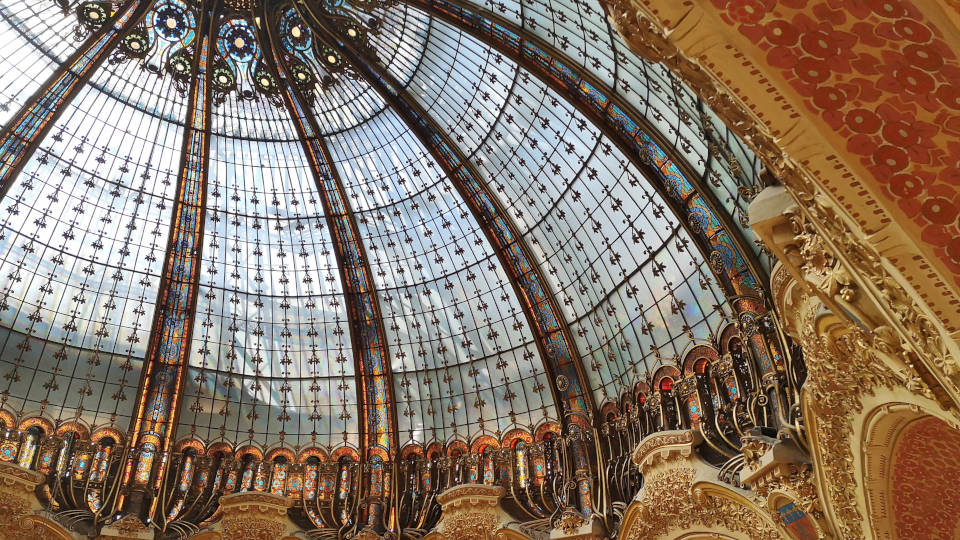
9 Paris Cupolas and Art Nouveau Architecture Landmarks
By ANL | UPDATED:
1. Printemps Haussmann
2. Le Grand Palais & Le Petit Palais
3. Galeries Lafayette Haussmann
4. Institut de France
5. Bourse de Commerce
6. Panthéon
7. Hôtel National des Invalides
8. Sacré-Coeur Basilica
9. Sorbonne Chapel
This guide to Paris domes and Art Nouveau architecture in Paris explores nine key landmarks that combine history, design and cultural storytelling. Each site highlights a different interpretation of the cupola form, from sacred monuments such as the Panthéon and Sacré-Coeur Basilica to commercial icons like Printemps Haussmann and Galeries Lafayette. Together, they define a unique architectural identity that still shapes the Paris skyline today.
A deeper understanding of how these architectural landmarks are experienced can be found through a cultural travel approach that focuses on history, design and place identity.
The architect Hector Guimard is the mind behind the iconic metro entrances that can still be found all over Paris, constructed after a competition for street architecture in 1899.

Photo: Travel In Culture
In line with the trend of the period, the Art Nouveau architect designed cast-iron Art Nouveau-style entrances of the metro stations – some with glass roofs and some without – all with the floral elements typical for the style. 141 entrances were created 1900 – 1912 – many of them still exist.
Where is the Paris Art Nouveau Architecture? Everywhere in Paris, you will stumble upon the wrought-iron and cast-iron balconies, gates, metro entrances, and building ornaments that date back to the turn of the 19th century.

Photo: Travel In Culture
Founded in 1865 by Jules Jaluzot and Jean-Alfred Duclos, Printemps was a novelty in Paris. With elevators from the 1867 Universal Exposition, electric lighting installed in 1888, and direct metro access in 1904, the grand magasin pioneered in the French capital.

Printemps Haussmann | Photo: Travel In Culture
Due to prices affordable for the French middle class and the introduction of seasonal sales, the department store soon grew in popularity. Initiatives such as offering violets to the customers in spring supported the new Art Nouveau style with its floral motifs.

Printemps Haussmann | Photo: Travel In Culture
Over time, several building transformations have taken place, reflecting multiple architectural styles, including Art Noveau and Art Déco. The architectural highlight is the immense 20-metre diameter glass cupola, an Art Déco masterpiece. Under the dome heaven, customers can enjoy a culinary meal in the elegant restaurant.

Printemps Haussmann, Art Nouveau Stained Glass | Photo: Travel In Culture
Le Grand Palais des Champs-Élysées is an exhibition hall which dates to 1897 when construction was initiated. Together with the adjacent Petit Palais and Pont Alexandre III, it was designed as a contribution to the Universal Exhibition of 1900 and won the competition held. The four French architects, Henri Deglane, Albert Louvet, Albert Thomas, and Charles Girault, were responsible for the comprehensive project. The Grand Palace was intended for shows and art exhibitions, as well as exhibitions of modern technological inventions such as automobiles, aviation, and everyday appliances.

Le Grand Palais | Photo: Travel In Culture
The 240-metre-long construction is a marvel of Art Nouveau ironwork, steel, and a glass-vaulted roof with a central flattened dome as the icing on the cake. The total weight is estimated to be around 8,500 tonnes (the amount of steel matches the amount used to build the Eiffel Tower)! There is a spectacular colonnade and an outstanding frieze along the façade. The interior space includes an impressive staircase in Art Nouveau and classical styles, and the exterior statues symbolise the classical Beaux Arts, the Renaissance, and industrial engineering – a tribute to the new architectural trends in Paris at the turn of the 19th century.
Today, the Grand Palais serves multiple purposes as it contains the Galeries Nationales, Société de Beaux Arts, Palais de la Découverte (exhibiting scientific discoveries) and more. It was also used for the Tour de France in 2017, undergoing restoration in 2021-2024, and hosting fencing and taekwondo in the 2024 Olympic Games.
The architectural coherence of this area is closely linked to the Seine river axis, which is further explored in Seine River Cruise and Paris Bridges.
Like the Grand Palais and the Pont Alexandre III, the Petit Palais was built for the Universal Exhibition of 1900, replacing the former Palais de l’Industrie.

Le Petit Palais | Photo: Alexandria / Pixabay
The competition announced for the ‘smaller’ palace, located opposite the larger Grand Palais, was won by the architect Charles Girault (among several winners of the palace complex). The Petit Palais became the Palais des Beaux-Arts of Paris and has collections of antiques, Renaissance artefacts, paintings, and other art items. The works of art on display include masterpieces by Delacroix, Renoir, Manet, and Monet, among others.
The Petit Palais, topped by a beautiful dome, reflects the architecture of La Belle Epoque in Paris. It has an iconic colonnade of Ionic columns like the Grand Palais. Moreover, the palace features a gilded door, a semi-circular courtyard, and a lovely inner garden.

Galeries Lafayette Haussmann | Photo: Travel In Culture
The Galeries Lafayette on Boulevard Haussmann, existing on this address since 1903 (an expansion of the original store from 1893 on the corner of rue La Fayette and rue de la Chaussée d’Antin), is a popular upmarket department store in Paris.

Galeries Lafayette Haussmann – Paris architecture | Photo: Travel In Culture
The style of the time in Paris is reflected in the architecture: the Paris Art Nouveau. A magnificent dome in a Neo-Byzantine style was completed a few years later by the architect Georges Chedanne and his apprentice, Ferdinand Chanut. The store underwent renovations again in 1932 in the prevailing Art Déco style. The spectacular cupola is 43 metres high and is still the centrepiece of the Galeries Lafayette Haussmann.
Five academies belong to the Institut de France, established in 1795 by the National Convention. The societies are the Académie Française, the Académie des Sciences Morales et Politiques, the Académie des Inscriptions et Belles-lettres, the Académie des Sciences, and the Académie des Beaux-arts. Besides, the Institut de France also houses the Bibliothèque Mazarine, the oldest library in the country.

Institut de France | Photo: Travel In Culture
Originally, the building with the beautiful cupola housed the Collège des Quatre-Nations, a school for students from provinces related to France under the rule of Louis IIV. The Institut de France is considered a protector of arts, literature, and science – and manages many foundations, museums and castles in France.

Bourse de Commerce | Photo: Travel In Culture
Erected in the late 18th century, the Bourse de Commerce (Trade Exchange) originally served as a traditional commodities exchange. It was built in a neoclassical style with Corinthian columns, a stunningly beautiful domed glass roof, and an interior space lined with frescoes and remarkable paintings.
Today, the Bouse de Commerce is a cultural centre and home to the Pinault Collections of contemporary art. The building features a rooftop terrace where you can enjoy panoramic views of Paris while having a culinary lunch in the restaurant.
The foundation of the Panthéon was laid in 1758, and commissioned by King Louis XV. The construction undertaken by the architect Jacques-German Soufflot was intended to be a church dedicated to St Genevieve, the patron saint of Paris. The architectural style was a neo-classical approach, striving to combine the Gothic with the classical Greek design. The Panthéon was not completed until 1790 – during the French Revolution.

Panthéon | Photo: Travel In Culture
As a temple of the French nation, the Panthéon became a patriotic monument and mausoleum for great French personalities, including writers, revolutionaries, politicians, and scientists such as Voltaire, Jean-Paul Marat, Jean Jacques Rousseau, Victor Hugo, Emile Zola, Alexandre Dumas, and Pierre and Madame Curie! Napoleon Bonaparte and later Louis XVIII restored the building during their reigns.
The interior is impressive, with beautiful columns and art sculptures, and, not least, the spectacular dome rising towards the sky. In the centre, the famous Foucault’s Pendulum hangs to demonstrate the rotation of the Earth.

Hôtel National des Invalides | Photo: Gerhard Bögner / Pixabay
The Hôtel National des Invalides was originally a Royal chapel, dating to 1677 under Louis XIV. The architect behind the Dome was Jules Hardouin-Mansart, and he erected the building as Paris’ tallest building at the time.
The Dome has a comprehensive history – from housing disabled veterans in the 17th century to being a museum of the history of the French army today. In 1861, it became the resting place of Napoleon I, and under WWII, it provided shelter for the Allied Forces. Covered with gold leaf, the Dome is one of the most striking structures in Paris, visible from many places in the city.

Sacré-Coeur | Photo: Travel In Culture
The white Roman-Byzantine Sacré-Coeur Basilica rises picturesquely on the top of the Butte Montmartre above all Paris’s roofs. The iconic basilica was designed by Paul Abadie, constructed 1875-1914, and consecrated in 1919. With its height of 83 m, it is still one of the most famous landmarks in Paris.
The Sacré-Coeur is renowned for its large mosaic inside, its crypt, and, of course, its mesmerizing white dome, which is extremely beautiful against a blue sky. From the cupola, visitors have panoramic views of all of Paris. The nearby Place du Tertre is known for its painters and portraitists and is a beloved site in Montmartre.
The surrounding Montmartre district adds further cultural depth, as explored in Montmartre, Place du Tertre and Sacré-Coeur Paris.
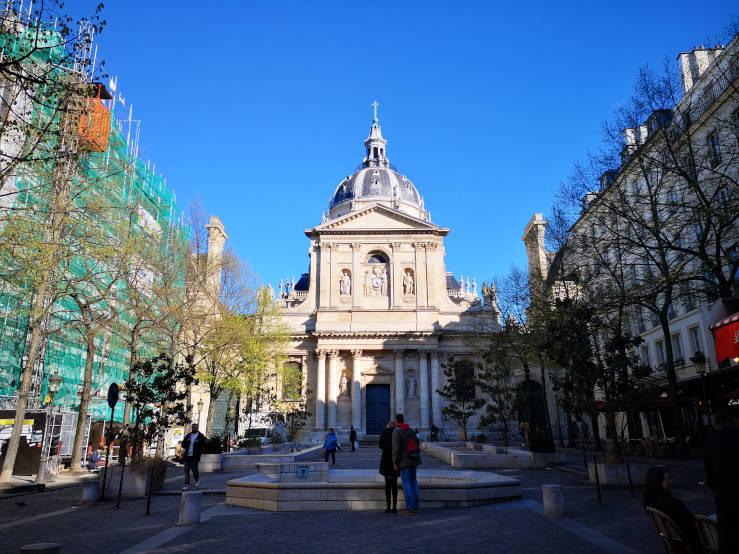
Sorbonne Chapel | Photo: Travel In Culture
The Sorbonne Chapel is a national historical monument in Sorbonne in the Latin Quarter, part of the Sorbonne complex.
Replacing the former Collège de Calvy, construction began in 1635 and was completed eight years later as a part of Cardinal Richelieu’s reconstruction project in Paris. The dome was decorated by Philippe de Champaigne, and the architect behind the building was Jacques Lemercier.
Frequently Asked Questions
What is the most famous cupola in Paris?
The Grand Palais dome is considered one of the most famous cupolas in Paris due to its scale, steel structure and glass roof.
Where can I see the best Art Nouveau architecture in Paris?
The best examples are found in metro entrances by Hector Guimard, Galeries Lafayette, Printemps Haussmann and decorative façades across central Paris.
Can you visit the Panthéon dome in Paris?
Yes, visitors can enter the Panthéon and access its dome for panoramic views over the Latin Quarter and central Paris.
Is Sacré-Coeur part of Art Nouveau architecture?
Sacré-Coeur is not Art Nouveau but Roman-Byzantine in style, although it is often included in dome architecture tours due to its iconic cupola.
What is special about Galeries Lafayette dome?
The Galeries Lafayette dome is a stained-glass Art Nouveau masterpiece that creates a dramatic central atrium in the department store.
How many famous domes are there in Paris?
Paris has many notable domes, but around nine to twelve stand out as key architectural landmarks depending on classification.
What is the best time to visit Paris architectural landmarks?
Spring and early autumn offer the best conditions for visiting Paris landmarks, with softer light and fewer crowds.
Are Paris cupolas accessible to visitors?
Several cupolas such as the Panthéon and Galeries Lafayette are accessible, while others like the Grand Palais depend on exhibitions and events.
Inspiration for Paris: Where to Stay in Paris – Best Areas & Neighbourhoods and 3 Cultural Days in Paris
Read next: 9 Things to See & Do in Hamburg Port & City and Frederiksborg Castle

Images courtesy of Travel In Culture. Selected images from Pixabay.