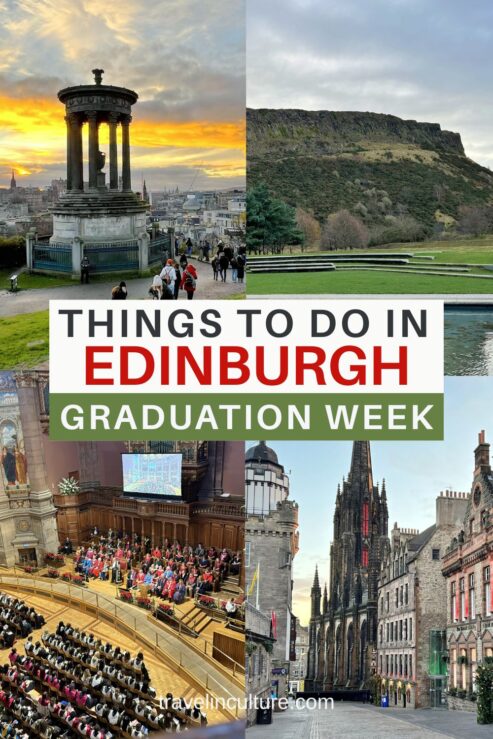





Things to Do in Edinburgh: Historic Sights, Attractions & Graduation Week
By ANL | UPDATED:
Looking for the best things to do in Edinburgh? Scotland’s capital offers a remarkable mix of historic sights, cultural attractions, and university traditions that make it one of the most fascinating cities in the United Kingdom. During Edinburgh graduation week, the city takes on a particularly special atmosphere as students and families gather among centuries-old university buildings and ceremonial traditions. Beyond the graduation celebrations, visitors can explore Edinburgh Castle, the Royal Mile, Greyfriars Kirkyard, Calton Hill, Arthur’s Seat, and many other Edinburgh attractions. Whether you are interested in history, architecture, Harry Potter connections, museums, or scenic viewpoints, this guide highlights what to do in Edinburgh and the must-see places that define the city’s unique character.
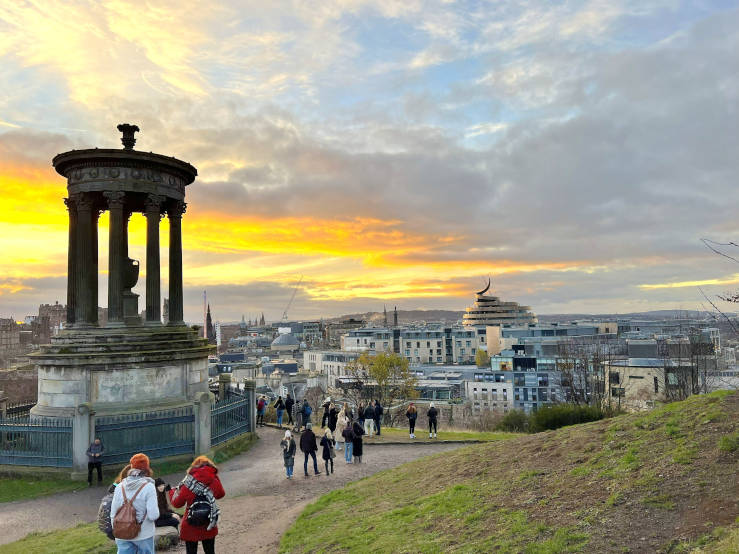
Calton Hill is one of the top attractions in Edinburgh.
Graduation week in Edinburgh is a time when the city’s historic charm meets lively celebration. Stroll through centuries-old streets, admire iconic university buildings, and immerse yourself in the rich culture that defines the Scottish capital. From enduring university traditions in Edinburgh to the unmissable sights of the historic Old Town, Edinburgh offers experiences that leave a lasting impression on any visitor.
For a truly memorable stay in Edinburgh, you might want to choose one of these perfectly located hotels, just steps from the city’s top historic attractions.
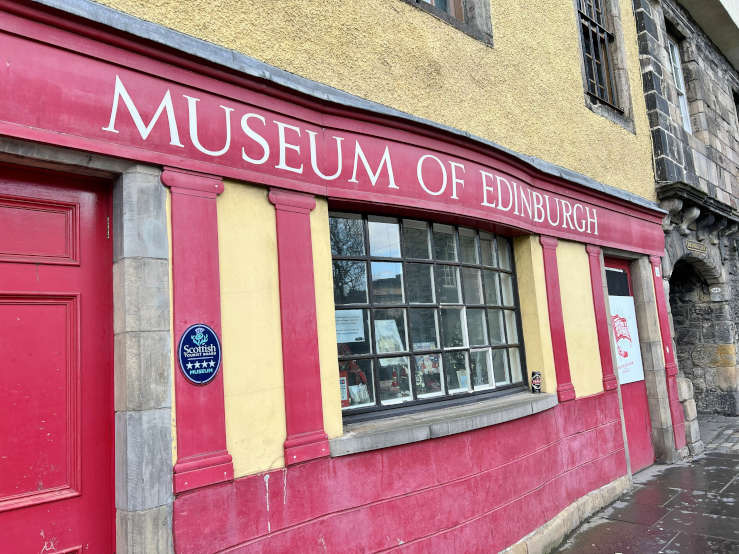
Photo: Travel In Culture
For an authentic experience during your visit, consider taking a tour to explore the city or its surrounding areas:
1. Edinburgh in Graduation Week
Stepping into Edinburgh during a rainy November graduation week is like entering a city that understands ceremony. In the Old Town, we are watching centuries of scholarship unfold in real time, feeling the weight of tradition in the air as families gather at gates and college buildings that have seen generations of graduates pass through their doors.
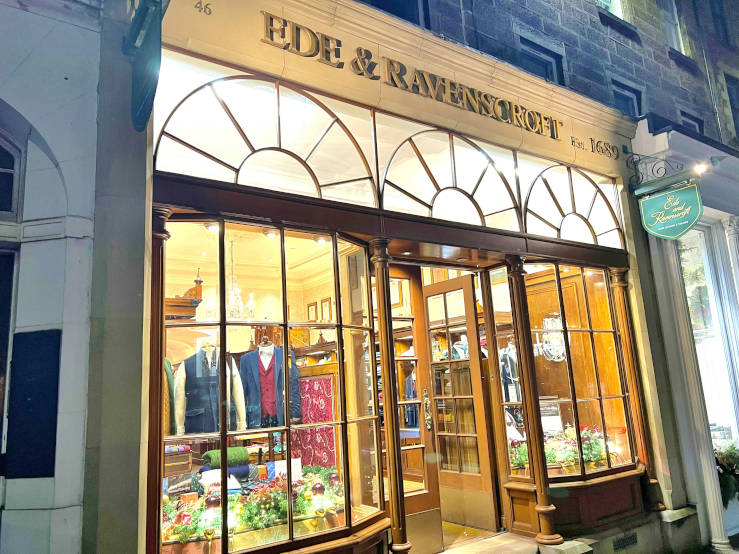
During graduation week, graduands hire their gowns from Ede & Ravenscroft, a historic outfitters in Edinburgh.
Graduation in Edinburgh is more than a series of formalities. It is a ritual that binds students to a city shaped by learning. Old College stands at the heart of it, a place where personal achievement culminates in the wearing of academic robes, continuing university traditions that have grown in Edinburgh across centuries.

The beautiful McEwan Hall is one of the must-see Old Town attractions during graduation week in Edinburgh.
Even as November rain falls steadily and families raise their umbrellas outside McEwan Hall and other historic buildings, a unique atmosphere fills the air, giving a deep sense of witnessing something special. It is a reminder that learning has always been at the heart of this city, and that completing a degree here becomes part of something far larger than the individual.
For travellers interested in exploring destinations through local history and traditions, our cultural travel method explains how to experience places more deeply and meaningfully.
2. Graduation Week Traditions – Edinburgh Old College
The University of Edinburgh was founded in 1582. Old College lies at the heart of academic life in Edinburgh, and during Edinburgh graduation week, its courtyard becomes one of the most meaningful places in the city. Walking through its arches in academic dress feels like entering a tradition far older than any individual achievement.

The elegant Playfair Library.
After graduation breakfast, in the elegant Playfair Library, the ceremony takes place in McEwan Hall with its grand interior and its atmosphere reminiscent of a theatrical auditorium. Outside, two bagpipers play traditional Scottish tunes, their distinctive sound carrying across the courtyard and adding a sense of ceremony to the day. If families have wondered what to do in Edinburgh on graduation day, simply standing here becomes a highlight in itself, one of the historic sights that feels truly once in a lifetime for the graduands.

Graduation at McEwan Hall is one of the iconic university traditions in Edinburgh.
The University of Edinburgh traditions at graduation include the formal procession, led by the bagpipers, followed by the university choir, the professors and the wider academic staff, and finally the Dean and the Principal, who carry the ceremonial mace. The ceremony carries echoes of ecclesiastical ritual and is shaped by customs that reach back centuries. All graduands are seated on the floor of the hall, while family and guests take their places in the gallery above.
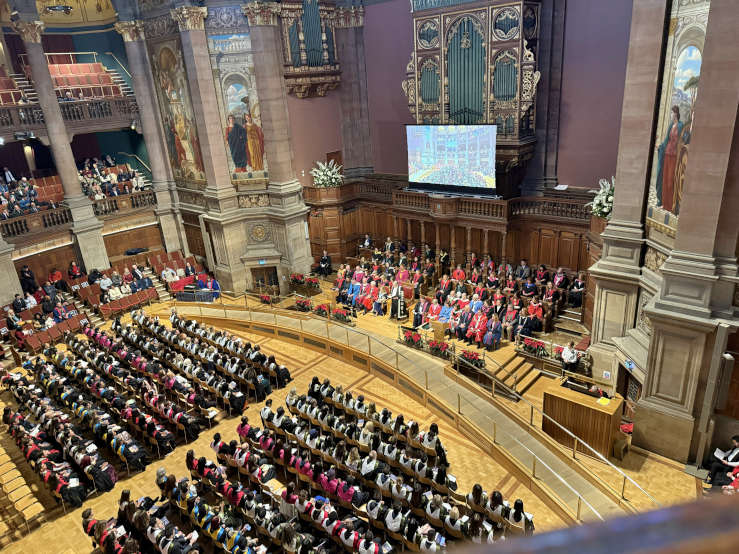
McEwan Hall is a central venue for Edinburgh University traditions. Each gown and hood, with its distinctive colour combination, represents a different field of study.
The highlight of the ceremony is the moment when each graduate is tapped on the head with the Geneva Bonnet, a velvet cap used since the earliest days of the university. According to legend, it is sewn from the trousers of the Reformer John Knox, whose influence helped shape the intellectual climate of the period. The gesture is brief yet symbolic, marking the formal passage into a new chapter. As graduands bend their heads for the tap, it is easy to see why many students and their families consider the Edinburgh Old College ceremony one of the city’s standout attractions during graduation week.
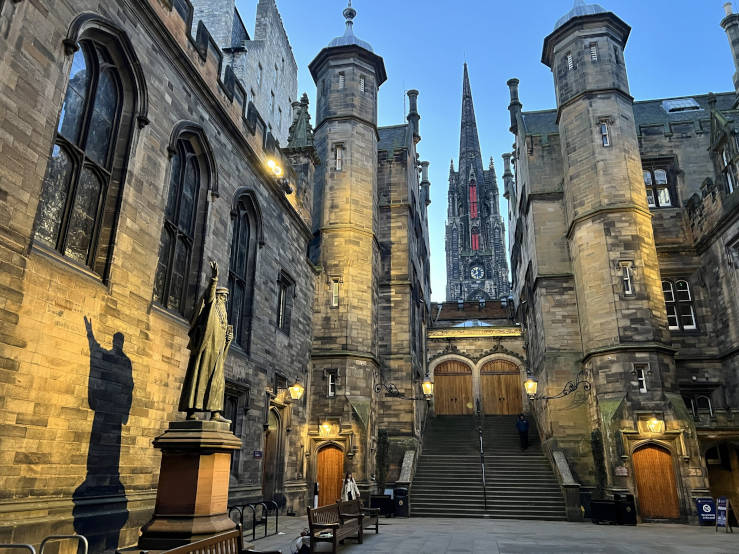
Statue of John Knox at New College.
Nearby, the statue of John Knox and the historic John Knox House remind us of the city’s long scholarly and religious heritage. Their presence suggests how learning, belief, and identity have shaped Edinburgh over the centuries. Some even wonder whether rituals such as the bonnet tap might have offered a glimmer of inspiration for the famous sorting hat from the Harry Potter universe.
3. Harry Potter Highlights and Inspirations

Greyfriars Kirkyard.
What to do in Edinburgh to follow in the footsteps of J.K. Rowling? Walking from the Royal Mile towards Greyfriars, we begin to sense how Edinburgh shaped the imagination behind the Harry Potter universe. The city feels steeped in stories, especially during graduation week, when students in graduation gowns move through the streets in a way that almost blends with the world of wizards and scholars.

The gravestones in Greyfriars Kirkyard seemingly inspired J.K. Rowling when naming characters in the Harry Potter universe, for example ‘Potter’ as seen on this gravestone.
Greyfriars Kirkyard is our first step into these inspirations. The air is quiet beneath the trees, and the old stones lean at gentle angles, each one carrying centuries of memory. Here we find the gravestones that lent their names to some of the most recognisable characters in the series, from Tom Riddle to Professor McGonagall and many others. It feels as if we are walking through the first draft of a manuscript. Nearby, the statue of Greyfriars Bobby stands watch at the gate, a reminder that loyalty and legend have long echoed through this place. Greyfriars Bobby was a loyal dog who famously spent 14 years guarding his owner’s grave and is now a beloved symbol of devotion in Edinburgh. The dog also lends its name to the restaurant located just outside the kirkyard.

The statue of Greyfriars Bobby stands outside the restaurant named after him, commemorating the loyal dog who guarded his owner’s grave for 14 years.
The remnants of the old city wall behind the kirkyard add to the sense of stepping into a world that is both historic and slightly enchanted. A stone’s throw away, through the kirkyard gates, the towers of George Heriot’s School rise in elegant symmetry. With its turrets, courtyards, and stone archways, it is easy to understand why many visitors see hints of Hogwarts in its architecture. As we look at it, we cannot help wondering whether J. K. Rowling might have had this place in mind when imagining the school of witchcraft and wizardry. Standing outside its gates, we feel how the city’s academic heritage blends with imagination, making Edinburgh a place where real scholarship and fictional magic coexist naturally.

George Heriot’s School is widely believed to have inspired Hogwarts in the Harry Potter series.
From here, the path takes us to Victoria Street, whose curve and vibrant colours are likewise said to have inspired Diagon Alley. Its bright shopfronts, stacked closely together, give the sense of discovering hidden corners and curious treasures, even on a rainy November afternoon. A dedicated Harry Potter shop adds to the atmosphere, selling magical wands and swift Quidditch brooms that invite visitors to step briefly into the world of the famous books. Continuing down into the Grassmarket, the bustle of cafés and pubs blends with layers of local history, creating an atmosphere that feels both lively and slightly otherworldly.
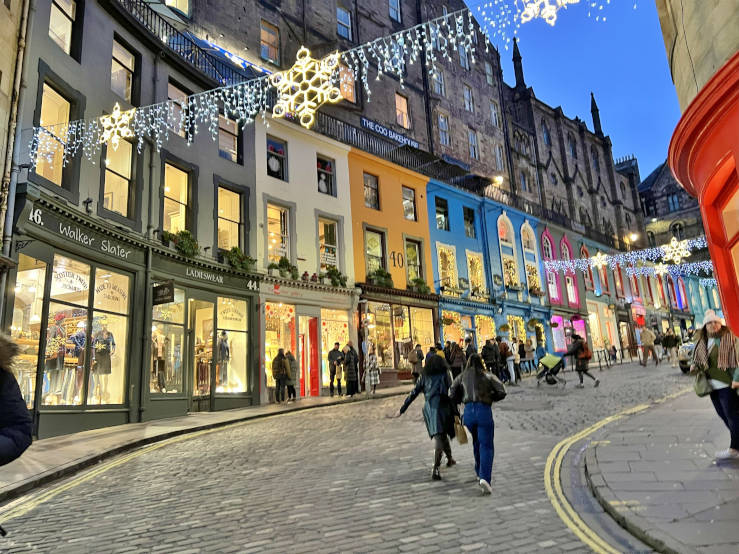
Edinburgh Old Town attractions include Victoria Street, said to have inspired Diagon Alley in the Harry Potter universe.
4. Old Town: Royal Mile – Historic Sights & Attractions in Edinburgh
What to do in Edinburgh Old Town? Walking through the Old Town during Edinburgh graduation week means moving through streets where ceremony and history are intertwined. The Royal Mile draws us forward with its enticing courtyards and hidden closes. Anyone searching for things to do in Edinburgh beyond exploring the Scottish whisky tradition will soon discover that this part of the city holds some of its most enduring stories.

The iconic Edinburgh Castle is one of the city’s top historic sights.
The attractions along this stretch of Edinburgh Old Town are many. Starting at the upper end, Edinburgh Castle rises above the Mile with quiet and enduring authority, only interrupted by the daily sound of the One o’clock Gun. Inside, the Crown Jewels rest securely behind glass, making Edinburgh Castle one of the top heritage attractions in Edinburgh’s Old Town – especially during the annual Tattoo. Arriving early, just as the sun rises, we enjoy breathtaking views over the city, with the hills framing the skyline and a glimpse towards Princes Street Gardens below.

Edinburgh’s top sights include the historic Royal Mile.
Further down the Mile, St Giles’ Cathedral offers a moment of stillness, inviting us to pause and admire its soaring crown steeple and intricate architecture.

A statue of Adam Smith, the ‘father of modern economics’, stands outside St Giles Cathedral, serving as a reminder of Edinburgh’s influential thinkers.
Outside, the Heart of Midlothian mosaic catches the light on the pavement, carrying centuries-old superstition. Many students and visitors still spit upon it for good luck, a tradition that has gradually transformed from its original meaning of showing disdain for the executions that once took place within the Old Tolbooth. This former administrative centre, prison, and execution site stood on the same spot from the fifteenth century until it was demolished in 1817.

The Heart of Midlothian mosaic is one of the historic sights in Edinburgh.
The Museum of Edinburgh and the small Trinity Apse provide quieter corners, with brass rubbing offering a brief hands-on connection to the past. Further along, Real Mary King’s Close invites exploration of hidden sights, the city beneath the city, its seventeenth-century passages revealing the layered stories of Edinburgh’s past. The lower end of the Royal Mile, past the Museum of Edinburgh, leads to the royal Holyrood Palace and, opposite it, the modern Scottish Parliament.
Those planning a wider journey across Britain may also enjoy our guide to One Day in London, featuring historic landmarks, hidden alleys, and cultural highlights.
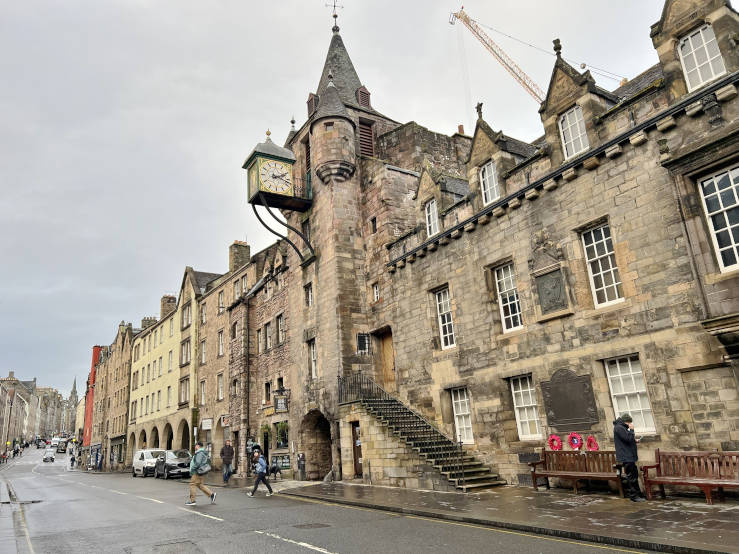
The clock of the Canongate Tolbooth, built in 1591, projects out over the Royal Mile.
5. What to Do in Edinburgh New Town?
In the New Town, Georgian order replaces medieval architecture, and the broad sweep of Princes Street and George Street offers a wealth of shopping opportunities with their many stores. Princes Street Gardens, viewed from the New Town side, presents a different skyline, with the Scott Monument rising sharply above the trees. Climbing its narrow stairs rewards the brave with one of the most striking views in the city.

Rose Street.
Further west, Charlotte Square and the surrounding Georgian terraces show Edinburgh at its most elegant, their symmetry reflecting the ambitions of an eighteenth-century city. As we wander along Rose Street, the parallel street between the main avenues, we take in the lively pubs, shopfronts, and small surprises, including rose patterns set into the pavement.

Sights along Edinburgh’s historic Rose Street include the decorative roses embedded in the pavement.
St Andrew Square Garden surprises us with an unexpected visitor: since October 2024, Paddington has been seated on a bench here with a marmalade sandwich in paw, one of twenty-three locations taking part in Paddington Visits across the United Kingdom. Exploring this part of the city, we find it full of character, offering a different set of Edinburgh attractions that balance the historic weight of the Old Town.
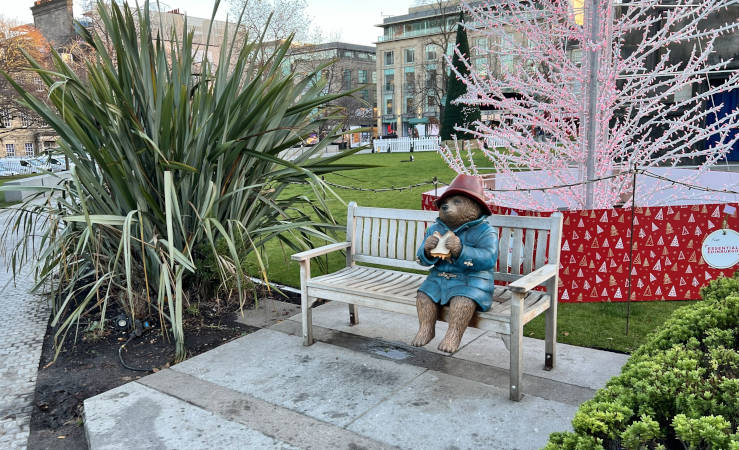
Photo: Travel In Culture
6. Attractions & Cultural Things to Do in Edinburgh – Museums, Art, and Academic Identity
Edinburgh’s museums and galleries offer a rich insight into the city’s history and culture. The National Museum of Scotland combines science, art, and natural history, making it one of the top Edinburgh attractions for students and visitors.
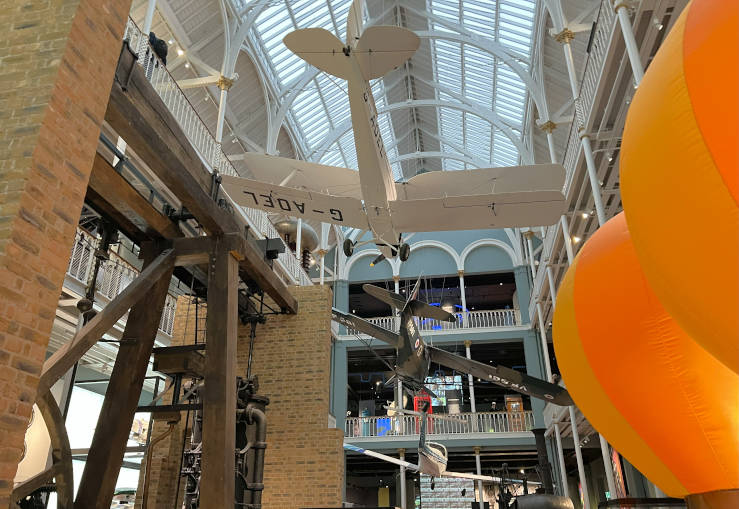
The National Museum of Scotland is one of the top attractions in Edinburgh for science and natural history.
We particularly enjoy exploring the fascinating inventions on the main floor and the spectacular view from the upper galleries. Its diverse collections inspire curiosity and reflection, capturing the spirit of learning that runs through the city.

Exploring the galleries of the National Museum of Scotland is one of the top cultural things to do in Edinburgh.
Other cultural things to do include a visit to the National Galleries of Scotland, which are spread across three sites in Edinburgh. The Scottish National Gallery on the Mound, the Scottish National Portrait Gallery, and the Scottish National Gallery of Modern Art together showcase Scottish and international art, offering a comprehensive view of the city’s creative heritage.
7. Escapes Beyond the Lecture Hall
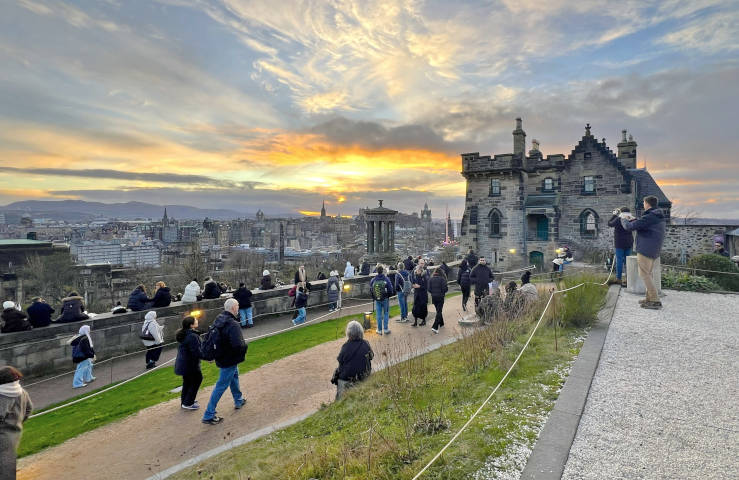
Watching the sunset from Calton Hill is one of visitors’ favourite things to do in Edinburgh.
Top attractions in Edinburgh include Calton Hill, a favourite spot for graduands and their families during graduation week. This becomes clear as the trail up fills with people of all nationalities, each eager to enjoy sunset over the city. The hill is home to an impressive collection of monuments, including the National Monument, Burns Monument, Nelson Monument and Dugald Stewart Monument, standing like silent witnesses to centuries of history.

Calton Hill.
The next day, as we wander through Dean Village along the Water of Leith, we discover a quiet, picturesque corner where cobbled streets, historic buildings, and gentle waters offer a peaceful contrast to the more touristy things one can do in Edinburgh.
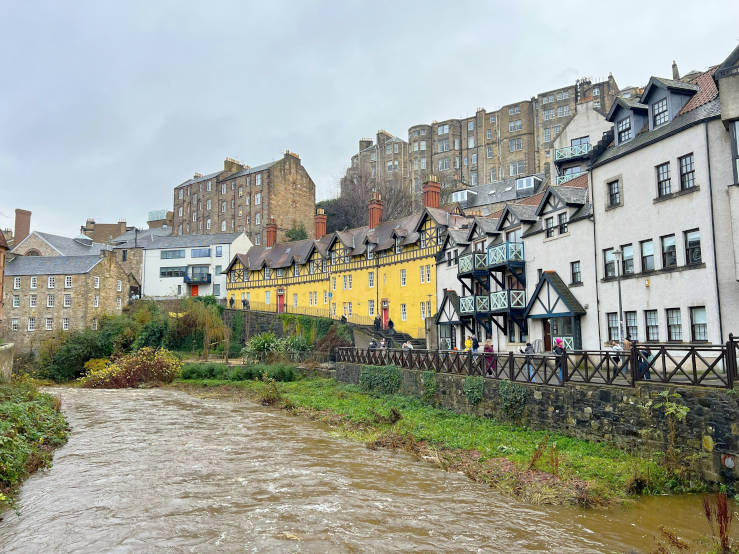
Dean Village.
Edinburgh also provides opportunities to step further away from the formalities and breathe. Climbing Arthur’s Seat in the afternoon, after the graduation ceremony and once the sky has cleared, we are rewarded despite the slippery and muddy paths with sweeping views across the city. The calm of the hill offers a striking contrast to the historic attractions and buzz of Edinburgh below.
If university history and academic heritage interest you, consider visiting another famous British university city in our article Where in Cambridge is Darwin?

Arthur’s Seat.
Frequently Asked Questions
What are the best things to do in Edinburgh for first-time visitors?
Edinburgh Castle, the Royal Mile, Calton Hill, Arthur’s Seat, Greyfriars Kirkyard, and the National Museum of Scotland are among the city’s top attractions.
What happens during Edinburgh graduation week?
Graduation week includes formal ceremonies, academic processions, traditional bagpipe performances, and celebrations across the city.
Can visitors attend University of Edinburgh graduation ceremonies?
Graduation ceremonies are generally reserved for graduates and invited guests, but visitors can enjoy the atmosphere around Old College and McEwan Hall.
Why is the Geneva Bonnet used at Edinburgh graduations?
The Geneva Bonnet is part of a long-standing university tradition and is used during the ceremony to symbolically confer degrees on graduates.
Which Edinburgh attractions are linked to Harry Potter?
Greyfriars Kirkyard, Victoria Street, and George Heriot’s School are widely associated with inspirations behind the Harry Potter books.
How much time should I spend exploring Edinburgh Old Town?
A full day allows enough time to visit major sights such as Edinburgh Castle, St Giles’ Cathedral, the Royal Mile, and several museums.
Is Edinburgh worth visiting outside graduation week?
Yes. Edinburgh offers historic landmarks, museums, festivals, scenic viewpoints, and cultural attractions throughout the year.
What are the best viewpoints in Edinburgh?
Calton Hill, Arthur’s Seat, and the Scott Monument provide some of the finest panoramic views across the city.
What is the best time of year to visit Edinburgh?
Spring and early autumn offer pleasant weather and fewer crowds, while August is famous for its festivals and cultural events.
Planning to travel around the United Kingdom? You may find inspiration in our London itinerary: London in 3 Days: Best Museums, Sights & Attractions.