


Copacabana Beach Rio, Brazil: Exploring History, Culture, and Daily Life
By ANL | UPDATED:
Copacabana Beach is among the most iconic beaches in Rio de Janeiro, located in the South Zone of the city between powerful Atlantic waves and elegant front-row houses, impressive beachfront hotels, restaurants, and clubs, all enjoying scenic ocean views.
1. Discovering Copacabana Beach: First Impressions of Rio, Brazil
We arrive in Rio de Janeiro on a flight from the Brazilian side of Iguazú, leaving behind an airport that blends charm with chaos, where border gates merge unexpectedly just before boarding and the border procedure from Argentina by taxi has already tested our sense of logic more than once. Relieved that our passports are stamped correctly into Brazil, we find ourselves in a shuttle bus towards Copacabana, ready to begin our first real encounter with Brazilian culture.
Driving along the highway towards Copacabana, the city bursts into view. The streets are alive with traffic, yellow cabs, and motorbikes weaving through the flow. Brazilian driving culture is intense and assertive, yet somehow efficient, offering a vivid first taste of the energy that defines Rio. With our seat belts fastened, we convince ourselves that the driver is experienced and has completed this journey countless times before. As we approach the beach, the iconic black-and-white promenade and palm-lined sand stretch before us, sparkling in the sun.

Yellow cabs approaching the tunnel during Rio’s rush hour.
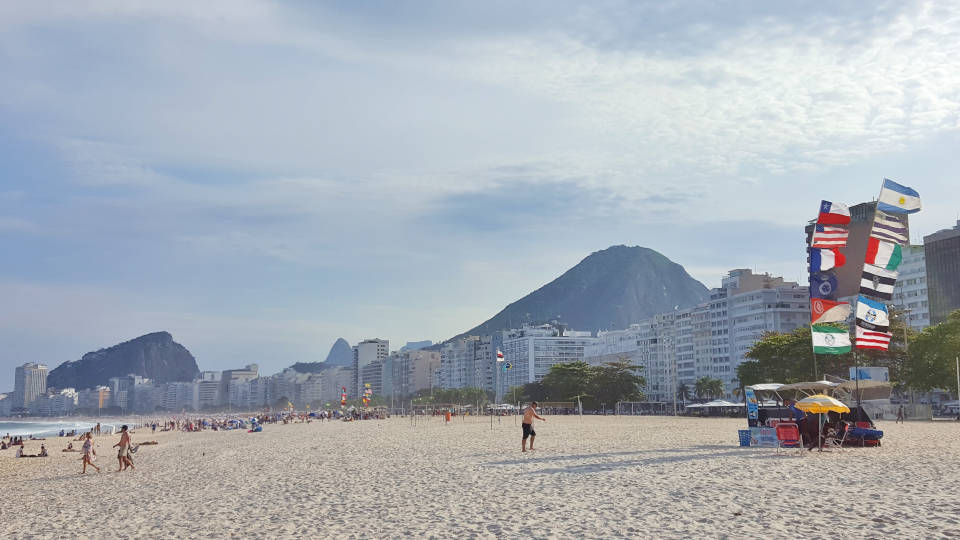
Situated between Watchtower Two and Watchtower Six, Copacabana Beach Brazil spans four kilometres from Leme to Copacabana, framed by golden sand and powerful Atlantic waves. Even though it is July and winter here, Brazil’s tropical climate allows beach life to continue. Vendors walk along the shore, calling out with sunglasses, hats, and handmade jewellery. Joggers and street performers animate the promenade, blending daily routines with a vibrant atmosphere. The beach is not only a place to sunbathe. It is a living stage for the rhythm and culture of the city. Experiencing Copacabana in this way reflects our Cultural Travel Method, which focuses on connecting with daily life beyond the obvious highlights.
Would you like to stay at the iconic Copacabana Beach? You may wish to consider one of these hotels, all of which enjoy excellent locations in this part of Rio.
2. From Farmland to Iconic Beach: Copacabana’s History
Copacabana begins as a quiet, sparsely inhabited stretch of farmland along the Atlantic. Until the early twentieth century, the seashore remains largely undeveloped, but this is about to change. By the early twentieth century, elegant townhouses begin to appear along the waterfront, including the famous Copacabana Palace (today known as the grand hotel Belmond Copacabana Palace), which opens in 1923 and remains an enduring landmark. Historic forts, Fort Copacabana from 1914 and Fort Duque de Caxias from 1779, guard the ends of the beach, hinting at its strategic importance.
The neighbourhood evolves over the decades, initially a retreat for the upper class and celebrities, and later welcoming middle-class residents. It grows into a multicultural, vibrant area and a tourist hub with extensive nightlife, where the glamour of the beachfront meets the lively streets beyond.

Winter brings a calmer rhythm to Copacabana Beach, with fewer crowds than in summer.
Seen from the rooftop of our hotel, the Windsor Plaza Hotel, we notice sharp contrasts: neat buildings and terraces alongside poorly maintained stacked houses extending towards the favelas, home to thousands of residents. These communities date back to late 1800s migration from the countryside and housing shortages in the 1940s. Many favelas today are stabilised under the Pacifying Police Units, but the vibrancy and resilience of their communities remain evident in shops, social centres, and street life.
Copacabana’s history is not just found in buildings or fortifications but woven into everyday life. Observing locals chatting on pavements, children playing, and families walking along the promenade, we see history living and breathing in the present.
Beyond the famous beach, Rio de Janeiro is home to several iconic landmarks that are easily explored on an organised tour, allowing you to take in the very best of the city without the stress of planning every detail.
3. Daily Life, Festivals, and Spectacles on Copacabana Beach
Daily life at Copacabana unfolds with constant energy and small, revealing moments. Early mornings bring joggers along the promenade and vendors selling fresh coconuts and snacks. Surfers challenge the powerful waves, often performing extraordinary manoeuvres that captivate spectators on the beach, while families build sandcastles at the water’s edge.

Photo: Travel In Culture
Copacabana is also a stage for major public events. New Year’s Eve draws millions to the sand to witness one of the world’s largest fireworks displays. Historic concerts, such as the Rolling Stones in 2006 and Rod Stewart in 1994, transform the beach into a setting for collective celebration. Smaller-scale gatherings, from beach volleyball tournaments to spontaneous samba performances, reveal the cultural heartbeat and the neighbourhood’s strong sense of community and shared space.
Walking through Copacabana, the intensity of the traffic contrasts sharply with the relaxed atmosphere on the beach. Due to poverty, there is a certain level of crime risk in the streets during the daytime – and particularly after sunset. The locals sit on chairs on the pavement and play cards, the ambience is friendly, and we are about to forget about the risks. Right until it gets dark.

Photo: Travel In Culture
As evening approaches, the streets begin to change character. People gather on corners, and the nightlife slowly emerges. The atmosphere remains relaxed, and locals sit on chairs along the pavements, playing cards and chatting, lending the streets a sense of familiarity.
When we enter a nearby supermarket, everything still feels calm outside. We take our time inside, observing everyday details, including the cashier carefully checking our banknotes by holding them up to the light, a small but telling detail of Brazilian daily life.

Panoramic views over Rio, Sugarloaf Mountain and Cobacabana Beach.
When we step back onto the street barely fifteen minutes later, it has already started to grow dark, and the scene feels noticeably altered. Groups linger on corners, some sitting directly on the pavement, and by instinct, we sense that the mood has shifted. We head straight for our hotel, only two minutes away. Staying close together, the risk feels limited, yet the relief is immediate when we pass the security staff at the entrance and step inside.
From our hotel rooftop, with green parrots circling above, we notice the contrasts once again: the sprawling favelas in the distance with lights beginning to flicker on against the orderly façades of beachfront hotels. Looking down, we see the street full of yellow cabs and other cars. It is rush hour, and apparently, the road has been blocked at the tunnel. People are impatient and sound the car horns. Even here, we easily sense the frustration on the road and in the cars. The neighbourhood feels alive at every level: in its sounds, its movement, and its ability to hold contradictions side by side.
4. Copacabana Beach Through the Seasons: What to Expect
Copacabana remains active throughout the year. Even in winter (June to August), temperatures are mild enough to sustain daily beach life, although the crowds are noticeably thinner than in summer. Locals continue to arrive with umbrellas, blankets, and sunscreen, settling into familiar routines along the shore.
Seasonal changes subtly alter the character of Copacabana Beach Brazil. Summer brings intense heat, heavy crowds, and a festival-like atmosphere, with street performers, pop-up vendors, and extended nights. Winter, by contrast, offers a quieter rhythm, allowing visitors to observe daily life more closely and to move more easily along the promenade. In every season, the iconic statue of Christ the Redeemer rises above the city, watching over Copacabana and the surrounding Rio beach landscape.

The Christ the Redeemer Statue rising above the city.
Copacabana Beach Brazil is wide and visually striking, with beach volleyball courts lining parts of the pristine sand. Even while games are underway, one becomes acutely aware of the power of the Atlantic Ocean just metres away.
The waves are often substantial, and according to local Brazilians, swimming requires caution. Still, it is absolutely fascinating to observe the sea. From time to time, unusually high waves roll in and crash far up the shore, drawing attention from players, walkers, and onlookers alike. The conditions make Copacabana a popular spot for surfers, who gather to challenge the force of the ocean.

Photo: Travel In Culture
Along the waterline, vendors weave through the scene, carrying frames of sunglasses, hats, imitation jewellery, and other small goods, adding yet another layer to the beach’s constant movement.
From experience, staying close to the beachfront offers more than convenience. It allows early mornings and late evenings to unfold naturally, from joggers at sunrise to musicians and walkers after dark. Copacabana Beach reveals different layers depending on the time of day and season, rewarding those who linger rather than rush through.
5. Copacabana Beach: A Living Cultural Experience in Rio
Copacabana Beach Brazil is far more than a postcard setting. It is an immersive cultural experience shaped by history, geography, and everyday life. The golden sand, powerful Atlantic waves, lively promenade, and historic landmarks intersect with the rhythms of the city, creating an experience that extends far beyond sun and sea.
Photo: Travel In Culture
Walking along the beach, we are never simply observers. We feel the pull of the ocean, and watch daily life unfold across social and economic boundaries. The contrast between elegant hotels, crowded streets, and hillside communities forms part of Copacabana’s identity, revealing a neighbourhood defined as much by contradiction as by beauty.
What Copacabana offers is not a single narrative, but many overlapping ones. Morning joggers, evening card games on pavements, vast public celebrations, and quiet moments by the sea all contribute to its layered character.
To experience Copacabana fully is to slow down, observe, and accept its contradictions. This approach lies at the heart of our Cultural Travel Method, which seeks to uncover the deeper layers of a destination beyond its most photographed landmarks. In doing so, the beach reveals itself not merely as one of the most famous Rio de Janeiro beaches, but as a living cultural landscape where past and present continue to shape daily life.
Frequently Asked Questions
What is the best time of year to visit Copacabana Beach in Rio de Janeiro?
Copacabana Beach can be enjoyed year round, but the most popular time is from December to March when the weather is hottest and the atmosphere is at its liveliest. For fewer crowds and milder temperatures, the winter months from June to August are ideal.
Is Copacabana Beach safe for tourists during the day and at night?
The beachfront and promenade are generally safe during the day with normal precautions. At night, it is advisable to stay in busier areas, avoid quiet side streets, and use transport for longer distances.
How long is Copacabana Beach and what are its main sections?
Copacabana Beach stretches for around four kilometres between Leme and Copacabana. It is commonly divided into sections marked by watchtowers, each with its own atmosphere and activity level.
Can you swim at Copacabana Beach in Rio de Janeiro?
Swimming is possible but the Atlantic waves can be strong and unpredictable. Many visitors prefer to stay close to the shore and enjoy the beach atmosphere, while surfers take advantage of the larger waves.
What activities can you do at Copacabana Beach?
Visitors can walk or cycle along the promenade, play beach volleyball, surf, watch street performers, or join local events. The beach is also a social space where locals gather for exercise, food, and leisure.
How do you get to Copacabana Beach from Rio de Janeiro airport?
The easiest way to reach Copacabana Beach from the airport is by taxi, rideshare, or airport shuttle. The journey usually takes between 20 and 40 minutes depending on traffic.
What are the main attractions near Copacabana Beach?
Nearby attractions include Sugarloaf Mountain, Ipanema Beach, and Christ the Redeemer. The Copacabana Fort and the famous promenade mosaic are also popular cultural highlights.
Is Copacabana Beach suitable for families?
Copacabana Beach is suitable for families during the day, especially in calmer areas near the promenade. Families often enjoy the open space, playgrounds, and relaxed daytime atmosphere.
Read next: Discover the world-famous Christ statue in Brazil
