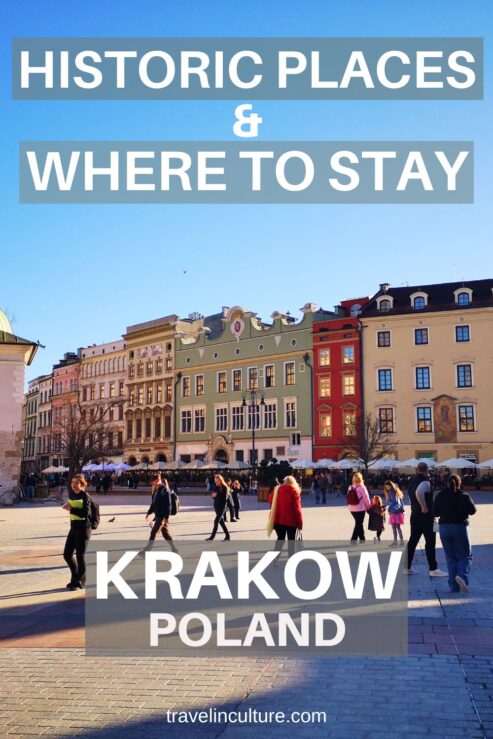





Where to Stay in Krakow, Poland: Old Town or Kazimierz?
By ANL | UPDATED:
This guide compares the best areas to stay in Krakow to help you choose a hotel base.
The Old Town places you among medieval squares, royal landmarks and some of Poland’s most important historic attractions. Kazimierz offers a different atmosphere, with centuries of Jewish heritage, independent cafés, cultural venues and a vibrant local character. Both districts are within walking distance of each other, yet they provide very different experiences.
This guide compares Krakow Old Town and Kazimierz to help you choose the best area to stay based on your interests, sightseeing plans and travel style.
Why should you visit Krakow
Krakow’s main attractions are concentrated in and around the Old Town and Kazimierz, making both districts excellent bases for sightseeing, depending on whether you prefer historic landmarks or a more local, atmospheric neighbourhood.

Church of St. Barbara, Cracow | Photo: Travel In Culture
Most of Krakow’s key attractions are located within walking distance of the Old Town and Kazimierz, so choosing where to stay is mainly about atmosphere rather than access.
So, where to stay in Krakow to explore the heart of the city and feel the unique atmosphere – the ‘vibe of Krakow’?
If you enjoy exploring destinations through their history, traditions and architecture, our Cultural Travel Method explains how to experience places on a deeper level.
Staying in Krakow’s Old Town places you within walking distance of Wawel Hill, the Main Square, and the city’s most important historic streets.
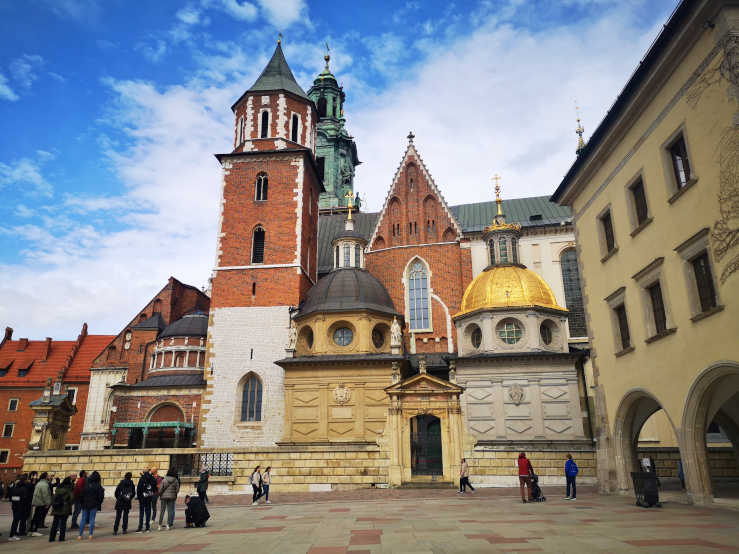
Wawel Cathedral & Royal Castle | Photo: Travel In Culture
A historic royal castle on Wawel Hill, even with a fabled dragon, is one of the highlights of Krakow Old Town. Inside the castle complex, there is today a museum with armoury and royal treasures on display, including the precious coronation sword. Wawel Cathedral can be found inside the castle walls, an impressive construction holding the sarcophagi of Krakow’s former kings in the crypt.
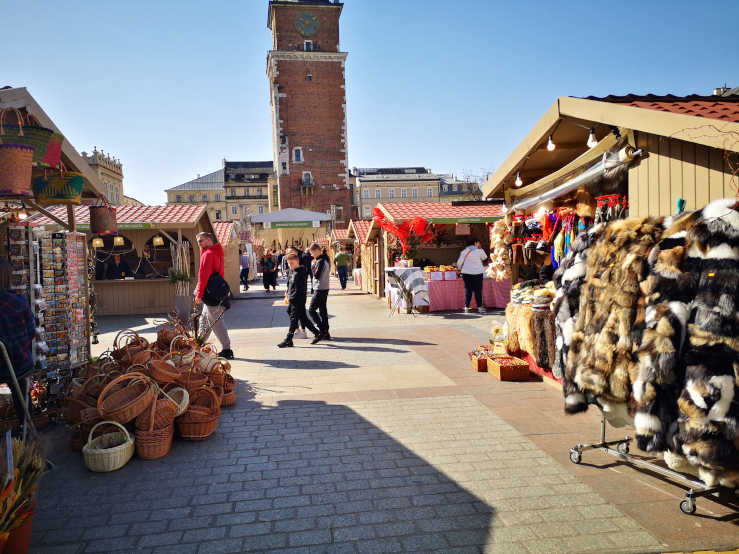
Cracow – Travel to Poland | Photo: Travel In Culture
The Main Square (Rynek Główny), with Sukiennice (also known as the Cloth Hall) adorning the old marketplace, is the central meeting point of the Old Town, and staying nearby means having cafés, horse-drawn carriages, and historic architecture just a short walk from your hotel.
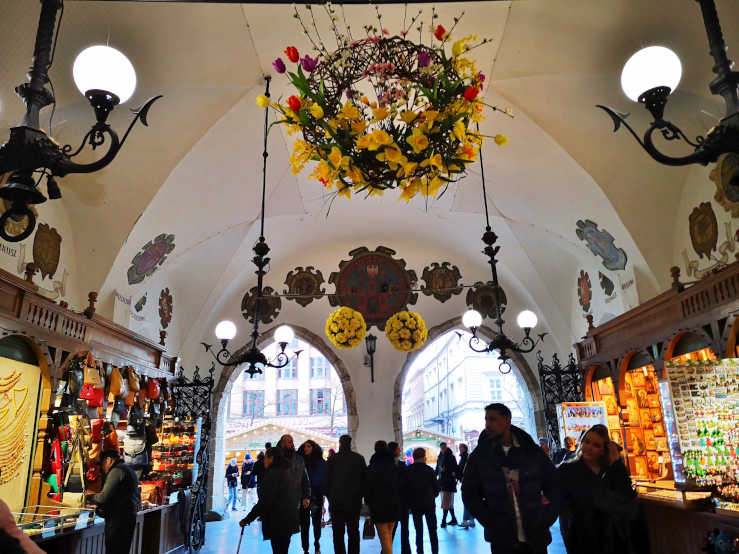
The Cloth Hall, Sukiennice, Cracow | Photo: Travel In Culture
In addition to Sukiennice, the Main Square features several other spectacular constructions. St Mary’s Basilica is one of the top sights. The highest tower is shrouded in legend since a young trumpeter, who in the 13th century wanted to warn the citizens about an imminent Mongol invasion by playing the trumpet, was killed during his act. That is why the hourly trumpeter tune from the top of the basilica appears incomplete.
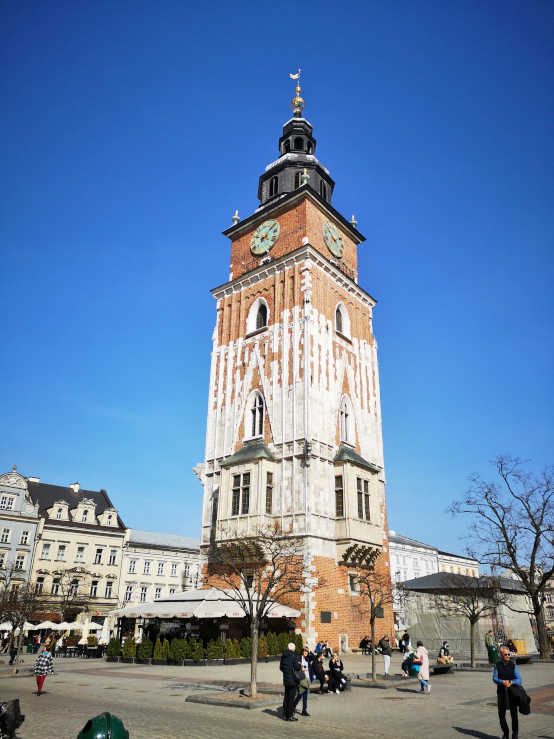
The Town Hall Tower | Photo: Travel In Culture
Also, the traces of the former Kraków Town Hall are visible in the Main Square, with the unique Gothic stone and brick Town Hall Tower as the only remnant (and is one-of-a-kind in Poland!). It dates to the 14th century. Time has put its mark on the building since the original tower was struck by lightning towards the end of the 17th century, and a terrible storm caused it to lean a few years later. In 1820, the Town Hall was torn down, except the tower, to provide more open space in the Main Square.
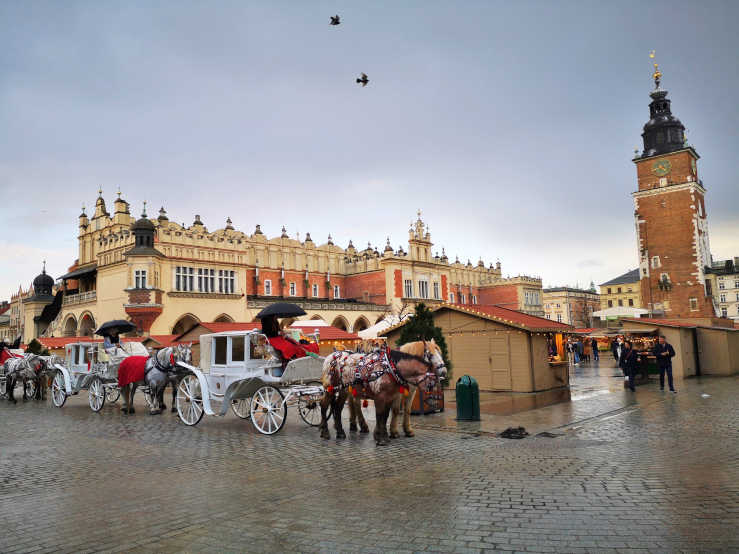
Main Square | Photo: Travel In Culture
Staying in the Old Town means you are within walking distance of Krakow’s main landmarks, including Wawel Hill and the Main Square.
Horse-drawn carriages line the marketplace to offer visitors a tour of the city from a different angle. It is picturesque and romantic, particularly at night, when the square is illuminated!
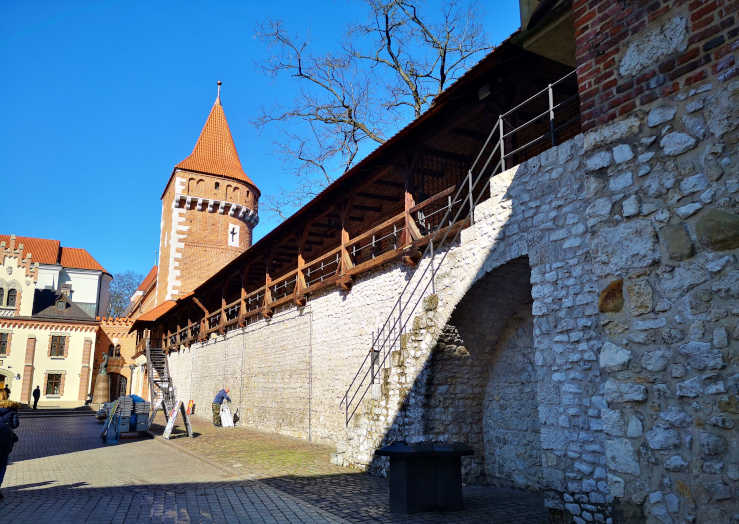
Medieval fortifications | Photo: Travel In Culture
Krakow Old Town was once protected by solid defence structures, which today mark the entrance to the city through St Florian’s Gate. The route continues along the historic buildings lining St Florian’s Street (Floriańska). It is a fine mix of historical constructions and Polish royal history from when Krakow was the capital of Poland.
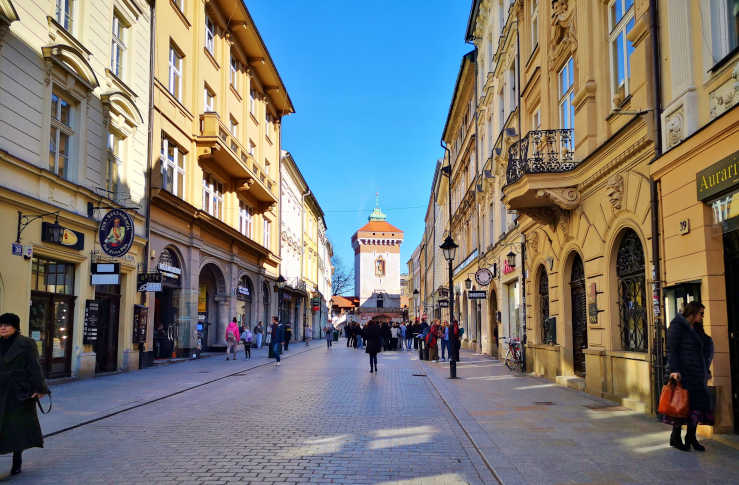
Florianska Street | Photo: Travel In Culture
You can take a nice walk from the Barbican Defence Gateway via medieval cobbled Floriańska down to Wawel Castle and Cathedral, also known as the Royal Road – and perhaps end up at the legendary Dragon’s Den close to the Vistula River. On the way, you will pass Saints Peter and Paul Church, a marvellous Baroque-style church with a Foucault pendulum, demonstrating the Earth’s rotation.
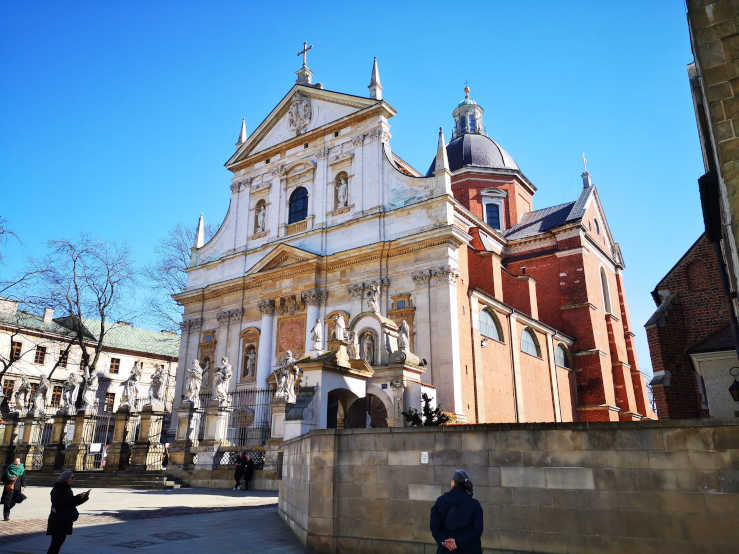
Baroque Saints Peter and Paul Church, with a Foucault pendulum | Photo: Travel In Culture
Within a few square kilometres, there is very diverse architecture. Almost all style periods are represented in Krakow, from Gothic, Renaissance, and Baroque to the Polish variant of the Art Nouveau style around the turn of the 20th century. A fine example of an Art Nouveau building (with an Art Nouveau façade) is Helena Modrzejewska National Old Theatre (Narodowy Stary Teatr), completed in 1906 by the sculptor Jósef Gardecki.
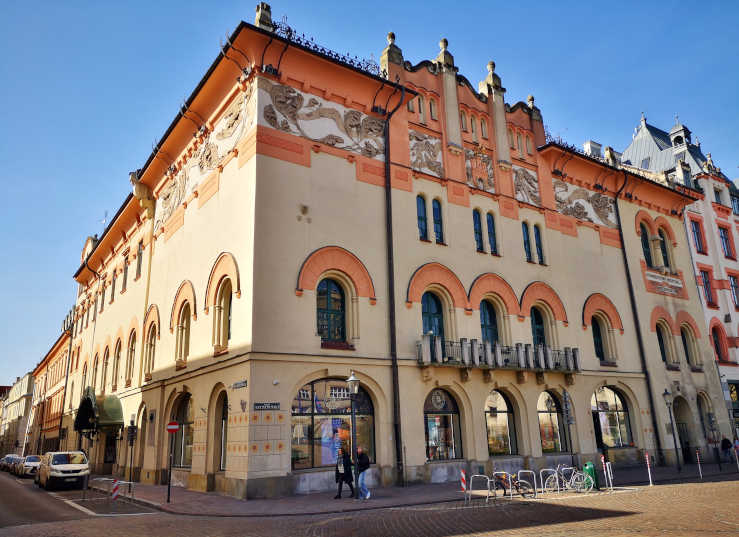
Art Nouveau façade of Helena Modrzejewska National Old Theatre | Photo: Travel In Culture
Close to the Old Theatre, you will also find the oldest building of the medieval Jagiellonian University (from 1364), Collegium Maius, as well as the Church of St Francis of Assisi, with a Monastery of the Franciscan Order and beautiful Art Nouveau stained-glass windows.
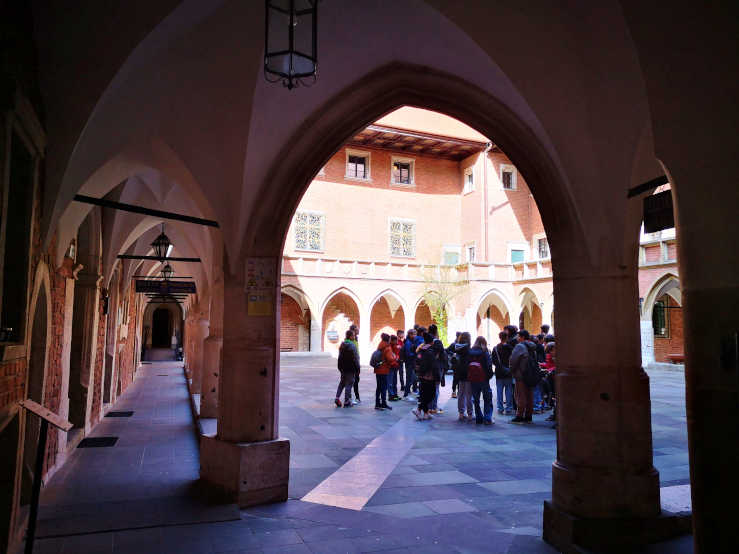
Collegium Maius, Cracow | Photo: Travel In Culture
Finally, try an obwarzanki (a Polish sesame or salt-sprinkled bagel) at one of the bagel carts, which can be found everywhere in the city.
For a detailed guide to the city’s top attractions, see our article on the best things to do in Krakow.
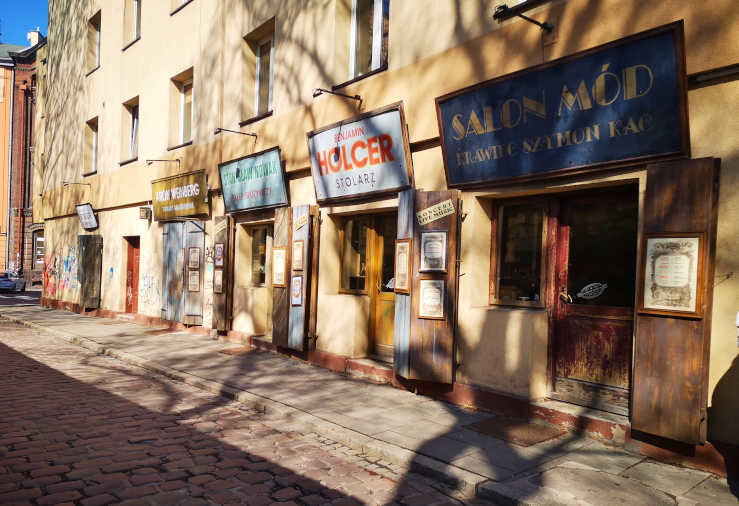
Cracow – Travel to Poland | Photo: Travel In Culture
Kazimierz is one of the best places to stay in Krakow if you are interested in Jewish heritage, local culture, and a more authentic neighbourhood atmosphere. It offers cafés, nightlife, and cultural heritage all within walking distance.
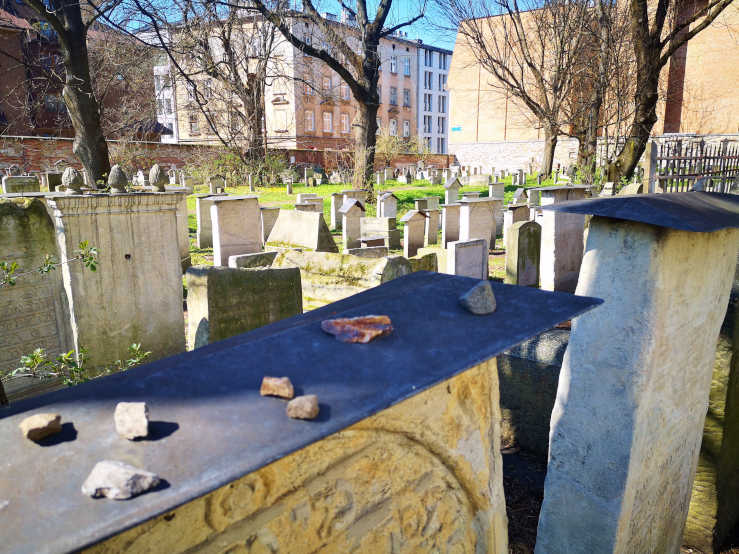
Remah Synagogue Cemetery | Photo: Travel In Culture
Kazimierz retains strong Jewish heritage, visible in its synagogues and historic streets, while today also being one of Krakow’s most vibrant districts. Until the 19th century, Kazimierz was the fourth-largest Jewish town in Poland, separated from Krakow by the Vistula River. The town was named after King Kazimierz the Great, who founded it. Nevertheless, today, Kazimierz is considered a separate district from Krakow.
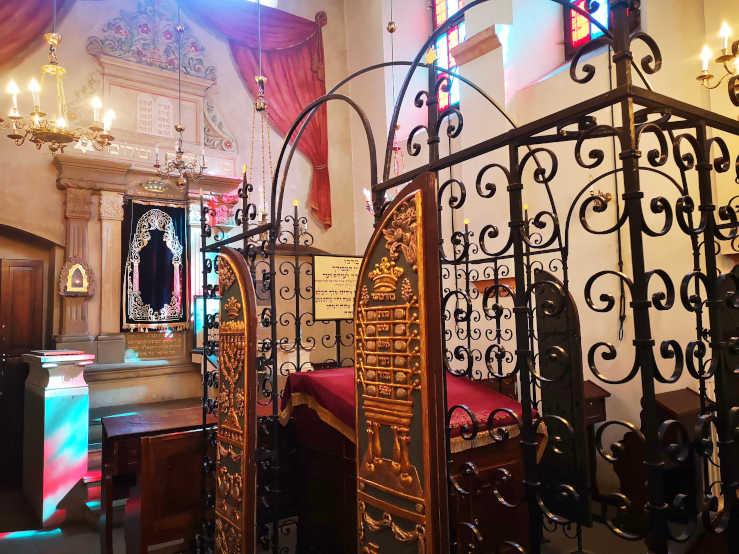
Remah Synagogue | Photo: Travel In Culture
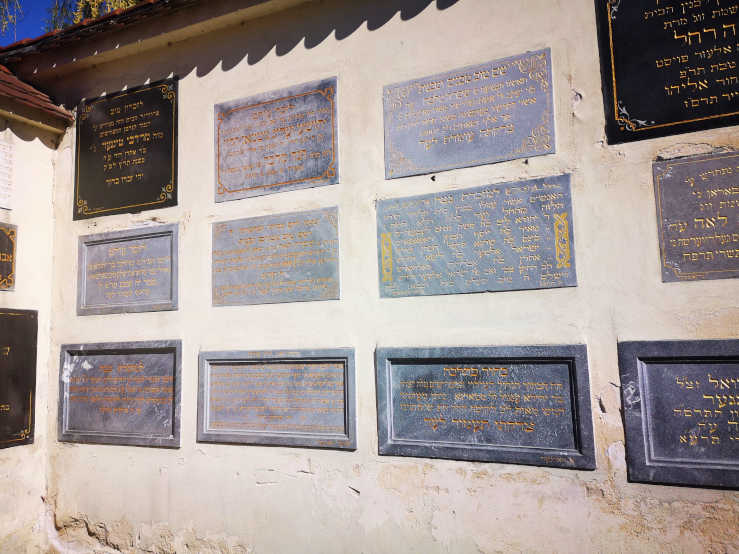
Remah Synagogue | Photo: Travel In Culture
Kazimierz has, ever since the 15th century, been a thriving Jewish community with several synagogues and a well-functioning Jewish cultural life, coexisting with ethnic Polish culture. Therefore, the town has attracted Jews from many places in Europe. However, in the 16th century, a wall was erected to separate the Jewish society from the Christian, thus creating a Jewish ghetto (oppidum ludaeorum). Affluent Jews later moved to Krakow.
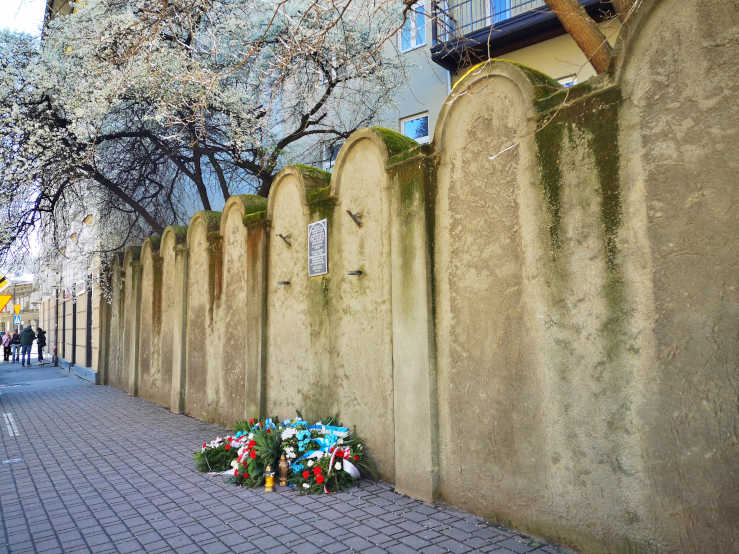
The Ghetto Wall | Photo: Travel In Culture
During WWII, the Nazis forced most Jews into first a ghetto (Podgórze) and then the concentration camps and gas chambers, and only a minor part of the Jewish citizens managed to escape and rescue themselves.
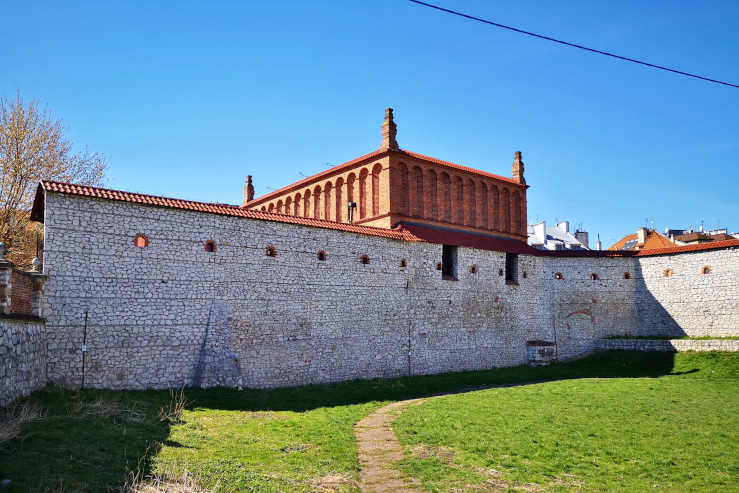
The Old Synagogue in Kazimierz | Photo: Travel In Culture
Today, six synagogues and several other institutional buildings remain for the Jewish community in Kazimierz, estimated to consist of over a hundred Jews. Likewise, there are several Jewish restaurants with traditional Jewish cooking and dishes.
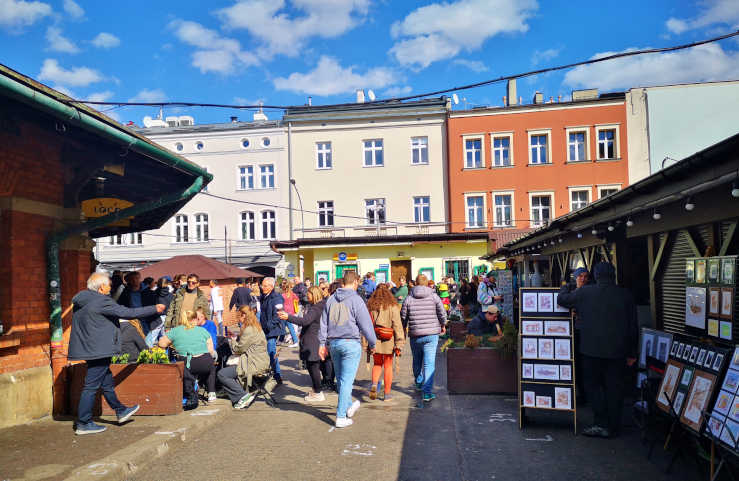
Kazimierz | Photo: Travel In Culture
An annual Jewish Culture Festival takes place in June, where the locals gather around their cultural heritage. In addition to the Jewish culture, Kazimierz is also a vibrant district of the city with young people and a cultural life that attracts visitors and locals alike.
Travellers interested in European history and heritage may also enjoy our guide to the Prague Historic Sights.
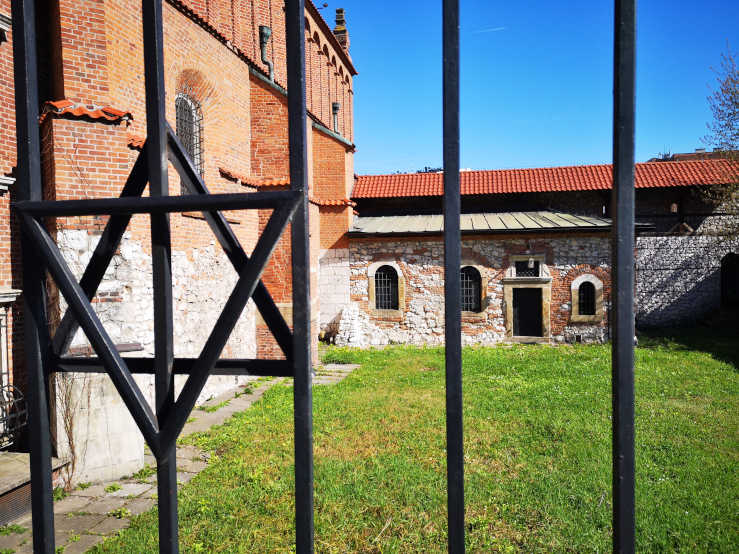
The Old Synagogue, Kazimierz | Photo: Travel In Culture
Visitors can enter some synagogues to gain insight into the Jewish tradition, e.g., Old Synagogue (also a museum), High Synagogue, and Remah Synagogue (sometimes written Remuh). The latter has a large cemetery in Kazimierz, where significant Jews were buried. You will notice the Jewish tradition of putting pebbles on the graves.
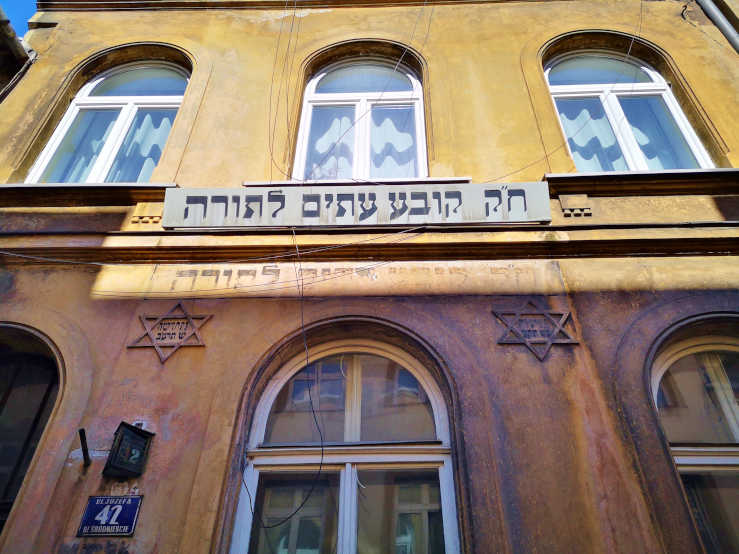
Photo: Travel In Culture
Across the river, Schindler’s Factory is open for visitors. That is the focal point of Steven Spielberg’s film Schindler’s List.
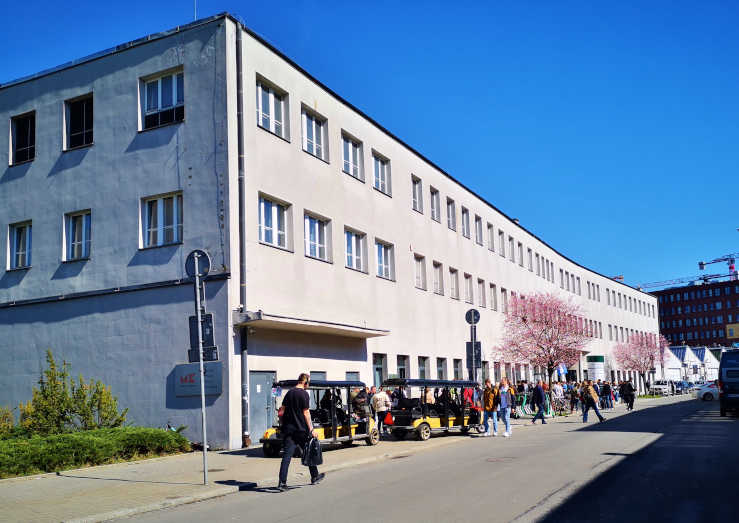
Schindler’s Factory | Photo: Travel In Culture
The former Ghetto Wall (restricting the Jews), shaped like gravestones, are also visible close to Schindler’s Factory. Nearby, the art installation in Zgody Square, or Jewish Heroes Square (where each of the 33 oversized chairs represents 1,000 Jewish lives), is a tribute to the Jews of the former Ghetto, whose destinies were decided on this very square. From Zgody Square they were transported by train to nearby concentration camps.
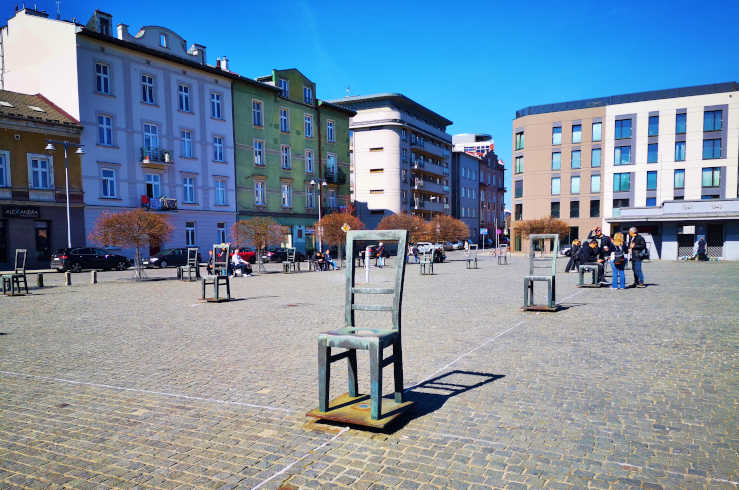
The Jewish Heroes Square | Photo: Travel In Culture
When in Kazimierz and Krakow, a day tour to Auschwitz and Birkenau concentration camps is also a possibility – to see for yourself the locations of the Holocaust horrors during WWII. Book tour to Auschwitz and Birkenau (affiliate link)
Frequently Asked Questions
Is it better to stay in Krakow Old Town or Kazimierz?
The Old Town is best for first-time visitors who want easy access to major attractions, while Kazimierz offers a more local atmosphere with Jewish heritage, cafés and nightlife.
How far is Kazimierz from Krakow Old Town?
The two districts are adjacent and can be reached on foot in around 10 to 15 minutes.
What is the best area to stay in Krakow for sightseeing?
The Old Town is the most convenient base for sightseeing due to its central location near Krakow’s main landmarks.
Is Kazimierz safe for tourists?
Yes, Kazimierz is generally considered safe and is one of the most popular areas for visitors, with many restaurants, bars and cultural attractions.
How many days do you need in Krakow?
Three to four days allows enough time to explore the Old Town, Kazimierz, Wawel Castle and several museums or nearby excursions.
Can you visit Auschwitz from Krakow?
Yes, Auschwitz-Birkenau is one of the most popular day trips from Krakow and can be reached by organised tour, bus or train.
What are the main attractions in Krakow Old Town?
Highlights include Wawel Castle, Wawel Cathedral, St Mary’s Basilica, the Cloth Hall and the historic Main Market Square.
What can you see in Kazimierz?
Visitors can explore historic synagogues, Jewish heritage sites, museums, traditional restaurants and the nearby Schindler’s Factory.
When is the best time to visit Krakow?
Spring and early autumn offer pleasant temperatures and fewer crowds, although Krakow is attractive throughout the year.
Is Krakow a walkable city?
Yes, many of the main attractions are concentrated within the Old Town and Kazimierz, making Krakow easy to explore on foot.
In short, choose Krakow Old Town for iconic sights and atmosphere, or Kazimierz for a more local, cultural, and evening-focused stay.
You can get more inspiration for Krakow in 9 Best Things to Do in Krakow
Read next: Moselle River Road Trip and Amsterdam’s Historic Places