


Røros Mining Town – UNESCO Wooden Heritage Town in Norway
By ANL | UPDATED:
Visitors come to Røros for its cultural heritage, historic architecture and unique Arctic inland landscape. Unlike Norway’s coastal cities, Røros offers a quieter and more traditional experience where mining history, wooden craftsmanship and rural life remain central to its identity. It is an essential destination for travellers interested in Norway’s cultural and historical depth.
To explore destinations like Røros in a more meaningful way, it is helpful to follow the Cultural Travel Method for deeper cultural understanding of places, which focuses on history, local identity and slow travel experiences.

Photo: Travel In Culture
Approaching Røros from the north, you will be driving along a beautiful sloping landscape in a mountainous region that will soon give you a feeling of being in the middle of nowhere in Norway with no specific places to visit. For a long time, you will only see forests, hairpin roads and signposts which warn against wild animals. You may suddenly – and unexpectedly – spot a moose or a couple of reindeer!
Eventually, you arrive at Røros, the somewhat isolated town in East Norway – far from the most common tourist stretches of road along the West Coast. Although much less known than Bergen, Oslo and Trondheim, Røros has much to offer, especially if you are interested in old Norwegian culture and mining history.
Photo: Travel In Culture
Already in 1644, a copper ore was detected in the Røros mountains in East Norway. Just two years later, the Danish-Norwegian King Christian IV permitted to utilise the natural copper resources in the area, and the Røros Copper Works saw the light of day.
The privileges included copper mining within a Circumference of four old Norwegian miles, corresponding to a radius of 45 kilometres from the initial mine, Old Storwartz.

Photo: Travel In Culture
Røros mining town was now established by the waterfall of the Hitterelva River, the location of the first furnace.
The surrounding land was not originally a fertile agricultural area but a mountainous region covered with forest. Therefore, the mining workers and inhabitants of Røros also had to do farming as a second occupation to provide themselves with agricultural products, and having livestock became usual in the small mining town.

Photo: Travel In Culture
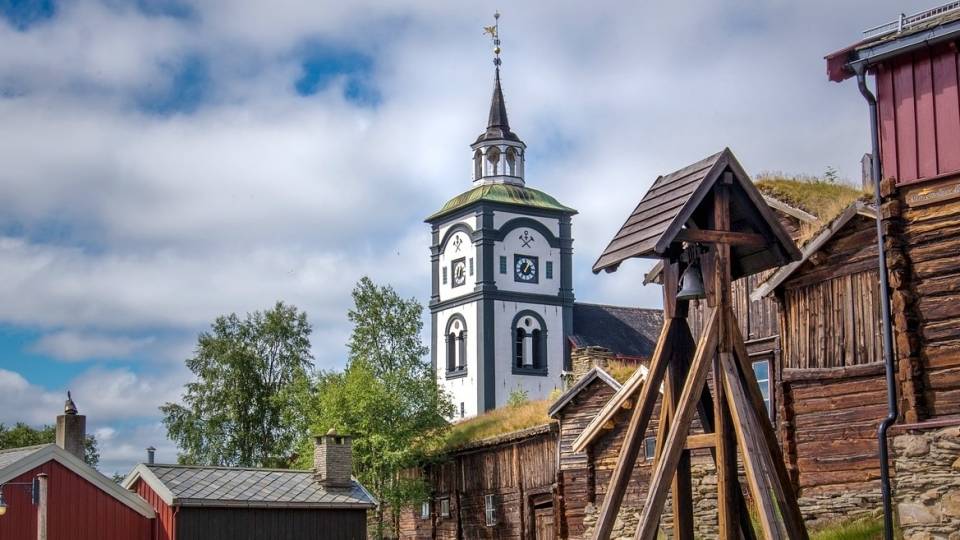
Røros Church was constructed in 1780-1784 as the town´s pride (known as the Ziir), today the fifth by size in Norway. It was founded by the Røros Copper Works and designed by the Norwegian architect Peter Leonard Neumann from Trondheim.
The church has a light blue interior and decor. Inside, you will notice the links to the Røros Copper industry: the logo of the Copper Works, paintings of the first manager and the manager in charge when the church was built.
Photo: Travel In Culture
Photo: Travel In Culture
Røros Church features both seats for the Royal family and for the Copper Work management. The churchgoers were generally seated according to rank. The most prominent people sat in the first row, and the poorest stood in the upper galleries – accessed only by the exterior stairs. Today, the church is still in use and is a popular concert site!
At the time of inauguration, the church counted 1,600 seats! It now ranks as the fifth-largest church in Norway!

Photo: Travel In Culture

Visit Røros | Photo: Travel In Culture
The Røros Copper Works produced large amounts of copper. Between 1644 and 1977, around 100,000 tons of copper were produced here. Therefore, the Røros Copper Works ranked among Norway’s most significant mining activities.
It is unique that so much of the old mining town has been preserved and still has so much authentic character. At this location in Norway you can visit both the Olav’s Mine, a mining museum, as well as climb the enormous waste heaps at the end of Slaggeveien. It has, not surprisingly, become a UNESCO World Heritage Site consisting of its historic houses, the Church and Copper Work buildings, smelters, charcoal pits, old cableways, as well as farming structures.

Photo: Travel In Culture
Photo: Travel In Culture
Things to do in Roros Norway: Visit the old mining town | Photo: Travel In Culture
In 1678 and 1679, the town was set on fire by the Swedes, but since then, many houses have been restored in their original style. That means that today, many houses from the 1700s and 1800s still stand.
At the time of the thriving mining town, the forest around Røros was gradually removed. In its heyday, the trees were utilised as fuel for the ovens.
Today, other forests near Røros are home to reindeer, moose and other wildlife. The Røros region in Norway features a lot of great spots to visit and for hiking.
Photo: Travel In Culture

Photo: Travel In Culture
As an interesting fact, Røros is one of Norway’s and the world’s coldest places, with a temperature record as low as -50.4 degrees Celcius!
Frequently Asked Questions
What is Røros famous for?
Røros is famous for its historic copper mining industry and its exceptionally well-preserved wooden town, which is a UNESCO World Heritage Site.
Is Røros worth visiting in Norway?
Yes, Røros is one of Norway’s most authentic historic towns, offering cultural heritage, museums and traditional wooden architecture.
How old is Røros Mining Town?
Røros was established in the 1600s after copper was discovered in the region, giving the town over 350 years of history.
What can you do in Røros?
Visitors can explore the old mining town, visit museums, walk historic streets and experience Røros Church and surrounding nature.
Is Røros a UNESCO World Heritage Site?
Yes, Røros and its surrounding mining landscape are listed as a UNESCO World Heritage Site due to their cultural and historical importance.
When is the best time to visit Røros?
Winter is popular for snowy scenery and Christmas markets, while summer offers hiking, wildlife and easier access to attractions.
How cold does it get in Røros?
Røros is one of Norway’s coldest towns, with winter temperatures often well below freezing and historical extremes reaching very low levels.
Going to Oslo? Then you may want to read Travel guide to Oslo
Read next: Explore the Lofoten Islands and Going on the Hurtigruten cruise ship MS Nordnorge
For a completely different Arctic experience, you can also explore Tromsø, the gateway to the Northern Lights and Arctic adventures in Northern Norway. If you are exploring Norway’s historic towns, you may also enjoy Ålesund, famous for its Art Nouveau architecture and coastal island setting.

Images courtesy of Travel In Culture. Selected images from Pixabay.