


Things to Do in Buenos Aires: Architecture, Culture and the City’s Soul
By ANL | UPDATED:
1. A City Shaped by Immigration and Architecture
2. Colonial Buenos Aires and the Birth of the City
3. Avenida de Mayo and the Art Nouveau
4. Neoclassicism, Power, and Public Space
5. From Art Deco to Reinvented Waterfronts
6. Tango as Living Cultural Heritage
7. Reading Buenos Aires Through Experience
Buenos Aires hums with tango, the aroma of empanadas from street corners, and layers of European and colonial architecture, inviting travellers to explore its culture on foot. This is a city where every step reveals a new layer of its storied past and vibrant present. Walking through the city, the most meaningful things to do in Buenos Aires are not confined to a checklist of landmarks, but are discovered in architecture, public space, and everyday rituals. Buildings seethe with history, cafés spill onto pavements where cultures mingle, and music appears unexpectedly in squares and markets. This is a city where culture is lived rather than staged, and where architecture tells a long story of immigration, ambition, and constant reinvention.

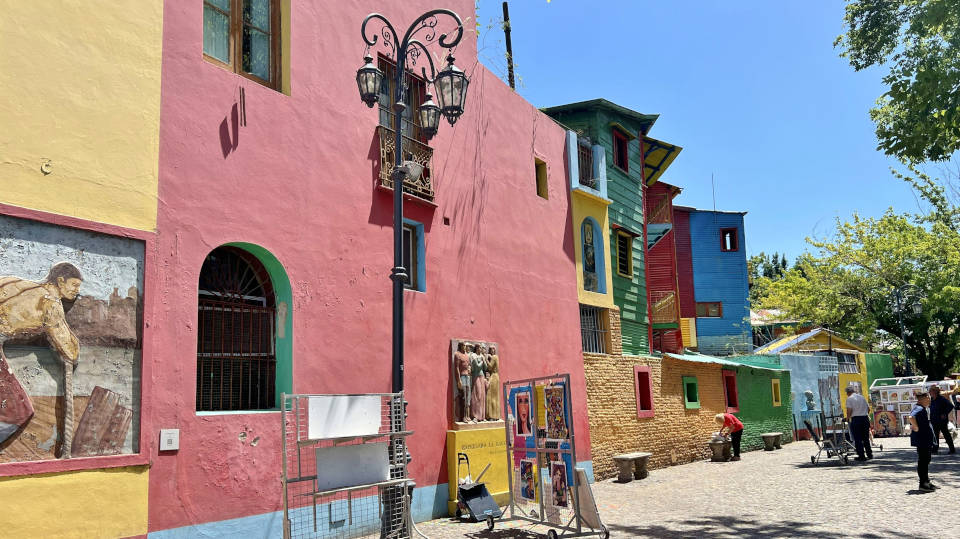
La Boca, one of Buenos Aires’ most colourful neighbourhoods.
After a few days in Buenos Aires, the pace of architectural change becomes striking. Neighbourhoods shift in character from one street to the next, and familiar European styles appear in new and often surprising combinations. Neoclassical palaces, Art Nouveau façades, Art Deco towers, eclectic mansions, colonial remnants, and contemporary interventions coexist across the city. Many of these buildings date from the late nineteenth and early twentieth centuries, coinciding with the height of European immigration. By 1914, Buenos Aires had become one of the most European-influenced capitals outside Europe itself.

The Monserrat barrio, known for its grand and historic buildings.
Rather than presenting a single historical narrative, the city unfolds in layers. Each period leaves visible traces, and understanding these layers transforms an ordinary walk into a cultural reading of how and why Buenos Aires became what it is today. Rather than presenting a single historical narrative, the city unfolds in layers. Each period leaves visible traces, and understanding these layers transforms an ordinary walk into a cultural reading of how and why Buenos Aires became what it is today. This approach reflects our cultural travel method, which explores destinations through overlapping historical, architectural, and lived experiences.
For those keen to explore further, the experiences below are rewarding ways to engage with Buenos Aires’ cultural life and beyond.
1. Buenos Aires, a City Shaped by Immigration and European Architecture
Much of Buenos Aires took its present form during the great waves of European immigration between the late nineteenth and early twentieth centuries. Italians and Spaniards arrived in large numbers, followed by immigrants from France, Germany, Eastern Europe, and the Middle East. As the city’s architecture evolved, so did its cultural expressions, blending European influences with the creativity of immigrants. These newcomers brought with them culinary traditions, craft skills, and architectural ideas that would reshape the city’s cultural expression and social fabric.
Historic conventillos in La Boca, once home to working-class immigrant families.
European architectural styles crossed the Atlantic and layered onto Buenos Aires’ colonial structures. Neoclassicism, embodying power and authority, gave way to Art Nouveau, which brought streets and façades to life with natural motifs such as flowers, plants, and wrought iron balconies. This style reflected optimism, modernity, and a cosmopolitan spirit, helping shape the city’s identity as it sought to mirror the vibrancy of European capitals.
As you stroll through Buenos Aires, you will see how immigrants and architects blended these styles, turning architecture into a living expression of the city’s culture. Later, Art Deco arrived, reflecting the belief in progress and technological growth with its bold geometric forms and verticality.

Beautiful San Telmo street, lined with colonial buildings and local charm.
In Buenos Aires, these architectural styles often stand side by side. A grand neoclassical building might sit next to an ornate Art Nouveau residence, with an Art Deco tower rising behind it. This mix of styles reflects how immigration influenced not only society but also the city’s visual identity. Art Nouveau, which emerged around 1900, is most vividly expressed along Avenida de Mayo and in the neighbourhoods of Monserrat, San Telmo, and Retiro, where we explore vibrant streets and discover the architectural layers that make up the city’s character.

San Telmo’s timeless charm, with its cobbled streets and colourful architecture.
Immigration also deeply shaped the neighbourhoods. San Telmo, originally an industrial district in the seventeenth century, was home to dockworkers and brick-makers, later developing into a neighbourhood of wool and leather industries. By the late nineteenth century, mansions began to emerge. However, the yellow fever epidemic of 1871 caused wealthier residents to flee. As we stroll through San Telmo, we see how European immigrants transformed it into a multicultural, bohemian district, still alive today with tango and artistic energy. For more on San Telmo, see our guide to Buenos Aires Barrios.

The colourful houses of La Boca, reflecting the neighbourhood’s immigrant past.
In La Boca, Italian immigrants found work in warehouses and meatpacking plants. Between 1880 and 1930, European newcomers settled here in large numbers, creating the distinctive conventillos – communal houses made of timber and corrugated metal. Today, the colourful houses and murals of La Boca remain one of Buenos Aires’ most recognisable symbols, rooted directly in its immigrant past.

La Boca | Photo: Travel In Culture
2. Colonial Buenos Aires and the Birth of the City
Plaza de Mayo marks the historic and symbolic heart of Buenos Aires. As the oldest public square in the city, it has witnessed colonial administration, independence movements, political turmoil, and mass demonstrations. Named after the events of 25 May 1810, which initiated Argentina’s struggle for independence, the square continues to function as a civic stage where history is not only remembered but actively lived.

La Casa Rosada, the Argentine presidential palace in Plaza de Mayo.
Standing in the plaza, absorbing the atmosphere and watching daily life unfold, a strong sense of historical presence emerges. The Casa Rosada faces the square with its distinctive pink façade, while the Metropolitan Cathedral anchors the city’s religious history through its restrained colonial form. The surrounding buildings reflect early urban planning, where political, religious, and commercial power were deliberately concentrated in close proximity.
Plaza de Mayo, the historic heart of Buenos Aires.
Plaza de Mayo has long been a gathering place for political expression. It was here that Eva Perón addressed vast crowds from the balcony of the Casa Rosada. Since the late 1970s, the Mothers of Plaza de Mayo have marched here weekly, circling the square in quiet persistence while demanding answers about relatives who disappeared during the military dictatorship.

Museo Histórico Nacional del Cabildo y la Revolución de Mayo, showcasing Argentina’s colonial and revolutionary history.
Standing here for a while, noticing how people pause, pass through, or linger, it becomes clear that colonial Buenos Aires was shaped around control, visibility, and authority. Streets radiate outward from this central point, forming the structural backbone of the city that followed. Visiting the colonial Museo Histórico Nacional del Cabildo y de la Revolución de Mayo at the edge of the plaza, and stepping through its historic interiors, reveals how these spaces were repeatedly reused and adapted, offering insight into a city defined less by preservation than by continual transformation.
Museo Histórico Nacional del Cabildo y la Revolución de Mayo in Buenos Aires.
3. Avenida de Mayo and the Art Nouveau Heart of Buenos Aires
Avenida de Mayo connects Plaza de Mayo with the National Congress and offers one of the most visually satisfying walks in the city. Developed at the turn of the twentieth century, the avenue reflects a moment of economic wealth, when Buenos Aires sought to present itself as a modern European capital in the Southern Hemisphere.
Décor and interiors in a historic Art Nouveau hotel in Avenida de Mayo, Monserrat.
Art Nouveau façades line the street, featuring wrought iron balconies, stained glass and decorative reliefs designed to impress. These buildings served everyday purposes, while also showing the city’s cultural ambition and openness to the wider world. Traditional cafés form an essential part of this architectural experience. Sitting beneath high ceilings and ornate mouldings, watching locals read newspapers over coffee, architecture becomes lived space rather than static backdrop.

An original antique lift in an Art Nouveau hotel on Avenida de Mayo.
We stay in one of the old nineteenth-century hotels along the avenue, which is undergoing careful renovation to preserve its original style. High ceilings, period décor, and an antique lift crowned with a stained-glass roof reveal the ambition embedded in everyday buildings. Experiences like this demonstrate how heritage in Buenos Aires is often encountered through use rather than display.

Palacio Barolo on Avenida de Mayo, combining Neo-Renaissance and Neo-Gothic architecture with Art Deco details, inspired by Dante’s Divine Comedy.
Nearby stands Palacio Barolo, one of the city’s most eccentric buildings. Inspired by Dante’s Divine Comedy, it reflects a time when architecture aimed to showcase both intellectual ideas and economic strength. Such buildings illustrate how European education and cultural reference points shaped the imagination of Buenos Aires.
Surrounded by Avenida de Mayo’s Art Nouveau façades and historic cultural institutions, these hotels sit in one of Buenos Aires’ most storied quarters.
For a closer look at where to stay in Buenos Aires by interest and neighbourhood, see our guide to Buenos Aires Neighbourhoods.
4. Neoclassicism, Power, and Public Space
Approaching the National Congress, the architectural style shifts again. The neoclassical Palacio del Congreso dominates the surroundings with its symmetry, columns, and monumental dome, projecting authority and stability. Near the Congress, a milestone marks Kilometre Zero for the Argentine national highway network, symbolically positioning this area as the centre of the nation. As we linger outside, we watch a demonstration unfold on the plaza, the chants and banners bringing the building’s political energy vividly to life. Its white marble exterior and bronze-plated dome make it one of Buenos Aires’ most recognisable landmarks, while inside, grand halls such as the Blue Room and the Hall of the Lost Steps reinforce the ceremonial weight of political life.

Volunteer firefighters protesting in front of the neoclassical National Congress building.
Neoclassicism dominates many public and private buildings in Buenos Aires, particularly in neighbourhoods such as Recoleta. Inspired by ancient Greek and Roman architecture, the style is characterised by columns, arches, and domes, elements intended to convey order, rationality, and power. Here, architecture frames political life and social tension, reminding visitors that Buenos Aires is not a museum city, but a living one where public space remains contested and active.

Teatro Colón, Buenos Aires’ world-famous opera house.
A short walk from the iconic Obelisco, the Teatro Colón offers another expression of civic ambition. The original theatre, near Plaza de Mayo, opened in 1857 but closed in 1888. After two decades of performances in other venues, the current Teatro Colón opened in 1908 with Verdi’s Aida. With its rich scarlet and gold interior, sumptuous cupola, and renowned acoustics, it quickly became one of the world’s leading opera houses.
After years of underfunding, the theatre underwent major restoration between 2005 and 2010. Today, it stands again as a world-class venue, reflecting Buenos Aires’ enduring desire to be a global cultural capital. Walking through the surrounding streets offers a practical lesson in architectural history, where culture, politics, and aesthetics intersect.
5. From Art Deco to Reinvented Waterfronts

The Edificio de la Casa del Teatro on Avenida de Mayo, a notable example of Art Deco architecture with Modernist influences in Buenos Aires.
As the twentieth century progressed, Buenos Aires continued to evolve. Art Deco left a strong imprint on the city and its skyline, most notably through the Kavanagh Building, which we pass as the dark falls, once the tallest skyscraper in South America. Its geometric forms and vertical emphasis were, at the time, associated with modernity and technological superiority.
Twilight over Buenos Aires, with the city’s skyscrapers silhouetted against the sky.
This forward-looking spirit is also evident in Puerto Madero, the former docklands transformed into a contemporary waterfront district. Old warehouses have been repurposed as restaurants, galleries and cultural venues, while modern towers rise nearby. Ambling by the water, and watching the light shift across the river, you discover a different layer of Buenos Aires, shaped by globalisation and urban redesign rather than immigration alone.

La Boca’s port and cityscape, reflecting a strong working-class identity linked to the area’s earlier port activity.
6. Tango as Living Cultural Heritage
Tango is one of the most distinctive cultural expressions of Buenos Aires, not as a staged attraction, but as a living tradition. It emerged in the late nineteenth century within working-class and immigrant communities, drawing on African rhythms, European musical forms, and local influences. Tango developed in shared spaces such as bars, courtyards, and streets, reflecting themes of longing, displacement, and social interaction.

Tango dance performance in a Buenos Aires restaurant.
Understanding tango’s history adds depth to experiencing it today. In places like San Telmo, dancers and musicians still claim public squares, sometimes spontaneously and sometimes through practised performances. As we catch glimpses of it around the barrio, we seek to grasp its meaning and pulse. Tango remains tied to place and shared space, revealing how cultural heritage in Buenos Aires continues to evolve, rather than remaining static.

A tango relief celebrating the dance tradition of Buenos Aires.
7. Reading Buenos Aires Through Experience
The most meaningful things to do in Buenos Aires involve slowing down and paying attention. Sitting in a café long enough to sense the rhythm of the street, buying empanadas from a local shop, stepping into a quiet courtyard behind an ornate façade, or watching tango dancers claim a public square for a few songs.
Buenos Aires is a city of urban heartbeat and layers. Architecture, immigration, colonial foundations, and cultural traditions overlap constantly, and understanding one layer helps reveal the others. Experiencing where these elements intersect turns the city itself into a form of cultural text, one that is read through participation rather than simply observed. If you would like to understand how we apply this layered way of interpreting destinations, you can explore our cultural travel method, which underpins our approach to cities like Buenos Aires.
Frequently Asked Questions
What are the best things to do in Buenos Aires for culture lovers?
Explore Plaza de Mayo, San Telmo, Avenida de Mayo, Teatro Colón, and local tango venues. These places reveal the city’s architecture, history, and cultural traditions.
How many days do you need in Buenos Aires?
Three to four days allows enough time to explore the main neighbourhoods, experience tango culture, visit museums, and appreciate the city’s architectural heritage.
Which neighbourhoods are best to visit in Buenos Aires?
San Telmo, La Boca, Monserrat, Recoleta, and Puerto Madero each offer distinct architecture, history, and cultural experiences.
Why is Buenos Aires known for its architecture?
Large waves of European immigration influenced the city between the nineteenth and twentieth centuries, creating a mix of colonial, neoclassical, Art Nouveau, and Art Deco buildings.
Where can you see tango in Buenos Aires?
Tango performances can be found in San Telmo, La Boca, traditional dance halls, theatres, and occasionally in public squares throughout the city.
Is Buenos Aires a walkable city for tourists?
Many of the city’s main cultural attractions are within walking distance of each other, especially in Monserrat, San Telmo, and along Avenida de Mayo.
What is the best time to visit Buenos Aires?
Spring (September to November) and autumn (March to May) usually offer pleasant temperatures and comfortable conditions for sightseeing.
What makes Buenos Aires different from other South American capitals?
Its strong European architectural influence, immigrant heritage, café culture, and deep connection to tango give the city a distinctive character.
Our guide to Where to Stay in Buenos Aires explores the city’s neighbourhoods in more detail.
Read next
Santiago de Chile Travel Guide
