


Things to Do in Cambridge: Colleges, Historic Places & Attractions
By ANL | UPDATED:
Looking for the best things to do in Cambridge? This guide highlights the city’s most famous colleges, historic places, museums, parks, and riverside attractions. For first-time visitors, Cambridge offers an ideal introduction to England’s university heritage, combining remarkable architecture, green spaces, and centuries of academic tradition. Whether you want to admire King’s College Chapel, stroll through the Backs, enjoy historic pubs, or explore fascinating museums, there is no shortage of memorable Cambridge attractions. This guide focuses on the essential sights and experiences that make Cambridge one of the most rewarding historic cities to visit in the United Kingdom.
If you enjoy exploring destinations through their history, traditions, and cultural heritage, our guide to cultural travel explains how to discover places more deeply and meaningfully.

The Market Square | Photo: Travel In Culture
Why should you visit Cambridge?
For centuries, Cambridge has been a British university town with stunning charm and prestigious colleges and churches surrounding Great St Mary’s and the old lively stall-filled Market Square in the city’s heart. It is one of the most vibrant places in Cambridge, with a hundred striped awning-covered stalls offering all kinds of produce and things, including fruits, vegetables, books, T-shirts, crafts, and souvenirs.
Moreover, for an authentic experience of the traditional Cambridge vibe, consider visiting some of the iconic places described below!
Whether you are visiting Cambridge for a day trip or a weekend break, these attractions offer an ideal introduction to the city for first-time visitors.
1. King’s College and Other Famous Cambridge Colleges

Peterhouse | Photo: Travel In Culture
Peterhouse is the oldest college, founded in 1284 by the Bishop of Ely, Hugo de Balsham, with a charter by King Edward I. The most prestigious colleges in Cambridge line the River Cam. King’s College (1441), Queens’ College (1448), Claire College (1326), Trinity Hall (1350), Trinity College (1546), and St John’s College (1511) all have access to the idyllic river cutting through meadows and parks as the city’s historic artery. The park with grassy areas behind the central colleges is known as the Backs.
St Catherine’s College | Photo: Travel In Culture
The 31 Cambridge Colleges are highly recognised, have world top rankings, and have fostered numerous Nobel Prize winners, successful researchers and scientists, and other influential political figures and top businesspeople in the UK and worldwide.
King’s College was founded in 1441 by King Henry VI and has the world-famous King’s College Choir with 13-14-year-old boy choristers from the King’s College School. It is world-famous and gives, beyond the daily choral services in Cambridge, concerts in the UK and overseas.
King’s College | Photo: Travel In Culture
Inside King’s College courtyard is a lawn of very closely trimmed grass as fine as the putting green of a golf course. A sign informs students and visitors that the soft grass is not for ordinary, mortal people to walk on. You need a special status and affiliation with the college to do so!
Visitors line up for the choral service, the Holy Eucharist Service. What in particular draws people to come is the King’s College Choir with the young choristers and their exceptional voices.

King’s College | Photo: Travel In Culture
King’s College | Photo: Travel In Culture
The choristers dressed in black gowns and starched white collars walk along the courtyard towards the church entrance.
Inside the church, the choristers and choral scholars line up and prepare behind the stained glass and curtains, ready for the concert. A church official notifies the visitors that they must stand up when the King’s College Choir passes.
King’s College | Photo: Travel In Culture
The church room is high with wooden carvings and decorations – and a solemn ambience propagates in the room where the sun enters from above through the glass mosaics.
Then, the King’s College Choir enters. The choristers appear in the procession in order of height, from shortest to tallest. They have now exchanged the black gowns for red and white dresses and proceed to their candlelit and carved seats.
At the back of the procession, the older members of the King’s College Choir and a couple of church officials or priests dressed in purple and golden follow, carrying two immense candles, a book, a sceptre, or a cross. Moments later, the gloriously catchy and awe-inspiring chorus fills the Chapel vaults.

Emmanuel College | Photo: Travel In Culture
2. The Parks and Meadowlands
King’s College | Photo: Travel In Culture
Photo: Travel In Culture
Among the best things to do in Cambridge is exploring the college parks, meadowlands, and riverside scenery that line the River Cam. The old Coe Fen at the back of Peterhouse and Fitzwilliam Museum is meadowlands. So is Sheep’s Green on the other side of the river and Fen Causeway, earlier grazing sites for cattle and sheep.
The areas around the old Mill and the Mill Pond are picturesque, with impressive willow trees providing shade on a hot summer day.

Newnham Grange and the Old Granary have been converted into Darwin College | Photo: Travel In Culture
Also, Lammas Land (in the past named Mill Pasture as well) was used for pasturage in the 18th century. In 1899, the Darwin family bought Lammas Land at Newnham Grange. For more about Charles Darwin’s connections to the city, read our guide Where Can You Meet Charles Darwin in Cambridge? At the time, Lammas Land (characterised as private land until Lammas Day, August 1st, after which the cows were put out) included more grassland in Cambridge, e.g., the current Christ’s Pieces.
Punting is one of the unique things to do in Cambridge (UK) | Photo: Travel In Culture
North of the city centre, you will find Jesus Green and Midsummer Common, the latter with houseboats and boathouses on the riverbank – and cattle during the summer season. Midsummer Common, originally a trade fair, also features annual events like the Midsummer Fair and Strawberry Fair and the fireworks for Guy Fawkes Day.
Students chill with a picnic in Parker’s Piece | Photo: Travel In Culture
The relaxed student life in Cambridge mixes with strong academic traditions. In Parker’s Piece, the municipal open space intersected by diagonal bike paths, children and young and elderly people relax on the lawns and the benches. Chalk lines mark the athletics areas and football and cricket fields. Two enthusiastic white cricket teams are playing energetically. Parker’s Piece is the perfect place to watch cricket and gain insight into the rules if you are not a cricket expert.

Cricket is a favoured sport in Parker’s Piece | Photo: Travel In Culture
Few places in the world feature the same concentration of historical colleges, churches and old stone houses as the centre of Cambridge. Wherever you glance, your eyes easily catch a couple of impressive towers pointing towards the sky.
3. Punting Along the Backs or to Grantchester

Punting is one of the unique things to do in Cambridge (UK) | Photo: Travel In Culture
Punting along the Backs is one of the most iconic things to do in Cambridge, especially on a sunny day when students and visitors fill the River Cam. From a distance, it is possible to see the top of the long poles and the upper part of the punters standing on the punt deck while gliding past, with the King’s College as the backdrop.
For a detailed route guide, practical punting tips, and information about visiting Grantchester, see our dedicated article on punting the River Cam from Scudamore’s to The Orchard.
You can rent a punt at Scudamore’s Mill Lane Punting Station at Granta Place. You will pass several college landmarks if you punt along the colleges and the Backs. Darwin College is opposite the punting station, with Newnham Grange and the Old Granary integrated into the college buildings, adding to the historic character of the riverside setting around Mill Pond and Laundress Green.
The Mathematical Bridge | Photo: Travel In Culture
The first bridge you pass is the Mathematical Bridge at Queens’ College, a footbridge designed by William Etheridge in 1748 and built by James Essex in 1749. It is an 18th-century masterpiece of engineering construction, an ingenious construction in compression, exclusively consisting of straight timbers despite its arch-looking appearance.
Photo: Travel In Culture
You will continue past the Backs with its great colleges, King’s College, Clare College, and Trinity Hall, before passing the Trinity College Punts at the end of Garret Hostel Lane. That is also the side entrance to Trinity College for a visit to the outstanding Wren Library.

St John’s College | Photo: Travel In Culture
Another famous bridge over the River Cam is the Bridge of Sighs at St John’s College, which comes next. It was built by Henry Hutchinson in 1831, having the similarly named covered bridge in Venice as its model.
Photo: Travel In Culture
If you prefer a punting trip through the idyllic meadow landscape with grazing cows, another option is to head towards Grantchester. You have to allocate at least half a day for this, perhaps including a visit to the tea garden The Orchard in Grantchester.
4. Historic Pubs & Places in Cambridge
A visit to Cambridge is not complete without exploring the historic pubs.
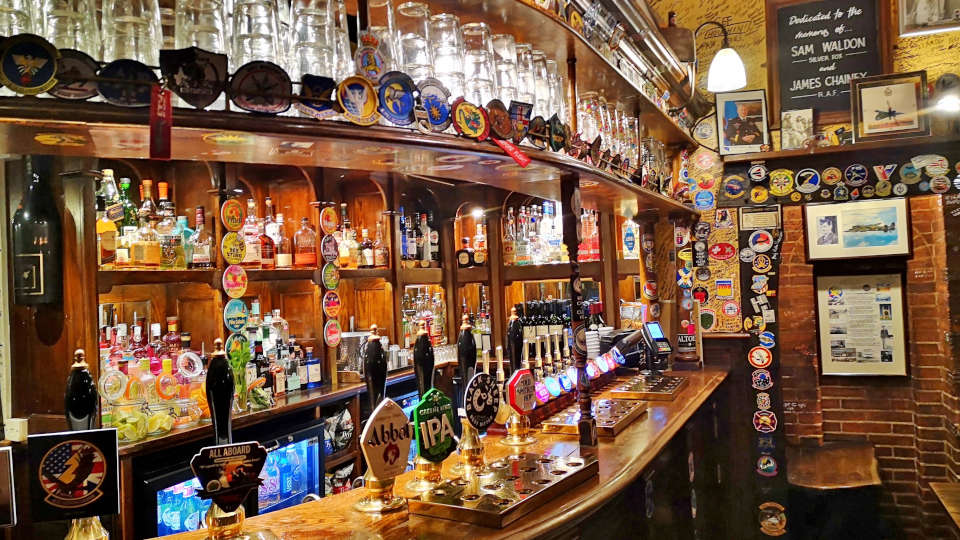
The Eagle, the RAF Bar | Photo: Travel In Culture
The Eagle seethes with history as it is the second oldest pub in Cambridge, dating back to 1667, when it opened as a coaching inn. Today, Corpus Christi College owns it. During WWII, the allied airmen frequented the pub and immortalised their names on the fixtures and ceiling, a graffiti tradition introduced by the RAF Flight Sergeant P. E. Turner – hence the name of the rear bar: the RAF Bar.
Another historic event inside the Eagle was the announcement of the discovery of the DNA structure by Francis Crick, who used to come to the pub for lunch when working at the Cavendish Laboratory. A plaque by his usual table commemorates the discovery of the ‘secret life’ by himself and James Watson in 1953.
Discovery of DNA, The Eagle | Photo: Travel In Culture
Two iconic Cambridge riverside pubs idyllically set at Laundress Green, from where visitors can enjoy the view of eager punters setting out on the Cam, are The Anchor and The Mill, the latter named after the mill probably existing as far back as the 13th century. However, its existence in the 18th century has more evidence. Over time, the windmill gave its name to the artery leading to the mill, Mill Road.
The Mill | Photo: Travel In Culture
5. Things to Do in Cambridge – Visit the Museums
For more insight into the role of Cambridge in the UK, the local places, people and their merits in the past, one of the things to do is to visit a few of the outstanding Cambridge museums.
The Sedgwick Museum of Earth Sciences
Photo: Travel In Culture
If you are fascinated by minerals and billion-year-old fossils and skeletons, this museum is perfect. A T-rex awaits at the museum entrance! The museum also explores the scientific history of Cambridge and features exhibits connected to Charles Darwin and the development of geology. Visitors interested in Darwin’s connection to Cambridge can read our detailed guide: Where Can You Meet Charles Darwin in Cambridge?
The Whipple Museum of the History of Science
Discover the scientific apparatus and tools of measurement scientists have used in their research and exploration of the world. Many scientific fields are represented in the galleries, and several unique instruments are exhibited – for exploration of the universe and navigation on the world seas. Among other things, the collection includes a Newtonian telescope. The museum is highly interactive, serving learning purposes.
The Museum of Archaeology and Anthropology
The Museum of Archaeology and Anthropology | Photo: Travel In Culture
Explore the past and places around Cambridge, where the Romans and other early settlers have left valuable traces of their cultural heritage. It is also an explorer’s museum, for example, following in the footsteps of the Brite Baron Anatole von Hügel, who travelled to the South Pacific and brought back artefacts from his trip.
The Museum of Classical Archaeology
Enjoy this heaven of Greek and Roman statues, telling the history of the Ancient World. The collection was assembled for the benefit of Cambridge classics students so they could easily access casts and models of the famous statues of antiquity.
Frequently Asked Questions
What are the best things to do in Cambridge for first-time visitors?
Cambridge’s highlights include King’s College, punting on the River Cam, exploring the Backs, visiting the museums, and discovering the city’s historic pubs and colleges.
How many days do you need in Cambridge?
One full day is enough to see the main attractions, but two days allow more time to explore museums, colleges, riverside walks, and nearby Grantchester.
Is punting worth doing in Cambridge?
Punting offers one of the best views of the colleges and the Backs from the River Cam and is considered one of the city’s most distinctive experiences.
Can visitors enter the Cambridge colleges?
Many colleges welcome visitors during opening hours, although access, admission fees, and opening times vary between colleges.
What is the best time of year to visit Cambridge?
Spring and summer offer pleasant weather, colourful college gardens, and lively riverside activity, while autumn brings beautiful seasonal colours and fewer crowds.
Are Cambridge museums free to visit?
Many university museums, including the Sedgwick Museum of Earth Sciences and the Museum of Archaeology and Anthropology, offer free admission.
What are the most famous colleges in Cambridge?
King’s College, Trinity College, St John’s College, Queens’ College, and Peterhouse are among the most well-known colleges in Cambridge.
Can you walk between Cambridge’s main attractions?
Yes. Most of the city’s historic colleges, museums, parks, and riverside attractions are located within easy walking distance of one another.
If you are a first-time visitor to Cambridge, the attractions above provide an excellent introduction to the city’s academic traditions, historic landmarks, and riverside scenery.
Read next: The Ultimate London Travel Guide and One-Day Itinerary for London
