


Tortuga Bay Galapagos: Wildlife, Beaches & Santa Cruz Island
By ANL | UPDATED:
Table of Contents: Santa Cruz Island
1. Walking Through the Cactus Forest to Tortuga Bay
2. Playa Brava and Playa Mansa
3. Marine Iguanas and White Tip Reef Sharks
4. Darwin’s Finches and Birdlife at Tortuga Bay
Tortuga Bay Galapagos is a stunning beach on Santa Cruz Island, full of fascinating wildlife and hidden discoveries, perfect for a day trip on foot from Puerto Ayora. Tortuga Bay Galapagos is a stunning beach on Santa Cruz Island, full of fascinating wildlife and hidden discoveries, perfect for a day trip on foot from Puerto Ayora. Approaching the trail slowly and attentively transforms the walk into more than a transfer between town and beach, reflecting a more mindful way of travelling that values observation as much as destination. A water taxi runs a few times daily from the lagoon to Puerto Ayora, shortening the return walk through the forest. Many travellers describe Tortuga Bay as one of the most remarkable beaches in the Galapagos.
1. Walking Through the Cactus Forest to Tortuga Bay – Observing Galapagos Wildlife
As we set out from town, we are already wondering whether a beach so often described as exceptional can truly live up to its reputation. Our walk through the cactus forest begins after leaving Puerto Ayora. We climb the stairs and sign in at the trail entrance for Tortuga Bay, following a straight stone path that cuts through dense vegetation. It is a 45-minute walk on foot to the picturesque bay, only accessible through the forest or by boat. Nevertheless, the distance still feels longer because of all the fascinating things we discover along the way.

Imposing cacti rise along the walk to Tortuga Bay, making the journey as spectacular as the destination.
Towering above are century-old cacti with thick brown trunks, growing amid jagged lava rocks. The forest is alive with the quiet movements of birds and the rustling of small reptiles. In the silence, our footsteps on the stone path echo softly. Darwin’s birds, the finches that inspired Charles Darwin’s studies, flit between branches or peek out from the undergrowth.

The towering cactus trees along the way to Tortuga Bay.
Suddenly, behind a cactus tree, we spot our first tortoise at close range. We stop, captivated by its deliberate movements and spellbound by its massive shell glinting in the sun. We are reminded that tortoises roam between lowlands and highlands following seasonal food. The encounter is unexpected, reshaping our expectations of the walk.

Walking through the cactus forest to Tortuga Bay Galapagos offers a thrilling introduction to Santa Cruz Island’s unique wildlife.
The trail continues through rocky terrain and a small mangrove area, keeping us alert for Galapagos wildlife along the way. All around us, small birds flit between branches, revealing the rich variety of Galapagos wildlife, from tiny birds to hidden reptiles. We have to watch our steps to avoid the fast, camouflaged lava lizards. Their colouration blends perfectly with volcanic rocks, providing natural camouflage. Females sometimes show a red throat or head, a subtle adaptation that helps them remain almost invisible.
2. Playa Brava and Playa Mansa: Beaches of Tortuga Bay

Playa Brava, Tortuga Bay: Emerald and turquoise-green waves lap gently at the shore, creating a striking backdrop to Tortuga Bay’s pristine white sands.
Emerging from the trail, the first beach we encounter is Playa Brava. The white powdery sand contrasts sharply with the emerald green sea, whose waves crash energetically along the shore. The beach stretches for roughly a kilometre, its pristine white sand meeting the restless teal waters, making it clear why swimming is discouraged despite the inviting colours.
Tortuga Bay Galapagos.
Walking along the rocky coastline, we reach Playa Mansa, a calm turquoise-green lagoon bordered by mangroves on one side and cactus forest on the other. It is an ideal beach for swimming and snorkelling due to its calm waters and wealth of species living underwater.

The lagoon at Playa Mansa, Tortuga Bay | Photo: Travel In Culture
We arrive with high expectations, as Tortuga Bay is renowned for marine iguanas, white tip reef sharks, and other wildlife, set against an outstanding natural seascape.
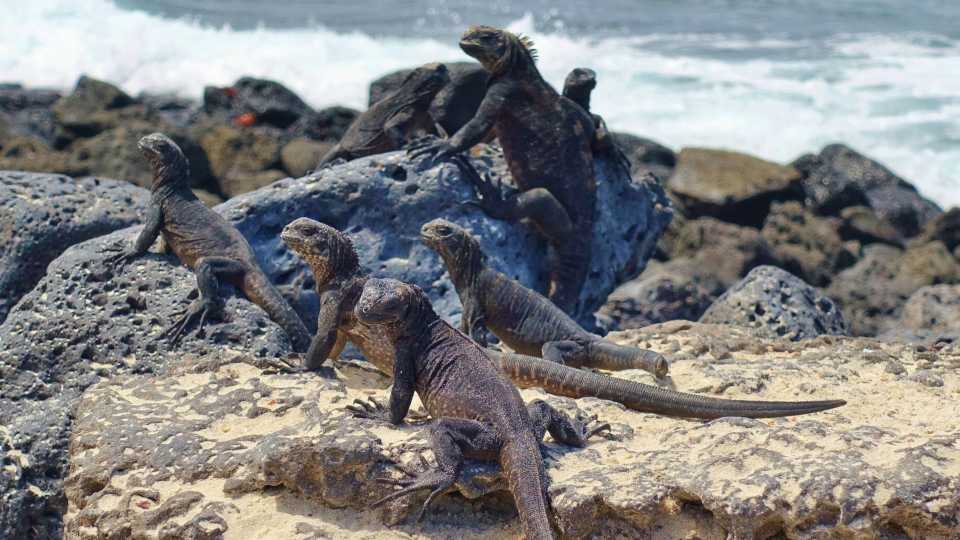
Here, marine iguanas bask on the black lava rocks, completely unconcerned by our presence.

Baby marine iguanas at Tortuga Bay.
Small baby iguanas crawl cautiously over the rough surfaces, their tiny bodies deliberate and careful. They completely spellbind us with their cuteness. The lagoon and surrounding vegetation create a serene setting, with cactus trees and mangroves framing the water perfectly.
Photo: Travel In Culture
Occasionally, tiny ghost crabs peek from burrows along the sand. Hidden during high tide, they emerge only as the water recedes, leaving small balls of sand and scratch marks behind, providing a fascinating glimpse of the hidden life thriving in the ecosystem.

Photo: Travel In Culture
3. Marine Iguanas and White Tip Reef Sharks
Sharks are a familiar sight around Santa Cruz Island, with the relatively small Galapagos shark posing no threat to humans. We have already seen hundreds in the harbour at Puerto Ayora, teeming with Galapagos wildlife. The archipelago hosts around 32 shark species, including scalloped hammerheads, whale sharks, and the white tip reef sharks we hope to spot at Tortuga Bay.
Photo: Travel In Culture
At the far end of Playa Mansa, a local woman explains that the sharks arrive with the high tide. Clambering over slippery rocks, we step into the shallow water and spot dark shapes gliding gracefully beneath the surface, their snow-white tips breaking the water. They linger among striped reef fish while spotted eagle rays drift past at a short distance, captivating onlookers of all ages.
A pair of marine iguanas on the sand.
Marine iguanas dominate the beach, some swimming in the water for short distances, some sunbathing lazily, without taking too much notice of people passing or shooting beautiful photos of them. Observing their movement, posture, and interaction with the environment provides a close-up view of these remarkable Galapagos animals. Every detail, from the scaly texture of their skin to the sunbathing behaviour, is fascinating and worthy of careful observation.
Photo: Travel In Culture
Marine iguanas share the rocks with striking red Sally Lightfoot crabs, which scuttle into crevices when we approach. Their vibrant colours and swift movements add a dynamic splash of life to the rugged volcanic landscape.

Sally Lightfoot crabs.
4. Darwin’s Finches and Birdlife at Tortuga Bay
During a picnic at Tortuga Bay on Santa Cruz Island, dozens of Galapagos finches, including a persevering mockingbird, gather around, drawn to crumbs of bread on Playa Mansa. Darwin’s finches, including cactus finches and other Galapagos species, compete for food, allowing us to observe them at close range and highlighting the scientific significance of Galapagos wildlife and their role in shaping the naturalist Charles Darwin’s theories of evolution.

Birds on the beach – ‘Darwin’s finches in Galapagos’ | Photo: Travel In Culture
Watching the finches, their beak shapes clearly reflect adaptations to the food available on each island, from insects and seeds to cactus nectar and even iguana blood. These variations have resulted in finches that still today differ between the Galapagos islands depending on local food availability.
Standing here, it is easy to see why Darwin, visiting in 1835 aboard the HMS Beagle, found the Galapagos so compelling. He noticed subtle differences between species on each island that reflected how isolation shaped unique adaptations. Observations on islands such as San Cristóbal, Floreana, Santiago, and Isabella helped him develop his theory of natural selection, turning the islands into a living laboratory of evolution.
Photo: Travel In Culture
Between Santa Cruz Island Galapagos and the other islands, subtle variations in finches and other birds show how feeding habits adapt to available resources. Watching birds, reptiles, and vegetation together reinforces how perfectly Galapagos wildlife has adapted to isolation. Pelicans glide along the coastline, and grey lava gulls circle above, offering a rare opportunity to observe some of the world’s most localised seabirds in their natural habitat.
Marine iguanas bask on the pristine sands of Tortuga Bay | Photo: Travel In Culture
Returning along the trail, sunlight filters through the cactus forest, the heat easing and the forest quieter than in the morning. Tortuga Bay combines breathtaking landscapes with intimate wildlife encounters, from marine iguanas and white tip reef sharks to Darwin’s finches and hidden lava lizards. Every step reinforces the uniqueness of Santa Cruz Island and the remarkable natural wealth of the Galapagos Islands. Tortuga Bay combines stunning beaches, fascinating wildlife, and the natural beauty of Santa Cruz Island, creating an unmissable experience in the Galapagos Islands. Experiences like this show how patient observation and respectful engagement with nature can deepen a journey, principles that form the foundation of our Cultural Travel Method.
For travellers seeking a more local, authentic atmosphere, this guest house-style hotel in Puerto Ayora is a great option.
Frequently Asked Questions
How long does it take to walk to Tortuga Bay from Puerto Ayora?
The walk takes around 45 minutes along a paved and well-marked trail through cactus forest. It is an easy route, but shade is limited, so it is best to start early in the day.
Is there an entrance fee for visiting Tortuga Bay?
Access to Tortuga Bay is free, but visitors must sign in at the entrance gate in Puerto Ayora. A short check-in is required for conservation monitoring and visitor safety.
Can you visit Tortuga Bay without a guide?
Yes, Tortuga Bay can be visited independently without a guide. The trail is clearly marked, and most travellers explore both beaches on their own at their own pace.
What is the difference between Playa Brava and Playa Mansa?
Playa Brava faces open ocean with strong waves and is not suitable for swimming. Playa Mansa is a sheltered lagoon with calm waters, making it ideal for swimming and snorkelling.
What wildlife can you see at Tortuga Bay?
Visitors may see marine iguanas, Darwin’s finches, lava lizards, Sally Lightfoot crabs, and white tip reef sharks. Occasional sightings of Galapagos tortoises are also possible along the trail or nearby areas.
Is swimming allowed at Tortuga Bay?
Swimming is only recommended at Playa Mansa due to its calm lagoon conditions. Swimming at Playa Brava is unsafe because of strong currents and heavy surf.
What should you bring for a visit to Tortuga Bay?
Bring water, sun protection, and light clothing suitable for walking in warm conditions. Snorkelling gear is useful if you plan to explore the calm waters of Playa Mansa.
When is the best time to visit Tortuga Bay?
Early morning or late afternoon offers cooler temperatures and better wildlife activity. Midday can be hot and exposed due to limited shade on the trail and beaches.
Get inspiration for what else you can experience in the Galapagos Islands: Exploring Puerto Ayora in 6 Days: Santa Cruz Island Itinerary
Read next: Seeing the Giant Tortoises at El Chato and Academy Bay Tour Galapagos: See Blue-footed Boobies and Giant Sea Turtles
