


9 Best Things to Do in Krakow: Wawel Castle, Old Town & Kazimierz
By ANL | UPDATED:
All photographs in this article were taken by Travel In Culture.
This guide covers the best attractions and things to do in Krakow for first-time visitors.
1. Wawel Royal Castle
2. The Wawel Dragon & Dragon’s Den
3. Wawel Cathedral
4. Main Square
5. Cloth Hall (Sukiennice)
6. Florianska Street
7. Collegium Maius
8. Kazimierz
9. Auschwitz & Birkenau Tour

The Papal Window, Bishop’s Palace | Photo: Travel In Culture
Looking for the best things to do in Krakow? Poland’s former royal capital is one of Europe’s most rewarding cultural destinations, combining medieval architecture, royal history, religious heritage, and poignant wartime sites. The city’s UNESCO-listed Old Town is home to iconic attractions such as Wawel Castle, Wawel Cathedral, the Cloth Hall (Sukiennice), and the vast Main Square. Beyond the historic centre, Kazimierz offers insight into Krakow’s Jewish heritage, while a visit to Auschwitz-Birkenau provides a deeper understanding of European history. Whether you are interested in castles, churches, museums, legends, or local culture, these top Krakow attractions will help you experience the city’s most significant sights and stories.
To make the most of your visit, you can also follow our cultural travel method for discovering the history, architecture, and local traditions behind each destination.
What makes Krakow’s Old Town special?
Krakow features cultural heritage buildings, art nouveau façades, stairs and theatres, solid fortifications, and ornate churches. The Old Town has an exceptional concentration of large, impressive churches, making it one of Europe’s most distinctive historic city centres. Catholic nuns are a common sight in the streets, and Krakow has strong associations with Pope John Paul II, who greeted crowds from the Papal Window of the Bishop’s Palace during his visits to the city.
If you are planning where to base yourself in the city, see also our guide to where to stay in Krakow.
The Royal Route begins in front of the St Florian Church, continues in the footsteps of the former Polish Kings around the Barbican Defence Gateway, through St Florian’s Gate and down St Florian’s Street (Floriańska) until it reaches the Main Square with its horse-drawn carriages and the iconic Cloth Hall, Sukiennice, before ending at Wawel Hill at the Royal Castle and Cathedral.

Juliusz Słowacki Theatre and world clocks | Photo: Travel In Culture
Krakow also has a harsh history associated with one of its former kings. The Bishop of Krakow, Stanislaus of Szczepanów, had a conflict with King Boleslaw the Bold, and it was ‘resolved’ by the King by brutally ordering the murder of the bishop! The crime scene is in the southern part of Krakow.
Kazimierz District is just southeast of Wawel Royal Castle and Cathedral (and the limestone Dragon’s Den). This district oozes genuine Jewish culture, synagogues, history, and eateries with local food specialities and is one of Krakow’s most important cultural districts.
For a more detailed guide to Krakow’s historic districts, see Where to Stay in Krakow: Old Town or Kazimierz?.
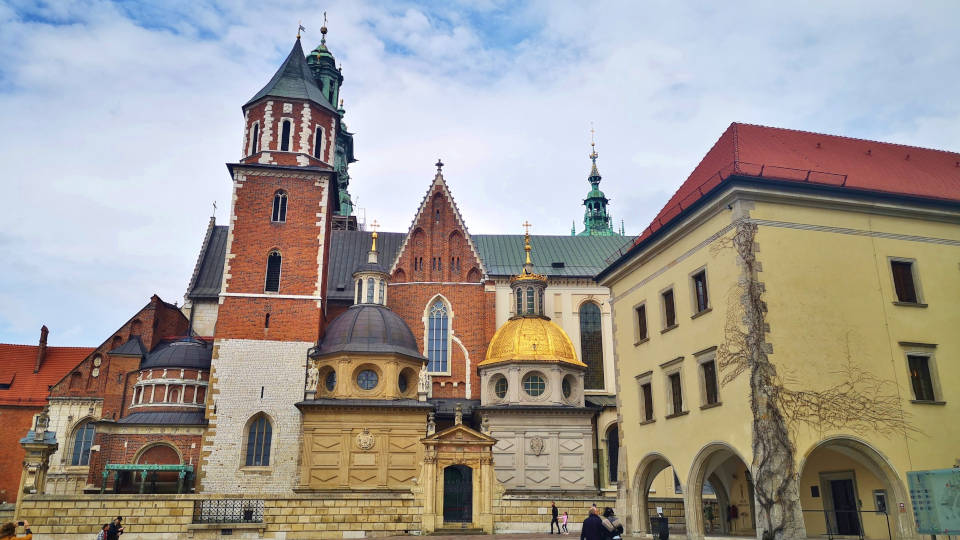
Wawel Cathedral & Royal Castle | Photo: Travel In Culture
No visit to Krakow is complete without exploring Wawel Royal Castle. Perched majestically on Wawel Hill, this magnificent royal residence is one of the city’s most iconic landmarks. As the residence of former Polish kings when Krakow was the capital of Poland, the Royal Castle has a fascinating history. Later, the city also became a royal necropolis. Today, the castle complex atop the hill is an icon of Krakow, visible from many places around the city.
Coronation sword | Photo: Travel In Culture
Its strategic position on a limestone hill above the river made Wawel Hill an important settlement site in ancient times. In the Middle Ages, it became a centre of secular power. Many centuries later, Wawel became the seat of the Polish kings. Coronations took place in Wawel Cathedral, from the 14th century until the 18th century.
Due to fires and wars, the castle has appeared alternately in Romanesque, Gothic, and Renaissance architectural styles. Today, Wawel Royal Castle is a unique museum with spectacular pieces of artwork, sculptural works, paintings, tapestries, banners, armoury, and, not least, the crown treasures, including the coronation sword.
Photo: Travel In Culture
No castle without a dragon – and Wawel has its own Dragon Den, linked to the legend of the medieval terrifying dragon, which breathed fire and terrorised the Krakow inhabitants. The Wawel Dragon lived in a limestone cave under Krakow city. The beast defeated all the brave knights who tried to slay it – until King Krak (Krakus), according to the myth, let a young shoemaker, Skuba, try. He let the boy, who had no weapons, only a needle and yarn, challenge the monstrous Wawel Dragon. Skuba filled a lambskin with sulphur, sewed it together, and lured the dragon into eating the bait. The sulphur burned the dragon’s throat, and the monster rushed to the river and drank enormous quantities of water until it burst.
The dragon’s den is beneath the Wawel Castle and Cathedral along the river, where there is also the dragon skeleton, sculptured by Bronislaw Chromy to commemorate the beast.
Krakow Royal Castle & Cathedral | Photo: Travel In Culture
There have been several cathedral constructions in Krakow. The current Wawel Cathedral is the third on this site, replacing a medieval cathedral from the year 1000 and a subsequent remodelling of this. It dates back to the 14th century and appears in mainly Gothic and Baroque styles.

Sigismund Bell Tower | Photo: Travel In Culture
One of the highlights of Wawel Cathedral is the Sigismund Bell Tower, with several imposing church bells, including Poland’s largest bell (11 tons).
Wawel Cathedral Crypt, sarcophagi | Photo: Travel In Culture
Wawel Royal Castle and Cathedral have contributed to shaping the history of Krakow, and the tombs of the former kings still stand in the crypt of the Cathedral. The crypt is a real gem with its spectacular sarcophagi of the Krakow kings, bishops, and famous Polish heroes.
Main Square | Photo: Travel In Culture
The Main Square (Rynek Główny) is the picturesque 13th-century plaza in the heart of the city, from where visitors can take in some of the most significant cultural sights in Krakow, including the iconic Cloth Hall (Sukiennice). The square is full of food stalls, where visitors can try all kinds of Polish food specialities and buy traditional Polish souvenirs. Moreover, it is a popular and romantic place to begin a horse carriage ride around the city.

The marketplace | Photo: Travel In Culture
St Mary’s Basilica is one of the most significant churches in Krakow. It holds the largest Gothic-style altarpiece in the world, which, temporarily, was removed by the Nazis during the Second World War. A unique feature is the hourly trumpeter tune from the taller tower, which, according to the legend, commemorates a trumpeter during a Mongol invasion in 1241. He was interrupted in his warning of the citizens. Shot by an arrow, he couldn’t complete his anthem. That is why the trumpeter tunes today end unexpectedly every hour.
The marketplace and Town Hall Tower | Photo: Travel In Culture
However, this is not all, since the Main Square also boasts the beautiful Town Hall Tower, a landmark which is the only remaining building of the former Town Hall. Although leaning a little, it still stands and offers the opportunity to get a panoramic view of the city from the top. The Church of St Wojciech is also a fine Romanesque building in the Main Square, among the oldest stone churches in Poland!
The Cloth Hall, Sukiennice | Photo: Travel In Culture
Another spectacular building in the square is the Cloth Hall, also known as Sukiennice, surrounded by tempting stalls in the marketplace. It dates to the 13th century and is where traders have sold colourful silk fabrics, pieces of clothing, handcrafted items, spices, and local food specialities since the 1400s. Originally a medieval marketplace with two rows of stalls, the Cloth Hall later acquired a roof. Despite a devastating fire in 1555, the Cloth Hall expanded over the centuries into the impressive two-storey building seen today.
The Cloth Hall is the place to find the perfect souvenirs to take home, whether it is amber, Polish icons, Easter eggs, or a dragon sculpture. Also, the Gallery of Polish 19th-century Art, with 18th- and 19th-century paintings, is housed in the Sukiennice building. Also, Rynek Underground can be explored here. It is an underground site of ruins and artefacts from Krakow’s past.

Florianska Street | Photo: Travel In Culture
Florianska Street is an iconic street in Krakow, existing since the 13th century. St Florian’s Gate north of Florianska Street marks the beginning of the cobbled Florianska Street (named after Poland’s Saint Florian). The Gate is part of the medieval fortifications and was one of eight possible entranceways to Krakow and the only one remaining. The defence structure is one of the best-preserved East European fortifications.
St Florian’s Gate | Photo: Travel In Culture
St Florian’s Gate also marks the beginning of the Royal Route or Royal Road that runs through Florianska Street down to the Main Square. Once, when Krakow was a royal city and capital of Poland, it was the formal route for royal processions such as crownings.

Medieval fortifications | Photo: Travel In Culture
Along Florianska Street, many bars and restaurants serve traditional Polish food and beer. In addition, several popular bagel (obwarzanki) street stands also line the street.
Collegium Maius | Photo: Travel In Culture
Krakow’s medieval university, the Jagiellonian University, was founded in 1364 by King Casimir the Great. It is the oldest university in Poland, and it is among the oldest universities in the world.
Collegium Maius | Photo: Travel In Culture
The Collegium Maius is the oldest building of the Jagiellonian University and is well-preserved with an arcaded courtyard and an interior balcony. A history museum, the Jagiellonian University Museum, is included in the buildings.

Kazimierz | Photo: Travel In Culture
Kazimierz contains several of Krakow’s most important Jewish heritage sites, including synagogues, cemeteries, and historic streets.
Kazimierz has a long Jewish heritage dating back to the Middle Ages, later becoming the centre of Krakow’s Jewish community.
The Old Synagogue, Kazimierz | Photo: Travel In Culture
Today, several synagogues are open to visitors, including the Old Synagogue (with a museum), High Synagogue, and Remuh Synagogue, along with its historic cemetery.
The Steven Spielberg film Schindler’s List has scenes from Kazimierz, and visitors can enter Schindler’s Factory.

Auschwitz concentration camp | Photo: Travel In Culture
Birkenau concentration camp | Photo: Travel In Culture
Auschwitz-Birkenau can be visited on a day trip from Krakow. There are many tour options to choose from. Book a tour to Auschwitz and Birkenau (advertisement – affiliate link)
Auschwitz concentration camp | Photo: Travel In Culture
Frequently Asked Questions
How many days do you need in Krakow?
Two to three days is a good starting point for exploring Krakow’s Old Town, Wawel Castle, and Kazimierz. Allow an extra day if you plan to visit Auschwitz-Birkenau.
Is Wawel Castle worth visiting?
Yes. Wawel Castle is one of Krakow’s most important historic landmarks, with royal state rooms, collections, and centuries of Polish history. Wawel Cathedral is also worth including in your visit.
Is Kazimierz worth visiting?
Yes. Krakow’s historic Kazimierz district is known for its Jewish heritage, historic synagogues, and distinctive cultural atmosphere. It is also a good area to explore cafés and restaurants.
Can you visit Auschwitz-Birkenau on a day trip from Krakow?
Yes. Auschwitz-Birkenau can be visited on a day trip from Krakow, either independently or on an organised tour. Allow most of the day for the visit, including travel time.
Is Krakow walkable?
Yes. Krakow’s Old Town, Main Square, and Wawel Hill are within walking distance of one another, and Kazimierz is also accessible on foot. Walking is one of the best ways to explore the city’s historic centre.
Planning a trip to Poland? Explore our two-day Warsaw itinerary, discover the best areas to stay in Warsaw, and browse our Poland travel guide for more cultural discoveries.
Read next: Visit the Historic Zaanse Schans in the Netherlands
