


Warsaw in 2 Days: A Complete Itinerary and Walking Guide
By ANL | UPDATED:
A practical guide to exploring Warsaw in two days, based on our own experience and supplemented by additional research and current travel information. All photographs in this article were taken by Travel In Culture.
Warsaw in two days reveals a city shaped by royal ambition, wartime destruction, and an extraordinary process of reconstruction. In the Old Town, colourful façades and cobbled streets create an inviting historic setting, while the churches, monuments, and memorials along the Royal Route tell a more complex story. Beyond the historic centre, the landscaped grounds of Łazienki Royal Park, the imposing Palace of Culture and Science, and the Vistula riverfront reveal other sides of the Polish capital.
Our two-day Warsaw itinerary combines the major sights with the smaller details that make exploring the city rewarding, from the place where Frédéric Chopin’s heart rests to a quiet garden behind St Anne’s Church. You will also have time to pause over a cup of chocolate, discover Polish food culture, and experience Warsaw after dark. Following our approach to cultural travel, we focus on both the landmarks and the stories that give them meaning.
The route follows our own sightseeing experience, with practical suggestions for adjusting the schedule to your interests, walking pace, opening times, and available time.
✔ The best things to do in Warsaw in 2 days
✔ A practical two-day sightseeing and walking itinerary
✔ The Old Town, Royal Route, and Łazienki Royal Park
✔ The Warsaw Uprising Museum and modern city centre
✔ Food and drink experiences worth considering
✔ Practical walking advice and where to stay in Warsaw
🏯 Selected for a luxury Old Town stay → Hotel Verte, Warsaw, Autograph Collection
📍 Selected for a stylish base on the Royal Route → Flaner Hotel, WorldHotels Crafted
🏛️ Selected for central sightseeing and transport links → Hotel Polonia Palace
📍 Destination → Warsaw, Poland
⏱️ Duration → 2 days
🚶 Walking distance → Approximately 19–22 km over two days, based on our route and depending on detours
🏰 Day 1 highlights → Old Town, Royal Route, and Łazienki Royal Park
🏛️ Day 2 highlights → Warsaw Uprising Museum, Palace of Culture and Science, and the Vistula area
🍽️ Experience → History, architecture, parks, Polish food, and contemporary city life
Warsaw in 2 Days: Itinerary at a Glance
This two-day Warsaw itinerary combines the historic centre and royal landmarks with the city’s wartime history, modern architecture, and riverfront. The route follows our own sightseeing experience, with optional stops that you can adapt to your available time.
| Day | Main route | Highlights | Walking distance |
|---|---|---|---|
| Day 1 | Old Town → Royal Route → Łazienki Royal Park | Castle Square, Old Town Market Square, historic churches, Chopin landmarks, Palace on the Isle | About 11–12 km |
| Day 2 | Warsaw Uprising Museum → City Centre → Vistula area | Warsaw Uprising Museum, Palace of Culture and Science, optional gardens and riverfront | About 8–10 km |
🏰 Day 1 → Focus on the historic centre, royal heritage, and the landscaped grounds of Łazienki Royal Park.
🏛️ Day 2 → Allow around 2.5–3 hours for the Warsaw Uprising Museum, followed by central Warsaw and optional riverfront stops.
🚶 Walking → Both days involve substantial walking. Wear comfortable shoes and allow extra time for museum visits, breaks, and detours.
Tip: Check museum opening times and ticket availability before finalising the route. The itinerary may need adjusting to the day of the week and season.
Day 1: Historic Warsaw, the Royal Route and Łazienki Park
Begin in Warsaw’s historic centre, where reconstructed streets and royal landmarks introduce the city’s past. Continue along the Royal Route before spending the afternoon among the palaces, gardens, and monuments of Łazienki Royal Park.
Suggested sightseeing sequence
Morning → Castle Square, Sigismund’s Column, the Old Town, and the Barbican
Late morning → Warsaw Uprising Monument and the Royal Route
Lunch → Nowy Świat area
Afternoon → Aleje Ujazdowskie and Łazienki Royal Park
Late afternoon → Palace on the Isle, Old Orangerie, Chopin Monument, and parkland
Evening → Polish dinner around Plac Trzech Krzyży or Nowy Świat
The direct route covers approximately 11–12 km on foot, depending on the exact route and stops.
Castle Square and Warsaw Old Town

The view towards Castle Square from Warsaw’s pedestrian streets, with Sigismund’s Column and the Bell Tower of St Anne’s Church.
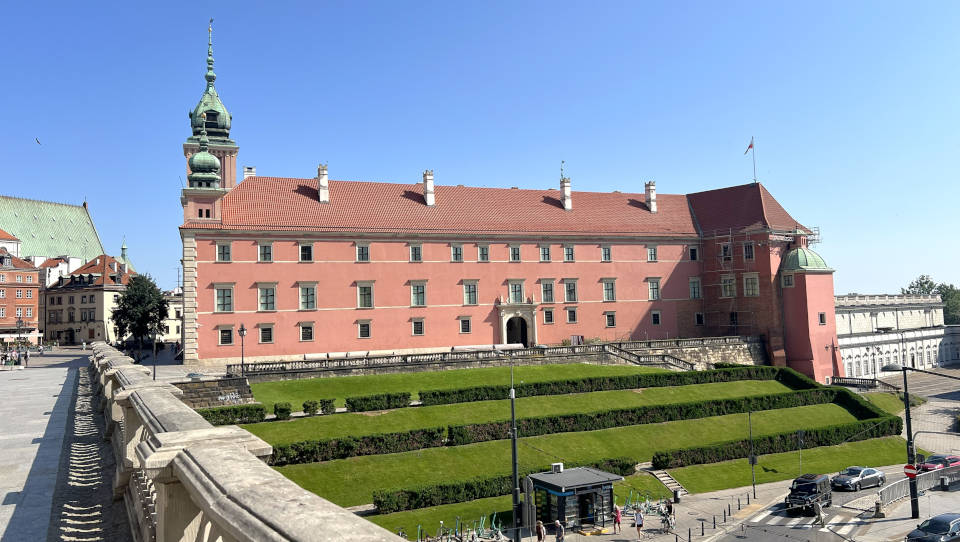
Beginning at Castle Square, we find ourselves among the landmarks that define Warsaw’s historic centre. Sigismund’s Column stands prominently in the square, while the red-roofed buildings and the Bell Tower of St Anne’s Church frame the surrounding streets. Beside the Royal Castle lies the broken shaft of Sigismund’s Column, shattered by German fire during the Warsaw Uprising in September 1944. The king’s statue was later restored and placed on a new column, while the damaged shaft remains as a tangible reminder of Warsaw’s wartime destruction.
Before continuing, consider climbing the Bell Tower of St Anne’s Church, if it is open. The elevated viewpoint offers a different perspective over Castle Square and the Old Town rooftops, taking in the city from above before setting off through the historic streets.
Behind St Anne’s Church, take a moment to explore the small garden, a quieter corner away from the flow of visitors around Castle Square. With a view towards the Royal Castle and a bench inviting you to pause, it makes a pleasant spot to sit for a few minutes, take in the surroundings, and appreciate the atmosphere before continuing into the Old Town.
The Old Town Market Square, Mermaid and Barbican

The Warsaw Mermaid monument in the Old Town Market Square, one of the historic centre’s best-known landmarks | Photo: Travel In Culture
Wandering through the Old Town brings us to the Market Square, where colourful townhouses surround the Warsaw Mermaid, the city’s emblem. It is a natural place to pause, admire the façades, and watch the square going about its daily life. However, the picturesque streets tell only part of the story. During the Second World War, more than 85% of Warsaw’s historic centre was destroyed. After the war, a remarkable reconstruction effort recreated much of the Old Town’s historic appearance, including its market square, townhouses, defensive walls, and the Royal Castle. Walking through these streets is therefore not simply an encounter with old architecture, but also with the determination to restore a city’s cultural heritage. UNESCO’s account of Warsaw’s Historic Centre explains the significance of this reconstruction.
Continuing towards the Barbican, the route follows the line of the former defensive walls. The red-brick fortification provides a striking contrast with the pastel townhouses. Passing through the gateway offers a reminder of the city’s former defences. Allow time to explore the surrounding streets to appreciate the atmosphere and connection with Warsaw’s past.
The red-brick Warsaw Barbican, a historic defensive structure on the route between the Old Town and the New Town.
The Field Cathedral of the Polish Army offers another glimpse into Warsaw’s past. Stepping inside, look for the 15,000 small memorial tablets commemorating 15,000 individual Polish military and police officers murdered by the Soviet secret police in 1940. They invite a slower visit, turning the church from a beautiful historic building into a place for reflecting on the tragic events in Poland’s history.
An unusual glass-covered passage beneath the Field Cathedral of the Polish Army adds another layer to exploring Warsaw’s historic centre.
There is also more to discover in the Hall of Traditions in the vaults beneath the cathedral. The unusual glass-covered passage and the displays in the lower-level space showcase 500 distinct historical artifacts. If you have time, it is worthwhile to include this stop while exploring the Old Town rather than simply taking a quick look at another church on the walking route.
The Warsaw Uprising Monument commemorates those who fought in the 1944 uprising against German occupation.
Leaving the Old Town, explore the Warsaw Uprising Monument, commemorating those who fought in the 1944 uprising against German occupation. Its dramatic sculptural forms make it one of the route’s most powerful historical stops. After discovering the reconstructed streets, seeing this memorial further helps understand the destruction and suffering that shaped modern Warsaw.
The Royal Route: Churches, Chopin and Historic Landmarks
Following Krakowskie Przedmieście, we pass historic façades, churches, monuments, university buildings, cafés, and elegant street scenes. This section of the Royal Route is best enjoyed on foot, allowing time to look beyond the main sights, notice architectural details, and make occasional detours to explore the area. Instead of rushing through, pay a visit to the Holy Cross Church or have a coffee stop before continuing towards Nowy Świat.
Nowy Świat forms part of Warsaw’s Royal Route, linking historic landmarks with cafés, restaurants, and lively street life.
One of the most poignant stops is Holy Cross Church, where Frédéric Chopin’s heart is preserved in a pillar. The memorial provides an unexpected connection with the composer, whose music remains closely associated with Warsaw. The church is worth entering not only for its religious and architectural significance, but also for the personal story embedded within its walls.

A memorial inside Holy Cross Church on Warsaw’s Royal Route marks the resting place of Frédéric Chopin’s heart, preserved in a pillar of the church.
As you continue along the Royal Route, look out for the Chopin Benches placed at locations connected with the Warsaw-born composer Frédéric Chopin. Press the button to hear a short passage of his music, bringing the composer’s legacy into the streets of the city he once called home.
Łazienki Royal Park and the Palace on the Isle
Continuing along Aleje Ujazdowskie towards Łazienki Royal Park, the character of the streets gradually changes. The open spaces give way to expansive lawns and landscaped gardens, creating a welcome contrast with the closely packed historic centre. Allow plenty of time here: the park is not just a green space to cross on the way to something else, but a destination in its own right.
A peaceful view across the lake in Łazienki Royal Park, a welcome change of pace after exploring the city centre.
Following the paths towards the lake, we reach the Palace on the Isle, one of the park’s principal landmarks. Reflected in the water and in natural surroundings, the palace makes an especially attractive setting for a leisurely walk. Depending on opening times and your interests, you can explore the historic interiors and galleries, discovering the art and decorative details that give the residence its unique character.
The long gallery inside the Łazienki Palace complex, lined with sculpted faces as visitors explore the historic interiors.
Inside the palace complex and Old Orangerie, the galleries provide a closer look at its artistic and architectural heritage. Long interior spaces, sculpted details, a small Royal theatre, and historic rooms reward visitors who take time to look around instead of passing quickly through. Check which areas are open during your visit, as access to individual buildings and exhibitions can vary.
A fountain and sculptures in the park outside the galleries, where visitors stroll through the landscaped grounds | Photo: Travel In Culture
Back outside, the gardens invite a slower pace, with fountains, sculptures, lakeside views, and paths winding between the trees. In suitable weather, renting a boat on the lake offers a different experience around the Palace on the Isle. Allow time to wander, watch the water, and enjoy the quieter atmosphere before returning to the city streets.
The Chopin Monument standing among the greenery is another fine detail reminding visitors of Warsaw’s celebrated composer.
Day 2: The Warsaw Uprising, Modern Warsaw and the Vistula
Dedicate the morning to the Warsaw Uprising Museum, one of the most important stops for understanding the city’s wartime history. Continue towards the Palace of Culture and Science and the modern city centre, then choose an additional stop according to your interests and the weather.
Suggested sightseeing sequence
Morning → Warsaw Uprising Museum (allow approximately 2.5–3 hours)
Early afternoon → Walk towards the Palace of Culture and Science
Lunch → Around Złote Tarasy, Świętokrzyska, or Marszałkowska
Afternoon option 1 → Visit the Palace of Culture and Science observation terrace, subject to opening times and ticket availability
Afternoon option 2 → Explore Saxon Garden and the Tomb of the Unknown Soldier
Later afternoon option → Walk towards the Vistula Boulevards and riverfront, depending on the weather and available time
The second day involves at least 8–10 km of walking, depending on the route and optional stops.
The Warsaw Uprising Museum: Understanding the City’s History

Visitors queue outside the Warsaw Uprising Museum, one of the city’s most significant historical museums.
Beginning the second day at the Warsaw Uprising Museum brings the city’s wartime history into focus. The museum explores the 1944 uprising through historical objects, personal accounts, photographs, and multimedia displays, helping visitors understand both the resistance and the enormous human cost of the struggle. Allow around 2.5–3 hours for the visit.
The museum adds context to the previous day’s visit to the Old Town. Warsaw’s historic appearance reflects an extraordinary process of rebuilding after widespread destruction. Visiting the museum before exploring the contemporary city centre emphasises the contrasts.
The Palace of Culture and Science and Modern Warsaw

Warsaw’s Palace of Culture and Science dominates the skyline and remains one of the city’s most recognisable landmarks.
Continuing towards the Palace of Culture and Science, the city presents another architectural image. Rising above the surrounding streets, this monumental building is one of Warsaw’s most recognisable landmarks and a significant feature of its skyline. Its scale and style differ from the reconstructed Old Town, reflecting another chapter in the city’s twentieth-century history.
If you want a panoramic view of Warsaw, consider visiting the observation terrace, subject to opening times and ticket availability. From above, the contrast between historic districts, modern buildings, and the broad cityscape becomes clearer.
The Vistula Boulevards and Warsaw’s Riverfront
The Vistula riverfront offers a more relaxed side of Warsaw, with places to sit and enjoy views across the water | Photo: Travel In Culture.
Finishing near the Vistula reveals a more relaxed side of Warsaw. When we walk along the riverfront, stop on the stepped seating, and look across the water, it is a welcome change after a day of museums and city atmosphere. The ambience may feel even more different in warmer weather, when the riverside becomes a popular place to meet friends and spend time outdoors.
Treat the riverfront as an optional final stop. The riverside is best enjoyed in pleasant weather, when you have enough time to linger, whether that means walking a little further or simply having a drink by the water before dinner.
Where to Eat and Drink in Warsaw
Exploring Warsaw is not only about monuments and museums. A few food and drink stops offer another way to experience the city, from traditional Polish meals to long-established chocolate traditions and contemporary bar culture.
Try a Traditional Polish Milk Bar

A traditional meal in a Polish milk bar is a worthwhile part of a city break in Warsaw.
For a taste of everyday Polish food, consider stopping at a traditional milk bar, or bar mleczny. These modest, often informal eateries are associated with familiar Polish dishes served without the formality of a restaurant. Choosing a milk bar is a chance to see a different side of local food culture, making it an interesting contrast to the grand buildings and carefully planned sightseeing route.
Visit a Historic Chocolate Café
The ornate E. Wedel café interior adds a historic touch to Warsaw’s food-and-drink scene | Photo: Travel In Culture
Warsaw’s chocolate tradition offers a sweeter pause in the itinerary. E. Wedel traces its history to 1851, when Karol Wedel opened a confectionery in Warsaw and served drinking chocolate. At the historic E. Wedel café, you can explore a range of chocolate drinks, from hot chocolate to chilled versions, with different degrees of intensity and richness depending on the menu.
The ornate surroundings add to the appeal, making this a particularly inviting stop when you want to have a break from sightseeing.
Experience Warsaw’s Vodka Bar Culture
A cosy, dimly lit vodka bar in Warsaw, where small tables, warm lighting, and picture-covered walls create an intimate atmosphere.
For a different kind of evening, seek out a traditional vodka bar. What makes the experience particularly distinctive is the atmosphere inside one of these bars. In the dimly lit interior, where pictures cover the walls and small tables fill the long room, younger and older visitors sit chatting and drinking vodka, while it is often the older patrons who get up to dance. This unexpected mix of ages gives the place a character of its own, offering a glimpse of Warsaw’s social life beyond its historic landmarks and tourist sights.
Seeing this side of Warsaw is interesting as a contrast to the formal landmarks and museum visits. If you want to experience Warsaw after dark in a relaxed social setting, it can be an enjoyable alternative to spending the entire evening in a conventional restaurant.
Where to Enjoy Dinner in Central Warsaw
After a full day of walking, for example, choose somewhere around Nowy Świat or Plac Trzech Krzyży for dinner. This part of the city works well for rounding off the day with Polish food or a relaxed meal before exploring the evening atmosphere. If you have already visited a milk bar, a chocolate café, or a vodka bar, dinner is a convenient way to round off the day without making another major detour.
Practical Tips for Visiting Warsaw in 2 Days
🚶 Walking → Expect around 19–22 km in total over the two days if following a route similar to ours.
🎟️ Museums and interiors → Check current opening days, hours, and ticket requirements before your visit.
🌳 Łazienki Royal Park → Allow time for the grounds as well as the palaces and monuments. Access to individual interiors may depend on the day and season.
🌦️ Weather → Keep the Vistula riverfront as a flexible option, particularly if the weather is changeable.
🍽️ Food and drink → Consider a traditional milk bar, a historic chocolate café, or a vodka bar alongside a Polish dinner.
🚕 Getting around → Walking works well for much of the historic centre, while public transport or a taxi can be useful when you want to save time or energy.
Planning tip: Check the latest official visitor information for individual attractions before setting out, especially if you plan to enter several historic interiors.
Where to Stay in Warsaw
For a two-day city break, choosing a convenient base can make it easier to follow the itinerary without spending too much time travelling between sights. The Old Town and central Śródmieście are useful starting points, but the best area depends on whether you prioritise historic surroundings, transport connections, restaurants, or a quieter atmosphere.
For a closer comparison of the city’s neighbourhoods and selected accommodation options, read our guide to Where to Stay in Warsaw: Best Areas and Neighbourhoods.
Exploring more of Poland? If you are planning a wider trip, discover our guides to Poland, where to stay in Kraków, and the best things to do in Kraków, with practical advice for exploring one of Poland’s most historic cities.
