


Best Things to Do in Cologne: A Cultural Travel Guide
By ANL | UPDATED:
1. Visit Cologne Cathedral
2. Explore Alter Markt
3. Discover Dufthaus 4711
4. Follow in the Footsteps of the Romans
5. Have an Art Experience
Looking for the best things to do in Cologne? Germany’s fourth-largest city combines world-famous landmarks, Roman history, outstanding museums and a lively riverside atmosphere. Most visitors begin with Cologne Cathedral, one of Europe’s greatest Gothic masterpieces, but the city offers much more beyond its iconic skyline.
From exploring Cologne’s charming Old Town and discovering ancient Roman remains to visiting the birthplace of Eau de Cologne and enjoying modern art collections, the city rewards travellers with a rich cultural experience. Many of Cologne’s main attractions are conveniently located within walking distance of the cathedral, making it easy to explore the city’s history, architecture and local traditions in a single visit.
What are the best things to do in Cologne?
Read on to get inspired by fascinating things to see and do in Cologne – things that can all be done on foot in the city since they are all within walking distance of the Cathedral.
Cologne is an ideal destination for travellers interested in our cultural travel method, where local history, architecture, traditions and everyday life combine to create a deeper travel experience.
No visit to Cologne without seeing the Cathedral, or Kölner Dom in German, which rises well above the roofs of Cologne and is visible from many spots across the city. As the largest Gothic church construction in Northern Europe, it is most impressive and a must-see!

Photo: Michael Philipp / Pixabay
Officially, the name of the Catholic cathedral with the twin towers and spires is Hohe Domkirche Sankt Petrus, and it is the seat of the Archbishop of Cologne and the Archdiocese of Cologne. Due to its outstanding architecture, Cologne Cathedral was declared a UNESCO World Heritage Site in 1996.
Construction of the Cathedral in the new Gothic style took place over many centuries. It was initiated as a medieval church in 1248 (intended as a site of worship for the Roman Emperor and as a place to keep the relics of the Three Kings, also known as the Three Wise Men) and not finalised until 1880 – with an interruption of close to 300 years, from 1560 until 1840! The inauguration in August 1880 was in the presence of Emperor Wilhelm I.
Visitors planning a broader German itinerary may also enjoy our guide to spending three days in Berlin, another city filled with history, architecture and cultural attractions.

The main entrance of Cologne Cathedral was completed in the 19th century | Photo: Travel In Culture
Because of the relics of the Three Kings, Cologne Cathedral has, over the years, been a popular pilgrimage site, and the shrine still draws people to Cologne. The Treasure Chamber and the spectacular stained-glass windows are some of the highlights of the Cathedral.
If you have the energy for it, you may climb the over 500 steps of one of the 157-metre towers for striking panoramic views of Cologne city!
One of the great things to do in Cologne is to explore the old town around Alter Markt, today a pedestrian zone. It is the city’s former marketplace with a beautiful fountain from 1884 as its focal point, and there are still historical houses flanking the vibrant square full of restaurants and bars with outdoor seating in summer. In winter, you will find Cologne’s Christmas market here, including a carousel, skating rink, and food stalls.

One of the charming squares today in Cologne is Alter Markt, located close to the other central square Heumarkt, the former Haymarket. | Photo: Travel In Culture
Where to go in Cologne?
The oldest house dates back to 1580, but it is a fact that there was a market here on site already in the 900s. Unfortunately, many of the historic buildings were destroyed during World War II.
Cologne’s historical town hall, the Kölner Rathaus, is located right at Alter Markt, a fine building built in both 14th-century, 15th-century, and Renaissance styles – reflecting the distinct periods. It is today one of Germany’s oldest public buildings.

Fischmarkt | Photo: Jabra / Pixabay
Cologne’s large Romanesque Great St Martin Church is a stone’s throw away from Alter Markt. The church was built in the 1200s to replace the original Benedictine monastery. A few metres from Great St Martin, close to the Rhine River, the old ‘Fischmarkt’ is located, Cologne’s historic fish market – today a picture-postcard sight with its pastel houses adorning the quarter. However, only a few Gothic houses are left here due to the World War II bombings.
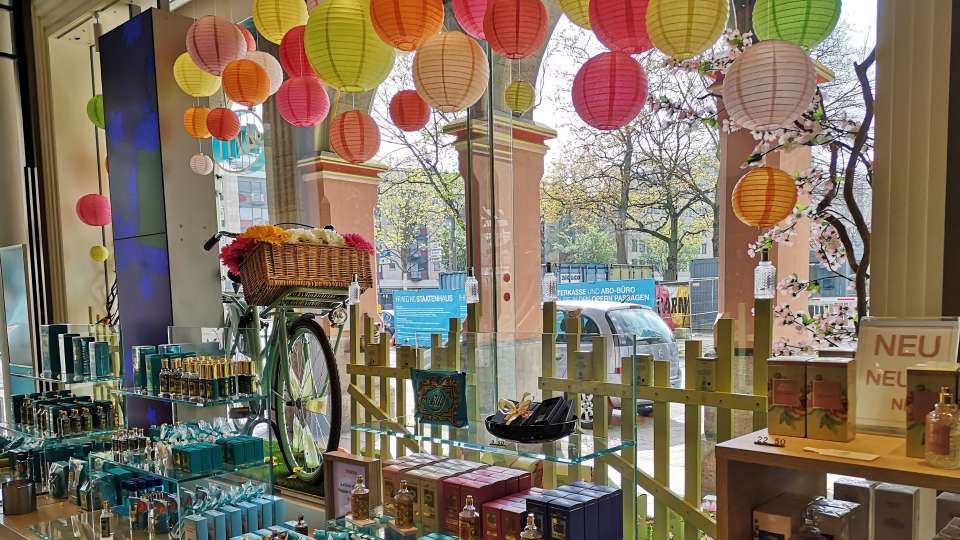
Why not explore the house of the world-famous fragrance Eau de Cologne at its original location? Dufthaus 4711 in Glockengasse lets you discover the city’s history and authentic fragrance brand through a guided tour, intriguing museum exhibitions and inside the flagship store. You can also order a fragrance 4-course menu or even attend a fragrance seminar!
Dufthaus 4711 | Photo: Travel In Culture
Entering the store, you will immediately notice perfume bottles everywhere – and not least a large tapestry depicting a mounted French corporal riding from door to door in Cologne, numbering all the houses. That was precisely the way Dufthaus 4711 received its number!
The Eau de Cologne fountain at Dufthaus 4711 | Photo: Travel In Culture
Just beneath the tapestry is a very unique fountain. It is a fountain of Eau de Cologne – for everyone to reach out and scent the expensive drops while feeling them running through their fingers.
The city was founded in the 1st century by the Romans and obtained status as a Roman colony in 50 AD with the name Colonia Claudia Ara Agrippinensium after Emperor Claudius’s wife, Agrippina the Younger, who was born there. Hence the name Cologne.

The Romans’ Northern Gate at Cologne Cathedral | Photo: Travel In Culture
Cologne expanded militarily and economically due to its favourable location on the Rhine, and it now became the capital of the Roman province Germania Inferior. Later, in 260 AD, Cologne advanced to being the capital of the Gallic Empire.
With the large number of imposing constructions erected, the Romans naturally left their mark on the city. Today, ruins of these constructions can be found scattered around Cologne city. Many remnants are still underground, but you can find pieces of the Roman walls, gates and other ruins, such as aqueduct parts, arches and towers in various places.
Photo: Travel In Culture
One of the centrally located ruins is the Romans’ Northern Gate, situated quite close to Cologne Cathedral.
On the other side of the Cathedral, many ancient Roman artefacts are exhibited in the Roman-Germanic Museum (Römisch-Germanisches Museum). A visit here is a straightforward way to gain insight into Cologne in Roman times. Among the items on display are locally produced Roman glass, vases, jewellery, mosaics, weapons, gravestones, portraits and much more. Moreover, you will find an entire villa in the museum basement and the large original Dionysus Mosaic. All items contribute to understanding how Roman life was in ancient Cologne.
Travellers interested in historic German cities should also consider visiting Münster, known for its beautifully preserved old town and important role in European history.
Museum Ludwig | Photo: Travel In Culture
Cologne is also the city to have an unforgettable art experience. One of the best cultural things to do is to visit either the outstanding Museum Ludwig, the Wallraf-Richartz Museum, or another art museum or gallery in the city. Pick Museum Ludwig if you prefer modern and contemporary painting and Wallraf-Richartz for outstanding work of the Cologne school.
Hohenzollern Bridge covered with love locks | Photo: Travel In Culture
Things to do in Köln (Art): Nevertheless, if you are more after an unusual art experience, stroll on the three-arched Hohenzollernbrücke from 1911 crossing the Rhein. It is the only bridge in Cologne not destroyed during World War II. It is also the famous bridge in Germany where couples place their pink, red and other brightly coloured love locks, turning the bridge into an amazing work of art created by several hundred thousand people in unison! Couples engrave their names on their love lock, hang it on Hohenzollern Bridge and finally throw the key into the Rhein.

The Crane Houses | Photo: Stefan 2703 / Pixabay
Another fascinating experience is to walk under the modern 60 m high Crane Houses, or Kranhäuser in German, an example of spectacular cutting-edge architecture. The Rheinauhafen waterfront complex is located on the Rhine and features a blend of residential and office buildings, modern galleries, and trendy cafés & restaurants. Three 17-storey buildings have a crane-like shape, referring to the harbour cranes in the former riverport that they are now replacing. They were designed by the architects Alfons Linster and Hadi Teherani as part of an urban redevelopment project beginning in 2006. Being a huge open-air work of art, the Crane Houses are extremely popular with both residents and architecturally interested visitors.
Frequently Asked Questions
What is Cologne most famous for?
Cologne is best known for Cologne Cathedral, a UNESCO World Heritage Site and one of the most visited landmarks in Germany.
How many days do you need in Cologne?
One to two days is enough to see the main attractions, while a longer stay allows time for museums, river walks and day trips.
Can you visit Cologne Cathedral for free?
Entry to the cathedral is generally free, although separate fees may apply for the tower climb and treasury.
Is Cologne a walkable city?
Yes, many of Cologne’s main attractions, including the cathedral, Old Town and museums, can be explored on foot.
What Roman sites can you see in Cologne?
Visitors can see Roman gates, sections of ancient walls and archaeological collections in the Roman-Germanic Museum area.
What is Eau de Cologne and why is it important?
Eau de Cologne is a famous fragrance that originated in Cologne, and Dufthaus 4711 remains one of the city’s best-known historic attractions.
When is the best time to visit Cologne?
Spring and early autumn offer pleasant weather, while December attracts visitors with the city’s famous Christmas markets.
What are the best museums in Cologne?
Museum Ludwig is renowned for modern art, while the Wallraf-Richartz Museum is known for its outstanding collection of European paintings.
What local drink should visitors try in Cologne?
Kölsch is Cologne’s traditional beer and is typically served in small cylindrical glasses in local breweries and pubs.
What attractions are near Cologne Cathedral?
Within walking distance are Alter Markt, the Roman-Germanic Museum area, Museum Ludwig, Great St Martin Church and Hohenzollern Bridge.
Want to discover the Moselle Valley? Then you may want to read Moselle Valley Road Trip – A Travel Guide
Read next: Schwalenberg – Where the Swallows Soar and Artists Thrive

Images courtesy of Travel In Culture. Selected images from Pixabay.