




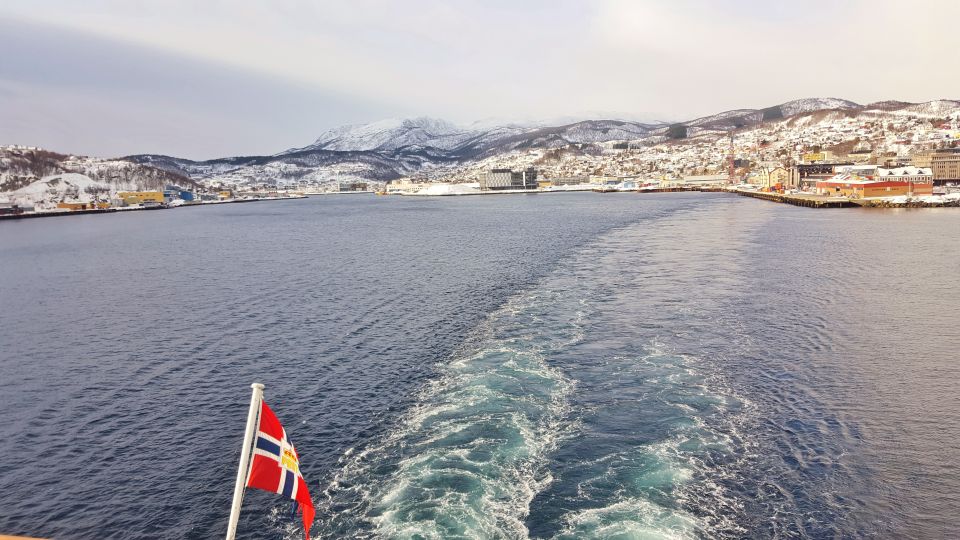
Exploring Norway by Hurtigruten Coastal Cruise Ship
By ANL | UPDATED:
The Hurtigruten ship itinerary is especially popular for travellers seeking northern lights cruises in Norway and immersive cultural experiences along the west coast. From winter aurora displays above Tromsø to the fishing heritage of Lofoten and the historic charm of Trondheim, this voyage reveals the diversity of Norway’s coastline in a continuous and changing panorama.
Learn more about responsible and immersive travel approaches in Cultural Travel Method, which explains how to engage more deeply with destinations like the Norwegian coast.
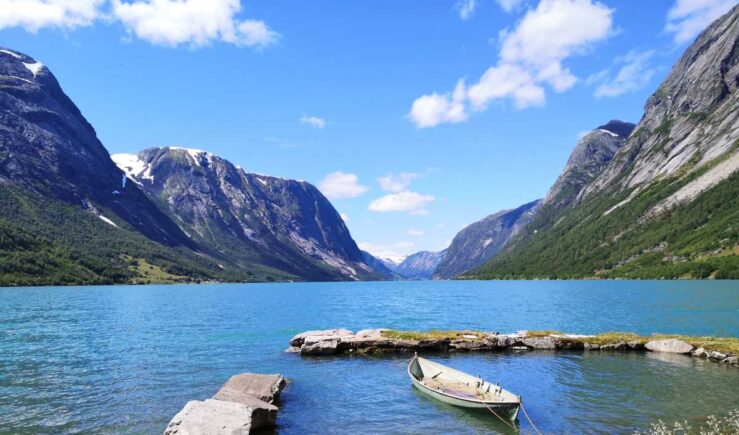
Photo: Travel In Culture
For several years, ads from Hurtigruten have repeatedly caught our attention, promoting what they call the most breathtaking sea voyage in the world. So far, only the hefty price of the voyage in Norway has held us back.
Choosing the right season to go has also been a factor. Each season offers its own unique advantages. Summer, the most expensive time to book, brings warmer temperatures and extended daylight hours. Around midsummer, it never gets fully dark, allowing you to sit on deck and read by natural light all night if you wish. It is definitely more inviting to be outdoors then compared to the dark winter months with only a few, if any, daylight hours. On the other hand, winter offers the best chances to catch a glimpse of the Northern Lights.
Hotels – before/after your Hurtigruten cruise Norway:
How to plan a Hurtigruten cruise in Norway
We finally seize the opportunity to go at the beginning of April, trying to capture all the advantages. With a bit of luck — and our warmest clothes — we hope to spend most days on deck, while still having a chance to spot the Northern Lights in Northern Norway. Moreover, at this time of year, we will likely see stockfish hanging to dry throughout the Lofoten Islands!
However, booking a full Hurtigruten package tour presents not only the challenge of cost but also a time constraint. How can you find enough time to truly explore the Lofoten Islands?
We decide to make two separate bookings directly with Hurtigruten: one from Tromsø in Northern Norway down to the Lofoten Islands, and another from Lofoten southbound to Trondheim. This way, we can enjoy a stopover in the Lofoten Islands while still experiencing the full beauty of the Norwegian coastal voyage. We also book a hotel in Lofoten and look into accommodations in Tromsø. In short, this approach offers a tailored trip that is also more affordable than the full package, replacing some nights on the ship with hotel stays in Lofoten.
Hurtigruten at a Glance
- 🚢 Norway’s famous coastal voyage
- 🌌 Northern Lights in winter
- ☀️ Midnight Sun in summer
- 🏔️ Fjords, islands and Arctic scenery
- 📍 Tromsø, Lofoten and Trondheim highlights
- ⚓ Flexible port-to-port travel
The Hurtigruten Fleet
Going on a Hurtigruten voyage is an excellent way to enjoy coastal Norway! The ships are used both as ferries between the small coastal communities and as fascinating cruise ships.
The Hurtigruten company was founded by the Norwegian ship captain, politician, and businessman Richard With. With a profound wish to improve the infrastructure around the small coastal villages, until then all served by different ferry companies, he included the routes in the Hurtigruten services.
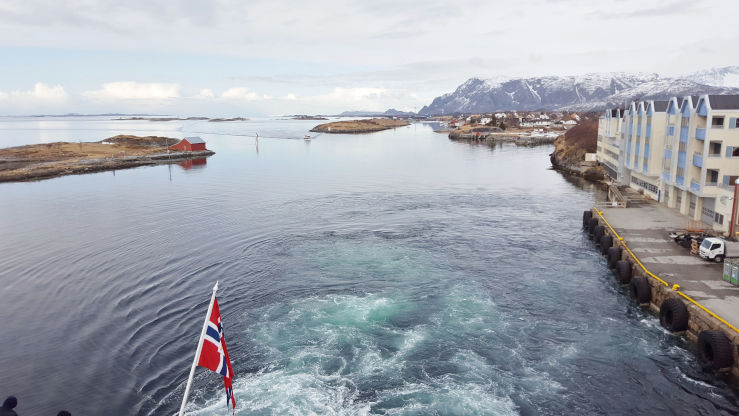
A Hurtigruten ship stops at one of the many small ports along the scenic Norwegian coast.
Today, the ships are still used by locals for transport, goods delivery, and postal service, and as cruise ships with passengers from near and far. The Hurtigruten fleet serves the Norwegian west coast, providing the passengers with a unique opportunity to experience and explore Norway from the seaside. Its route is both northbound and southbound along the Norwegian coast.
Due to receiving state subsidies, Hurtigruten has committed itself to serving all the small ports along the Norwegian west coast. Therefore, there are daily calls at all ports, such that you can embark and disembark according to preference and needs.
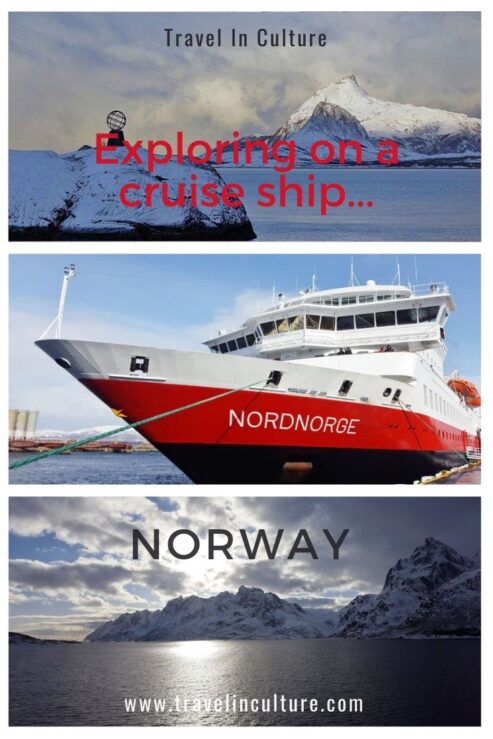
At the moment, a fleet of 11 out of 15 ships operates up and down the coast. A few ships serve Svalbard as well. Likewise, Hurtigruten has during the last years extended its routes to comprise even more distant locations and have today cruise ships reaching as far as Greenland and Antarctica. Read our detailed review of MS Nordnorge and the Arctic Circle crossing experience.
Passenger segments are supposedly a bit different on many of the ships! According to what we are told, it was most noticeable on the old and legendary MS Lofoten from 1968 with traditional, primitive berths and no stabiliser. However, it was recently taken out of the fleet. The interior was, though, in a class of its own with stylish wooden and leather furniture, and polished brass. That, in particular, attracted a segment of well-travelled passengers who precisely sought this kind of atmosphere on board.
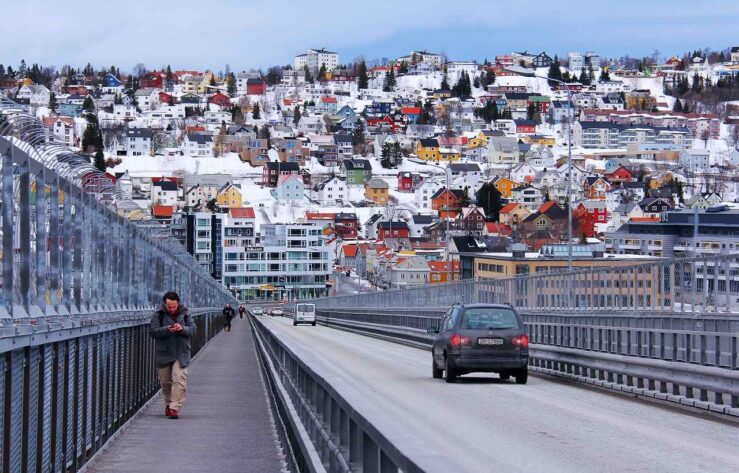
Tromsø Bridge | Photo: Sharon Ang / Pixabay
1. Tromsø
The flight from Oslo takes a couple of hours and emphasizes the length of Norway. When we step out, it is on a thick layer of snow – it seems to be a long-lasting winter here! The local bus takes us to the other side of the small island to the idyllic coastal city, Tromsø.
Now, strolling around, we are happy that we brought our boots. The snow is everywhere, and it is even icy here and there, so it is a matter of paying full attention while walking to keep our balance! In most places in the northern hemisphere, it is supposedly really spring-like now in April, and here, it still seems to be plain winter!
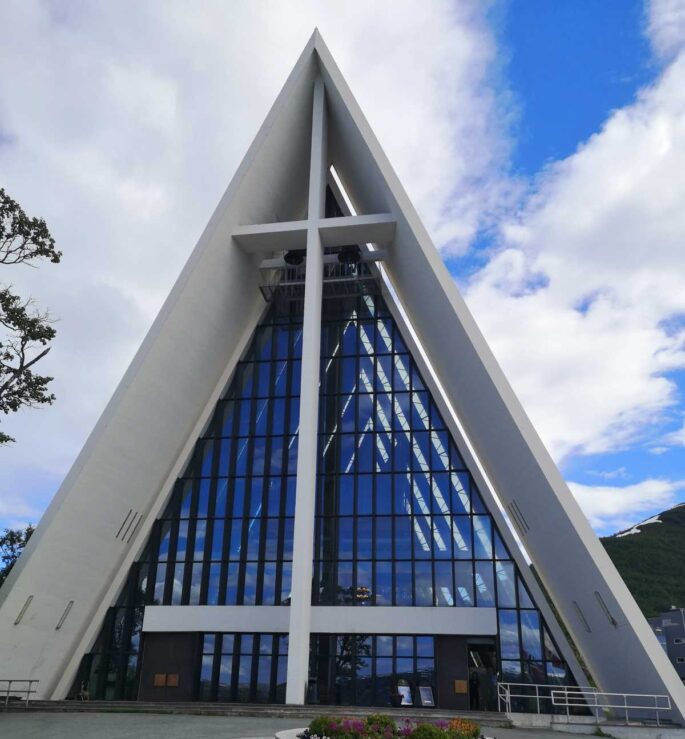
The Arctic Cathedral, Tromsø | Photo: Travel In Culture
From the waterfront, we have a picturesque view of the triangular Arctic Cathedral, or Ishavskatedralen in Norwegian, opposite, at the foot of the mountainside. It is from 1965, designed by the architect Jan Inge Hovig. To reach it, we have to cross the impressive bridge.
We find our way to a local bar, where we have reindeer pizza and the local Mack polar beer from their brewery. The room soon gets filled with Norwegian students and exchange students from the Arctic University of Norway. It is the northernmost university in the world and has, in addition to conventional university studies, a particular focus on regional interests such as auroral light research, fishery science and Sami culture!
Towards midnight, we put on our warmest jumpers and jackets and leave for the waterfront.
Read more about spending 2 days in Tromsø
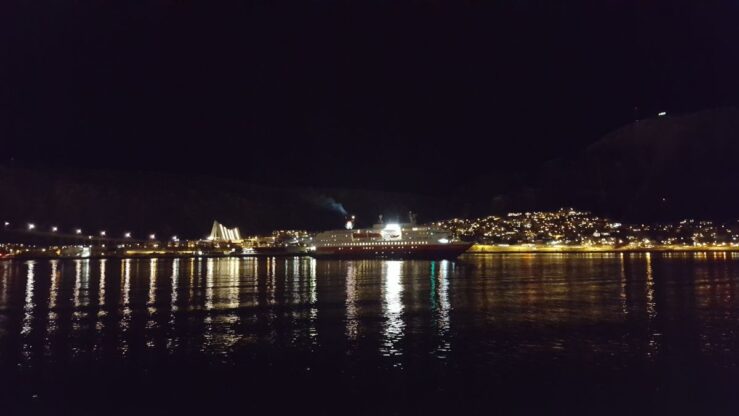
Tromsø, Norway, the Arctic Cathedral and a Hurtigruten cruise ship | Photo: Travel In Culture
The Hurtigruten Cruise Ship
Our Hurtigruten cruise ship, MS Richard With, is due to call at Tromsø at 11:45 p.m. It is cold – less than 5 degrees centigrade – when we patiently wait at the wharf. Strangely enough, there is no building, waiting room, or sign of a Hurtigruten terminal. We just stick to the spot indicated on the map received from Hurtigruten. Three backpackers and a young Norwegian join us in the cold.
Due to the Siberian temperatures, the wait seems infinite. The cold, biting wind justifies our scarves, gloves, hats and appropriate thermal underwear. Eventually, the ship arrives with a delay of half an hour. The view of the ship with all its prism-like lights against the black sky, flanked by the reflection of lights from the houses and the Arctic Cathedral on the other side, is stunning.
On board MS Richard With, we meet, besides the odd group of Asians, mostly European passengers: German, Swiss, French, Spanish, Italian, British, Swedish and, of course, Norwegian travellers.
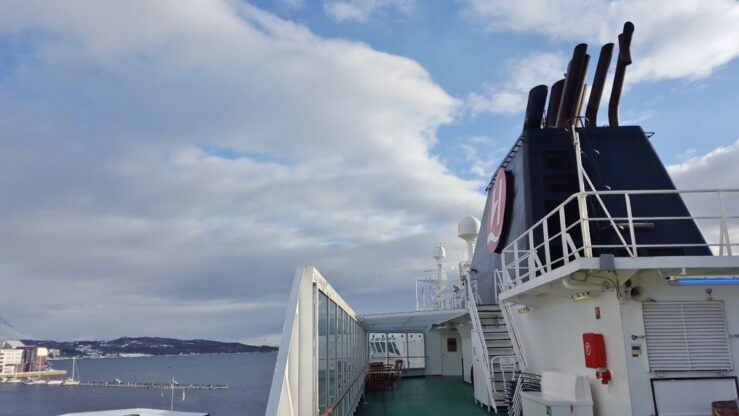
Exploring Norway from a Hurtigruten cruise ship | Photo: Travel In Culture
The ship features an expedition team that gives lectures and organises activities related to the flora, fauna, history and culture along the coast. The team is also in charge of the land-based tours between the ports of call.
Our cabin is relatively spacious and offers fantastic views through the window to the gorgeous mountainsides and sporadic, tiny islands we pass. Sunrise is already at 5 a.m., and the light wakes us up with breathtaking scenery right outside our window.
An irresistible breakfast buffet offers halibut, melon smoothies, Troms yoghurt and other local specialities. We enjoy all of it while watching the picture-postcard snow-covered mountains pass us all close.
For a deeper Arctic experience, read more about visiting Tromsø in winter in Tromsø Northern Lights Guide.
2. Harstad
We call shortly at Harstad on Hinnøya, Norway’s biggest island, to pick up new passengers and have goods and provisions brought on board. A ramp is competently manoeuvred out from the side of the ship so a single car can come ashore.
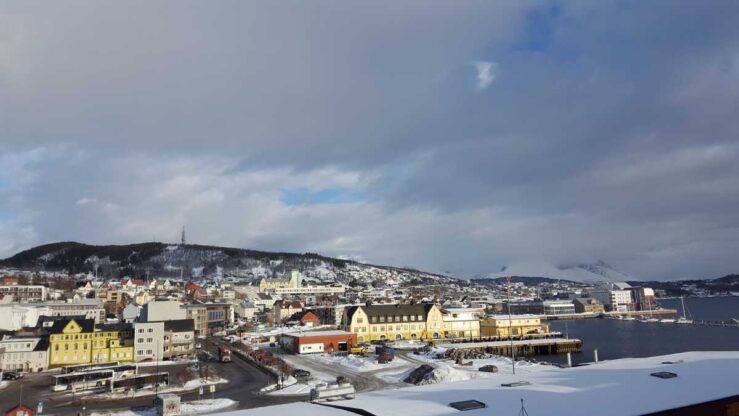
Harstad, Norway – view from our ship | Photo: Travel In Culture
Harstad is one of the most important towns in Northern Norway, surrounded by fertile land for agricultural purposes, and the town features particularly during summer numerous cultural activities, festivals and concerts. Trondenes Church is a remarkable landmark and the northernmost medieval church from the 13th century. The location has also brought considerable findings from both the Bronze Age and the Iron Age, evidence of the presence of these ancient cultures in the area in the past.
There is just time for a walk in central Harstad. We have put on our ‘polar clothing’ and take a refreshing stroll on the white, ice-covered streets. It is a crisp April morning, and the brief visit is an obvious opportunity to get the feel of the place. Five minutes before departure the ship blasts its horn to get everyone on board again.
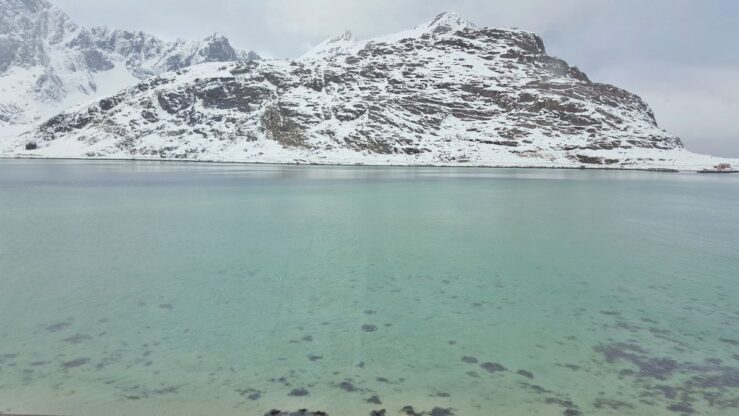
The old coral seabed produces the emerald water | Photo: Travel In Culture
3. Risøyhamn
On deck 7, there is now, weather permitting, an outdoor lecture on the island, Andøya and the small town of Risøyhamn. Simultaneously, we pass through pristine, emerald waters. It is the old coral seabed that is the explanation of the shades of green. Hadn’t we been at these latitudes, I definitely would have fancied a swim in the enticing water! Ignoring the temperatures, it is very inviting indeed! However, even if it is relatively mild at sea here, thanks to the Gulf Stream, it is still too cold in April!
Soon, we arrive at Risøyhamn, where the businessman, politician, ship captain and founder of Hurtigruten in Norway, Richard With, settled and lived part of his life. He had two Hurtigruten ships named after him: the one we are on, MS Richard With from 1993, and SS Richard With from 1909. Another significant person born just 2 kilometres from Risøyhamn, in Bjørnskinn, was the Antarctic explorer Helmer Julius Hanssen, who joined the explorer Roald Amundsen on the ship Fram for the South Pole expedition in 1911.
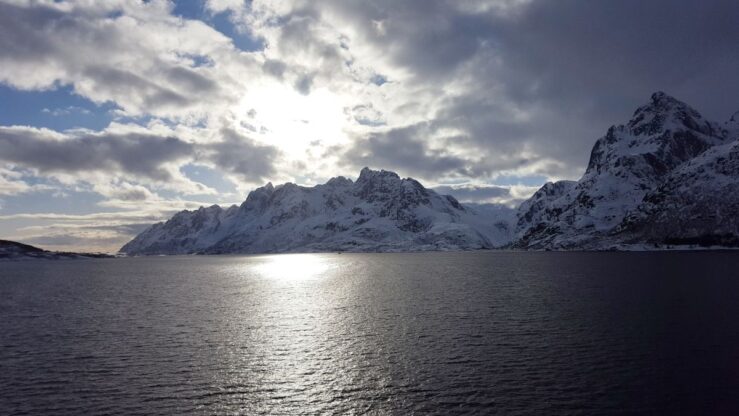
Photo: Travel In Culture
A little bit further to the north is Andenes, a community originally developed around fishing and which became rich in fishing history. Later, it also became an important site for Dutch whaling – after this discipline was introduced by Dutch explorers. They discovered whaling opportunities in the Arctic seas, around the coasts of Northern Norway, Svalbard and Greenland. Today, Andenes still benefits from the presence of the giant animals as a popular whale-watching location featuring year-round whale safaris – in addition to being the perfect location to watch the Northern Lights!
There are many whales in the seas around Northern Norway: humpback whales, killer whales, porpoises, sperm whales, minke whales, orcas etc. I ask about the possibility of whale watching from the ship. It seems that the whales, at the moment, are not as close to the coast as they sometimes are. Nevertheless, precisely the day before we boarded the ship, the passengers were lucky as they had a group of whales well within sight!
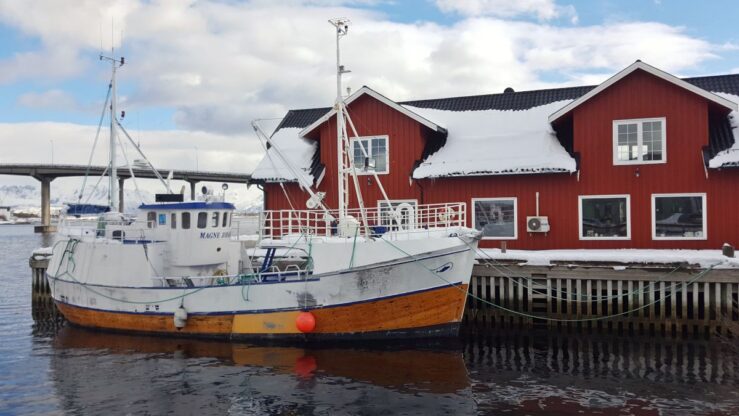
Photo: Travel In Culture
In Risøyhamn, we are among a handful of passengers ready to go ashore when our ship touches the wharf. The calls are not long, and if you want to benefit from the stops and see the places from the shoreside, it sometimes has to be at a brisk pace.
Hardly aboard the ship again, we go directly to our cabin to swap our outdoor outfits for appropriate indoor wear. Changing clothes is a discipline you get to master here since it is required many times during the day at this time of the year! We alternately need indoor and outdoor wear for the meals in the saloon, for unique nature experiences and related activities on deck, for coming ashore when the ship reaches the small ports of call, and then again inside for an enriching lecture or a well-deserved rest in our cabin with an effortless sea or mountain view.
4. Sortland
The next cruise stop is Sortland, the ‘blue’ picturesque coastal town in Norway, which we enjoy from our lunch table on board the Hurtigruten ship.
It is a small community with only around 10,000 inhabitants but yet a thriving town. Artists and locals have used their imagination and painted several houses and other structures in bluish colours.
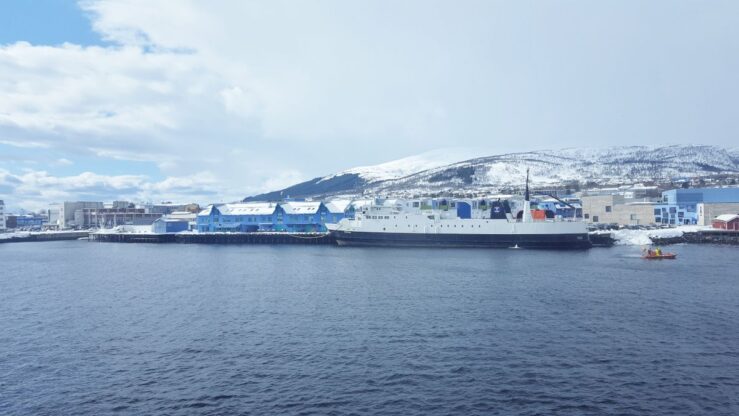
Sortland, the small coastal town with the blue houses | Photo: Travel In Culture
During the night, the crew announces through the speaker if there are suddenly chances to view the Northern Lights. It is fabulous to see it while at sea since the sky is completely dark, and there are no other lights to weaken the visual effects. When still in Northern Norway, the ship is an excellent spot to view the Northern Lights during the cruise!
We even get instructions on board on how to photograph the dancing light to get the most brilliant photos to take home. Of course, you can also opt for a Northern Lights tour on land in the evening if you stay overnight ashore at some time during your trip.
We check every day online what the aurora borealis forecasts are – the chances to view the Northern Lights. Before our trip, we followed the forecasts for the beginning of April. The evenings and the nights start getting lighter now, and the chances are thus smaller than during winter.
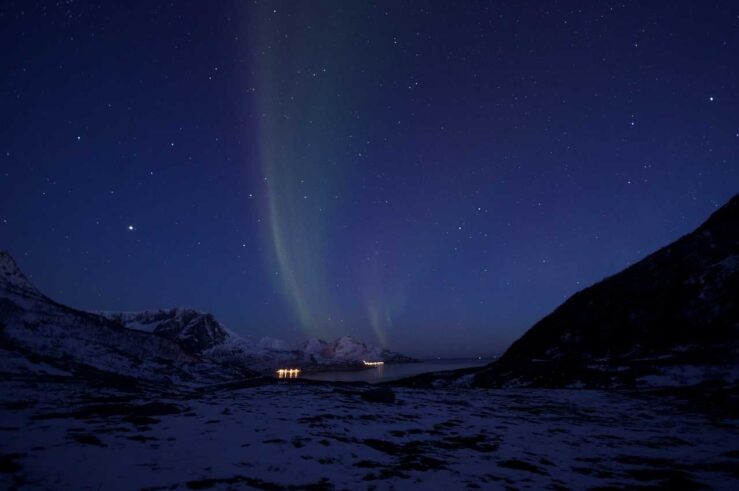
Photo: Rune Brustad-Hanssen / Pixabay
The aurora is caused by the interaction of electrons with neutral atoms in the Earth’s upper atmosphere. The green Northern Lights result from oxygen atoms being excited and subsequently emitting photons and visible light of the wavelength producing green colour when the electrons return to their original position and energy level. That is what creates the green Northern Lights. We are so grateful that we can view this fantastic phenomenon as late as April. The forecast for seeing the Northern Lights during our trip is only about 20%, so we are more than happy!
MS Richard With features gym facilities for those passengers who need exercise beyond the activities ashore. Other amenities on board include a small shop with a selection of Norwegian souvenirs, traditional knitwear, and the explorer team’s information desk. Here, we find all kinds of information related to the itinerary and surroundings, including inspiring tour suggestions.
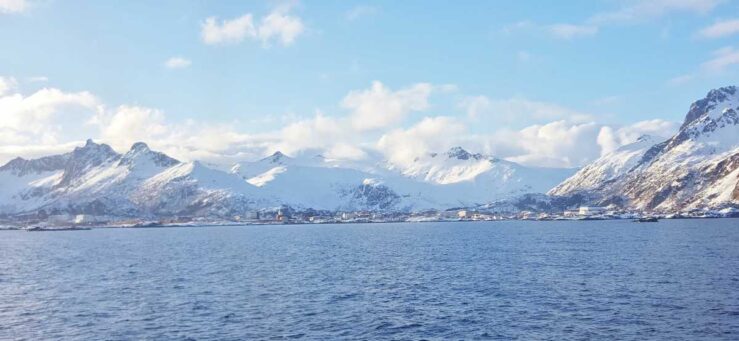
Photo: Travel In Culture
5. Stokmarknes
We are getting ready for the next port of call, the small coastal community, Stokmarknes. Here, we see the oldest Hurtigruten ship, MS Finnmarken, on display as part of the Hurtigruten museum. It served in the Hurtigruten fleet from 1956 until 1993 when it was replaced by precisely MS Richard With! The sun breaks through, and we must walk carefully to evade the meltwater on the streets. That is the first sign of spring we see on our trip!
We are on our way to the chef’s demonstration of salmon filleting on the top deck. His professional approach to handling the fish is nothing but exceptional! Confidently, he separates the skin and the flesh with a single and well-placed cut, taking all of us watching completely aback! Amazingly fast and elegantly, he has filleted the entire fish! As he explains, only the gills are discarded since their taste is not pleasant. Everything else from the salmon is used in the restaurant: head, eyes, skin, among other things, for the delicate fish soup they serve on departure from Bergen. Many Hurtigruten itineraries begin or end in Bergen, a key gateway to Norway’s coastal cruise routes.
The chef offers samples of raw fish and soya-marinated and chili-marinated salmon in the open! It is a blend of absolutely exquisite tastes, and the fish melts in your mouth!
MS Richard With blasts its horn, and all passengers get back on board, ready for the next stage of the voyage.
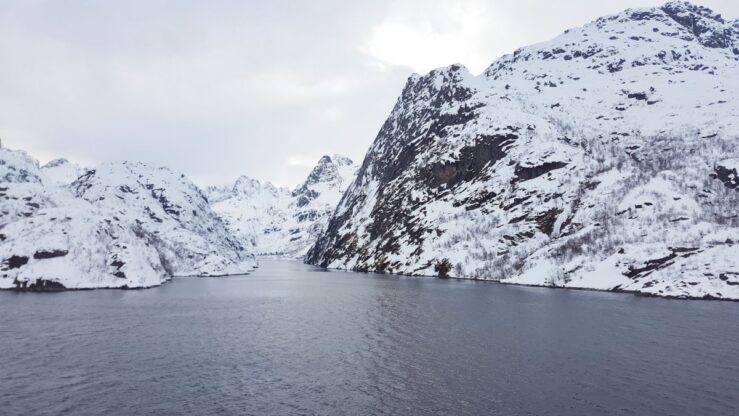
A view into the Trollfjord | Photo: Travel In Culture
6. Trollfjord
From the outset, we have wanted to include Svolvær and the Lofoten archipelago in our southbound route along the West Coast in Norway.
Our Hurtigruten ship is a means of transport for people living in remote coastal areas in Norway and is used as a cruise ship for tourists wishing to get close to the unique Norwegian fjords and awe-inspiring mountains.
We will be entering the breathtaking Trollfjord soon, but before then, a group of passengers will leave the ship to go on a sea eagle safari. I have not been able to figure out how they will set off while still at sea. My attention is now, suddenly, caught by a small vessel catching up, coming all close to our ship.
A deep, distant, roaring sound is now noticeable. From our cabin window, we are baffled to see a gangplank rolled out from the ship side, way above the sea surface! 15-20 passengers, seemingly dressed for the polar climate, step out on the platform, which is then slowly lowered as a lift until it reaches the deck of the small boat! Shortly, the boat detaches from our ship and leaves for awesome nature experiences in the biting cold!
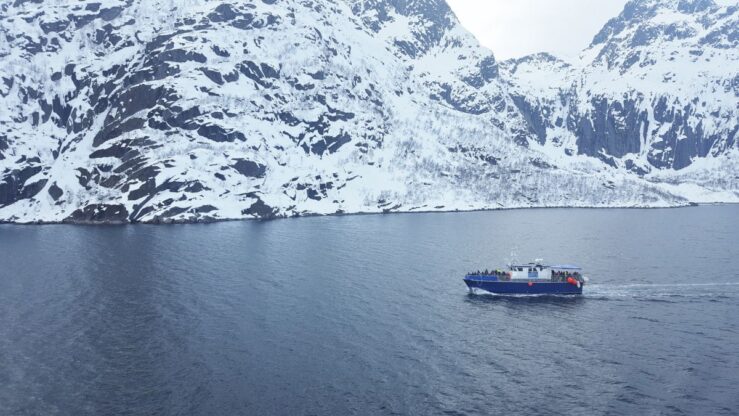
A group of passengers are off for a sea eagle safari | Photo: Travel In Culture
The Trollfjord is the unusually narrow and stunning canyon-like fjord at the Lofoten Islands, and Hurtigruten has on the southbound route in the direction of Svolvær incorporated a tiny detour in between islands and mountainsides for mere sightseeing purposes. The captain competently manoeuvres our huge ship, MS Richard With, around so all cruise passengers can get a remarkable glimpse of one of the top-rated fjords in Norway. At its narrowest point, it is only 100 m (328 ft) wide – at its deepest point, the depth is 60 m (197 ft). Our immense ship navigates around the narrow stretches of the fjord in a nearly surreal way.
7. Svolvær
At 6:30 p.m. we arrive in Svolvær. Although already having very high expectations, the entrance is even more scenic than I had imagined. As MS Richard With enters the Svolvær harbour area, we pass traditional Lofoten racks, which during April abound with fish on ‘hjell’, as they say in Norway.
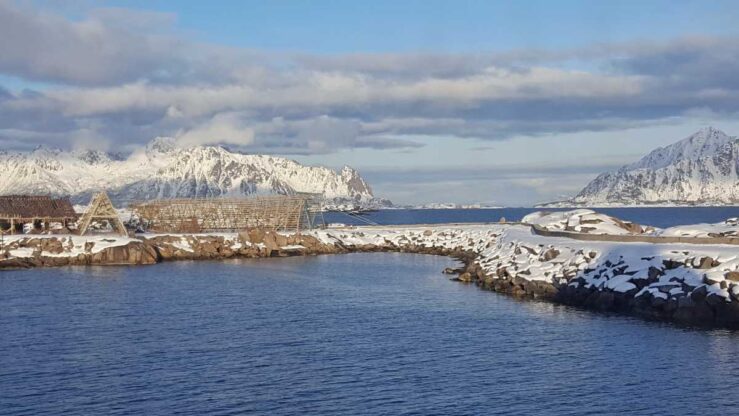
Hurtigruten Svolvær | Photo: Travel In Culture
We have booked a room in the hotel Scandic Vestfjord Lofoten in Svolvær, within walking distance of the harbour. To our delight, our room even has a spectacular view of a couple of fish racks!
All day, we keep an eye on the weather and the weather forecast, particularly the chances of viewing the colour play of the Northern Lights.
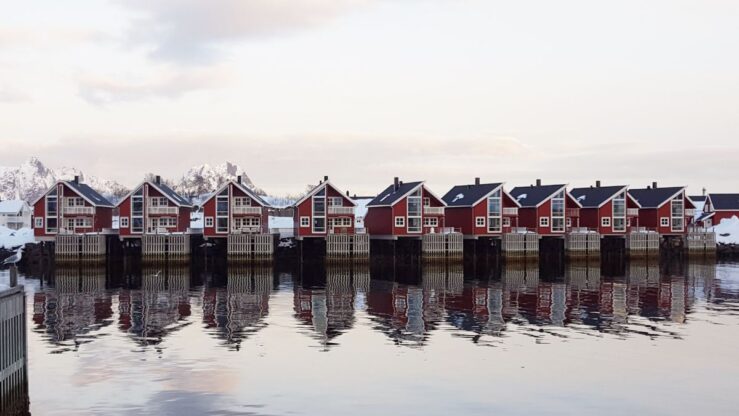
Modern rorbu cabins in Svolvær | Photo: Travel In Culture
In the evening, we treat ourselves to delicious fish cakes from a local place. An hour or two later, I suddenly observe an elongated ‘cloud’ in the dark sky from our room window. Can it be …? We act swiftly, put on our thickest clothes and get out. Then, we see the long, green stripes in the sky and waving lights turning into clear stripes. The night is starry, and we become spectators of a light show of shades of green.
Read more about Svolvær and Lofoten
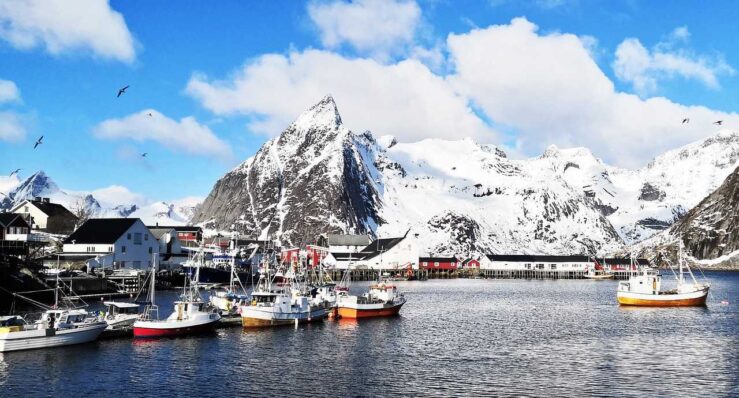
Photo: Narumi 31 / Pixabay
8. Reine
However, Lofoten is unpredictable. The weather abruptly changes when we reach Reine on our road trip across the islands. In beautiful Reine, all among the numerous fish racks, we experience the powerful forces of nature and a genuine snowstorm.
It doesn’t last very long, and it clears up again. South of Flakstad, all of a sudden, we spot an impressive prey bird very high up. It is a sea eagle majestically soaring into view. Its serrated wings remove any doubt that it is a sea eagle. Moments later, we identify another one hardly moving in the air but seemingly using its super eyes to scan the sea for prey.
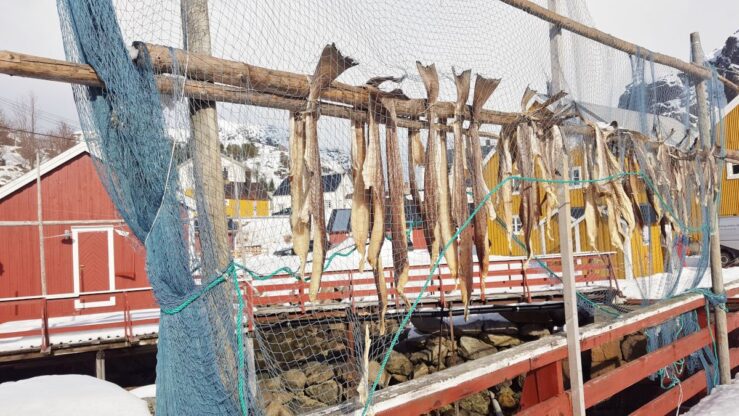
The ubiquitous stockfish in Lofoten | Photo: Travel In Culture.
Filled with impressions from our trip around Lofoten exploring the exceptional stockfish culture, unique in Norway and the world, we return to Svolvær at the end of the day. We go for a walk along the traditional rorbu cabins, today highly reputed accommodation here. If you can stay in a rorbu with a view of the drying cod on ‘hjell’ and the scenic fjord landscape, it just cannot be any better!
The next day, we continue our itinerary at sea. All during our cruise in Norway, it is announced through the loudspeaker when we meet a northbound Hurtigruten ship, and the ship horn duly sounds when passing!
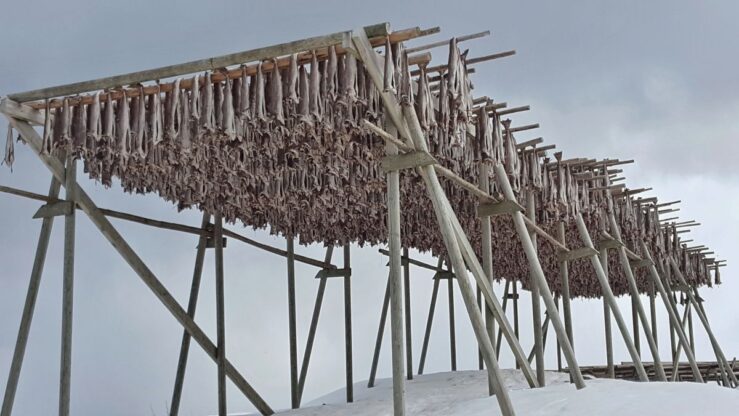
Racks of stockfish | Photo: Travel In Culture
9. Sandnessjøen
The Helgeland Coast (Helgelandskysten) is magnificent, with snowcapped peaks both to the starboard side and the port side since we go inshore between the rocky islands. The Seven Sisters at Sandnessjøen are partly covered in light, white clouds nearly melting together with the mountains.
Sandnessjøen is both a fishing, a shipbuilding and an oil town. The oil and natural gas resources are a welcomed injection into the local communities with the jobs they create.
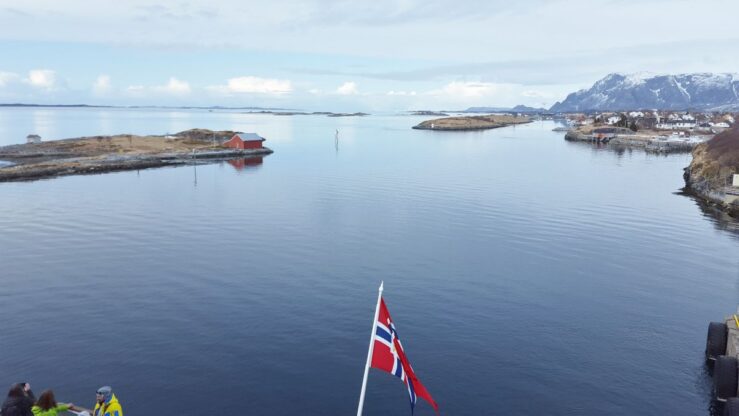
Brønnøysund, Norway – view from our ship | Photo: Travel In Culture
10. Brønnøysund
In Brønnøysund, on the long peninsula, we walk at a brisk pace to reach the small lake full of nimble and chirping birds and the old neogothic church from 1870 with medieval foundations.
Back in the port, we notice a group of people gathering on the wharf. Seemingly, their attention is captured by something in the water. Slowly approaching, we realise that it is a lively otter, which has found its way to the dock. It swims along the ship, under the car tyres attached to the pier. Now and then, it sporadically peeps up before continuing among the visible small fish in the ice-cold seawater.
11. Torghatten
The captain competently navigates between the rocks around Torghatten. It is a spectacular rock with a considerable hole inside, which you can look through! At first, we think we will not be able to see the hole from the cruise ship, but with an appropriate course, the ship is manoeuvred in position, so we get the right angle to discover the phenomenon! From the deck, we get a great view of it and see the light through the hole in the massive rock!
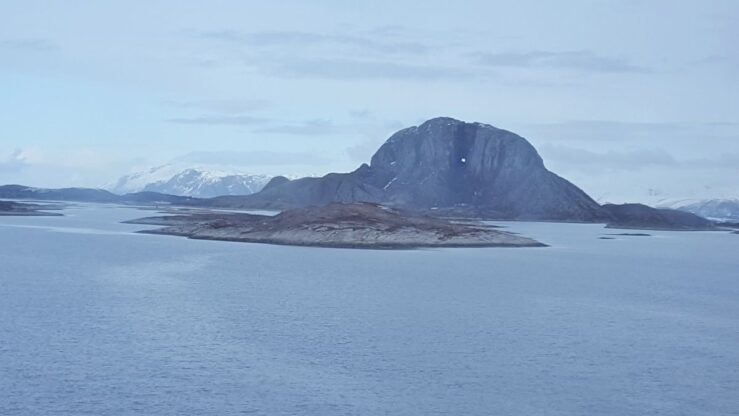
Torghatten | Photo: Travel In Culture
12. Trondheim
After a stop in Rørvik and the final five-course cruise dinner on board the ship, including champagne, as well as specialities like the Lofoten cod and a cloudberry ice cream dessert, the sea voyage in this part of Norway comes to an end for us. The next morning, we disembark from MS Nordnorge at Trondheim Fjord.
Here we just have the time to see the famous Cathedral, which is today a popular northerly pilgrim destination, the scenic old timber buildings on the embankment of the Nidelva River, and the picture-postcard wooden bridge, Gamle Bybro, before continuing to the airport.
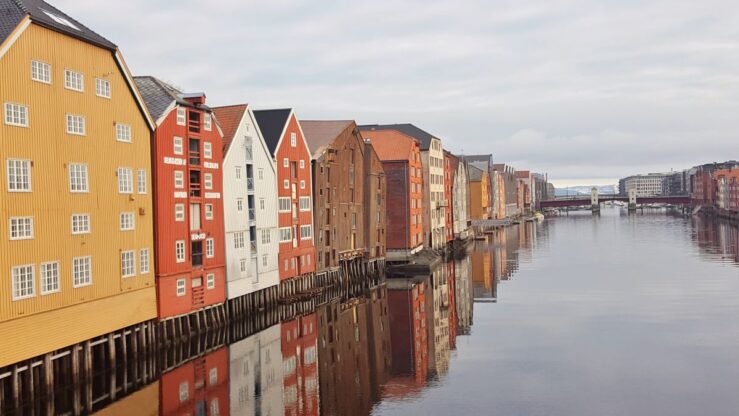
Trondheim, old riverside warehouses | Photo: Travel In Culture
Frequently Asked Questions
What is a Hurtigruten cruise in Norway?
A Hurtigruten voyage is a coastal service that combines passenger transport with tourism along Norway’s west coast, linking towns such as Tromsø, Lofoten, and Trondheim.
How long does the Hurtigruten coastal voyage take?
A full round voyage typically takes around 11 days, while shorter segments between ports can last from a few hours to several days depending on the itinerary.
When is the best time for a Norway coastal cruise?
Summer offers long daylight hours and mild weather, while winter is ideal for northern lights viewing along the Arctic sections of the route.
Can you see the northern lights on a Hurtigruten ship?
Yes, northern Norway sections of the route offer good chances of aurora sightings during clear winter nights, especially between Tromsø and Lofoten.
Which destinations are included on the Hurtigruten route?
Key stops include Tromsø, Harstad, Svolvær in Lofoten, Brønnøysund, and Trondheim, along with many smaller coastal communities.
Is the Hurtigruten cruise suitable for cultural travel?
Yes, the voyage provides direct access to local communities, museums, and coastal traditions, making it ideal for cultural exploration of Norway.
Do you need to book the full voyage?
No, travellers can book shorter segments between selected ports, which offers more flexibility and allows for hotel stays on land.
Read about Trondheim: Exploring 5 Historic Sites in Trondheim
Travellers extending their Norwegian coastal journey can also explore the architectural charm of Ålesund Art Nouveau Town.
Images courtesy of Travel In Culture. Selected images from Pixabay.