


Best Things to Do in Nuuk, Greenland: Attractions & Tours
By ANL | UPDATED:
1. Hans Egede Statue, House & Church
2. Old Nuuk Attractions
3. Greenland National Museum, Nuuk Local Museum, Art & Culture
4. Boardwalk and Memorials
5. Greenlandic Cuisine
6. Ice Fjord Tours & Natural Attractions Around Nuuk
7. Myggedalen
Nuuk, Greenland: Top Things to Do, Attractions and Ice Fjord Tours in the Arctic Capital
Visitors can experience Nuuk ice fjord tours, walk through historic Old Nuuk, and learn how Inuit traditions and modern Greenlandic life coexist. Nuuk sightseeing is compact and highly walkable, making it easy to explore museums, cultural landmarks, and scenic coastal areas in a short stay. This guide highlights the essential Nuuk attractions and experiences for travellers seeking nature, culture, and Arctic adventure in one destination.
How to Visit Nuuk in Greenland
To explore Nuuk, you can either arrive in the capital of Greenland by cruise ship along the spectacular coastline, or fly directly from Copenhagen, Reykjavik, or – on the recently opened route – from Newark in the United States. Alternatively, you can travel via Kangerlussuaq, the main air travel hub for domestic connections within Greenland.
If you want to understand how cultural immersion shapes responsible travel in Greenland, read our guide on cultural travel method and meaningful destination experiences before planning your Nuuk trip.
Where to Stay in Nuuk, Greenland
When staying in Nuuk, it is advisable to book your accommodation well in advance – ideally several months before arriving in Greenland. Since Nuuk Airport opened for international flights, and with the growing interest in both Nuuk and Greenland among international travellers, there can be a shortage of hotel rooms at certain times of the year. If possible, we recommend staying in central Nuuk, as this may offer unique opportunities to observe small icebergs drifting through the fjord – directly from your hotel window – during specific seasons.
Nuuk – Capital of Greenland – Attractions
Already in the taxi from the airport to our centrally located accommodation, we feel welcomed in Nuuk. Our first glimpse of the fjord and the surrounding mountains fully lives up to what we had hoped for.

Picturesque Nuuk and its heritage attractions.
Arriving in Old Nuuk as dusk falls over the city is a picturesque experience. With the statue of Hans Egede and drifting icebergs in the background, we immediately sense that this city belongs in a category of its own, especially for a capital. It feels both accessible and cosy, particularly in the area surrounding the Colonial Harbour.
Nuuk, the capital of Greenland, is a small town with only 20,000 inhabitants. It is therefore easy to explore Nuuk, shaped as it is by Danish influence over the past few centuries, on foot. The blend of Greenlandic cultural heritage and present-day Danish culture gives Nuuk a truly unique character, which is expressed throughout the town.
Photo: Travel In Culture
Summer has arrived in July this year, a marked contrast to last year, when it did not begin until September. Here in early August, we see for ourselves how the people of Nuuk are enjoying the sunny days and temperatures of 10 to 12 degrees Celsius (a pleasantly warm summer according to Greenland standards), with barbecues in front of their houses. In some cases, this even includes wearing shorts and T-shirts!
1. Hans Egede Statue, House & Church
Hans Egede Statue.
In 1728, Nuuk (Godthåb – ‘Good Hope’ – the name reflecting optimism and religious faith) was founded by the arriving Danish-Norwegian missionary, Hans Egede. His goal was to convert Norse settlers to Christianity. However, he found no remaining Norse population – only Inuit people, among whom he began his missionary work. He became known as the Apostle of Greenland, and his mission in Nuuk marked the beginning of Danish-Norwegian colonial presence. Although he also contributed to the preservation of Greenlandic culture, his arrival laid the foundation for later economic and political influence from Denmark.
The Hans Egede House is one of Nuuk’s heritage attractions.
His house still stands in the first row facing the fjord, as one of the preserved historic buildings. Standing by the old red wooden Lutheran cathedral, Nuuk Cathedral (Church of Our Saviour), it is easy to imagine Hans Egede peering from his home toward the Island of Hope, the site of his first mission. His statue gazes across the fjord from the top of the cliff above the cathedral, which was constructed in 1849 and is the only active cathedral in Greenland today.
The Church of Our Saviour (Cathedral).
Nevertheless, in stark contrast to the Lutheran cathedral, the white modern Hans Egede Church, built in 1971 in memory of Hans Egede, stands today as the largest church in Greenland.
Hans Egede Church.
2. Old Nuuk Attractions
The Colonial Harbour is the iconic historical heart of Nuuk, home to some of the city’s main cultural attractions significant to the colonial heritage of Greenland. It was here that Danish colonisation began in the early 1700s with the arrival of Hans Egede.

Photo: Travel In Culture
The attractions include, in addition to the well-preserved Hans Egede House and Nuuk Cathedral, the Greenland National Museum and Archives, the Nuuk Local Museum, as well as old warehouses and colonial-era administrative buildings. The scenic location directly by the waterfront is the icing on the cake – it quite literally draws visitors to this part of Nuuk like a magnet.
For a deeper understanding of Inuit history and Greenland’s cultural foundations, explore Inuit culture and Danish heritage in Greenland to better contextualise Old Nuuk’s historic sites.
Mother of the Sea statue.
Other attractions in Nuuk include the Mother of the Sea statue, located at a small beach at the foot of the Colonial Harbour, an inviting spot for a dip, weather permitting. We are told that every Sunday morning, even during the cold winter months, hardy locals gather here for a refreshing swim in the icy waters of the Labrador Sea. Just a short walk from there lies Brættet, the local open-air market for fish and meat supplied by hunters and fishermen. The fresh catch is sold directly to the community – anything from fish and birds to seal, whale, reindeer, and musk ox.

View in front of Brættet, the local fish and game market.
Upon arrival, the taxi driver told us that the best reindeer hunting is a seven-hour boat journey to the south. Hunting smaller game, on the other hand, only requires having lived in Greenland for two years to obtain a licence.
3. Greenland National Museum, Nuuk Local Museum, Art & Culture
Culture thrives in Nuuk, and the city’s distinctive identity is clearly reflected in its art. Just around the corner from our accommodation, we come across the iconic ‘Loading’ mural, an eye-catching visual representation of Nuuk’s past and present: a colourful settlement surrounded by snow-covered mountains, gradually transforming into an urban setting.
In addition to cultural attractions such as murals, craft shops, and local artisans, you will also find more established institutions such as the Nuuk Art Museum, the largest and most prominent art museum in Greenland. This fascinating museum portrays Nuuk’s identity and development through both Inuit and Danish art, spanning contemporary as well as older works.

Greenland National Museum and Archives in Nuuk.
A genuinely interesting museum for Greenlandic culture is the Greenland National Museum and Archives. A visit to the museum is one of the top cultural things to do in Nuuk for those with an interest in history. It houses, among other things, the famous Qilakitsoq mummies found in the Arctic and exhibits many prehistoric and Inuit artefacts, including clothing and tools found around Nuuk and other sites in Greenland. Through its exhibitions, the history of Nuuk and Greenland is brought to life – from ancient Inuit culture through colonisation to modern self-rule.

Nuutoqaa, the local museum.
Nuuk Local Museum has a particular focus on Nuuk’s social history, offering local urban perspectives. Standing by the waterfront, you can enjoy a beautiful view of these two history museums, which are an integral part of Old Nuuk.
Katuaq, the architecturally inspiring Cultural Centre, designed by Schmidt Hammer Lassen and inaugurated in 1997, serves as a modern gathering place for Greenlandic culture.
Katuaq, Nuuk Cultural Centre is one of the cultural attractions in the city.
The curved lines of the Cultural Centre symbolise the flickering northern lights in the sky, and it hosts concerts, cultural events, exhibitions, and films – while also being a popular meeting place for locals.
4. Boardwalk and Memorials
Coastal boardwalk.
A relatively recent addition to the city’s waterfront is the Nuuk Boardwalk, which was initiated in 2020. The scenic route, crafted by local artisans, adds an extra sense of connection with nature along the coast through its opportunities for leisurely walks. Strolling along it offers a unique chance to experience Nuuk from a different perspective – even at night, when it is beautifully illuminated. It seems to be the perfect spot to catch a glimpse of the northern lights when the opportunity arises!
A tribute to Queen Margrethe II and Prince Henrik atop Radiofjellet.
With our Danish background, we are also keen to explore some of Nuuk’s many royal memorials. These include tributes to King Frederik IX and Queen Ingrid, as well as to Queen Margrethe II and Prince Henrik – the latter’s memorial situated atop Radiofjellet, offering a sweeping view over the city and seascape.
Memorial stone commemorating the visit by King Christian X and Queen Alexandrine in 1921.
5. Greenlandic Cuisine
After a day of active sightseeing, we look forward to some culinary delights in Nuuk. Inspired by the wild game at Brættet – although we are not quite brave enough to buy any ourselves there – we instead head into the modern Nuuk Centre, where both the Danish ‘Brugseni’ and the local supermarket Pisiffik are located.
Pisiffik’s fish counters
Particularly, Pisiffik is ideal for finding local specialities (which have generally undergone standard food safety checks). Here, we discover intriguing local ingredients, including halibut, lumpfish roe, lamb roulade sausage, musk ox sausage, and reindeer cutlets – to prepare our dinner back at our apartment.
Photo: Travel In Culture
Of course, we could also have visited one of the city’s local restaurants for a refined taste of Greenlandic caribou, reindeer, seafood, seal, or mattak (whale skin and blubber)!
6. Ice Fjord Tours and Natural Attractions Around Nuuk
Now comes the highlight of our stay in Nuuk: a guided boat tour that takes us deep into the Nuuk Ice Fjord to behold stunning natural attractions – undoubtedly one of the top things to do in the area. The season is perfect for a spectacular journey among small drifting icebergs that have broken off from the Narsap Sermia glacier. In early August, these striking blocks of ice drift all the way to the outer reaches of the fjord near Nuuk, creating an unforgettable Arctic seascape.
Boat tour in the Nuuk Fjord to explore ice fjord attractions.
Our Greenlandic skipper steers the motorboat with skill and confidence as we make our way into the fjord, weaving in slalom-like fashion between blocks of ice in every imaginable shade of blue and white. He explains that the boat is reinforced with several layers of fibreglass and other materials – just in case we were to strike a submerged iceberg. While the white icebergs typically have 90 percent of their mass below the waterline, the blue ones have as much as 95 percent due to their higher density. And then there is ‘black ice’ – those completely solid, crystal-clear blocks that sit just at the surface and appear dark against the water, hence the name.

Photo: Travel In Culture
To our surprise, our guide ‘catches’ a piece of this black ice and chisels it at the bow of the boat into small, inviting chunks perfect for an authentic ice fjord-whiskey on the rocks!

Whiskey on the rocks in Nuuk Ice Fjord.
There is the chance to encounter fascinating wildlife in the fjord – from sea eagles to seals and whales. The latter, however, have now moved further south, but in spring they were able to recognise a beluga whale by the distinctive markings on its tail from previous visits. These whales had actually been declared extinct around Nuuk about a century ago!

Qoornoq.
Shortly afterwards, we pass over the deepest point in this arm of the fjord – 614 metres down. We then sail past the abandoned settlement of Qoornoq, which today is used for leisure visits and summer stays, despite having been officially abandoned in 1972. Archaeological traces go all the way back to Inuit cultures, but in more recent times, the settlement was inhabited by fishermen in the 19th century.
Many of the original buildings are still preserved: the school, the church, fishermen’s houses, an old fish factory once part of the fish processing industry, as well as cranes and winches used for hauling boats ashore. As a curious anecdote, the skipper tells us that a polar bear was spotted here last year, a sighting that led to a surge in visitors, even though the authorities advised against going ashore!
Photo: Travel In Culture
Nuuk Fjord, Greenland.
After around two hours, we suddenly reach as far into the fjord as it is possible to go at this time – a wide belt of pack ice appears before us. The skipper cuts the engine and explains that the conditions vary greatly from day to day. Just two days earlier, the pack ice had apparently shifted much further towards the open sea, and they had only been able to travel half as far into the fjord from Nuuk. In the distance, we catch a glimpse of the ice cap, lying like a massive backdrop beyond the fjord.

Pack ice in the fjord.
The skipper tells us that he has only once encountered real difficulty with tourists on board, when the boat became surrounded by pack ice in the fjord. He had to climb onto the roof of the vessel to get a sense of their position. They were not rescued until the following morning, when an icebreaker arrived to free them!
After we turn around, the skies suddenly clear, and as we cruise into another arm of the fjord, we are treated to the most fabulous sunshine.
Iceberg in the inner fjord.
There are generally only a few scattered cabins along the coast. Greenlanders are not allowed to own land and must apply for permission to build a hut. Even that is a considerable undertaking, as it can take two to three years to acquire all the necessary materials – most of which must be brought in by boat, primarily during the summer months.
One of the other fascinating attractions on the boat tour from Nuuk is a soaring bird cliff, rising 1,200 metres above sea level.
Ice fjord experiences in Nuuk can be combined with broader Arctic travel routes, such as connections through Iceland and Norway, as explained in Tromsø Itinerary 2 Days: Northern Lights, Fjords and Arctic Attractions.
Bird cliff.
Ice fjord boat tour.
We cruise close to the rock face to observe the impressive variety of birdlife nesting along the cliffs. Around the far side, where the terrain flattens slightly, our guide suddenly jumps ashore to gather local plants and herbs. The tour also includes a culinary surprise – we are offered Greenlandic rhubarb and wild salad greens, unlike anything we have tasted before. The rhubarb is prepared on deck with sugar and passed around!

Greenlandic rhubarb and salad.
Our local guide explains that Nuuk, with its natural and cultural attractions, has recently become incredibly popular – not only among Danes but also with Americans, South Africans, and tourists from Dubai. She herself is studying at the University of Nuuk (the only one in Greenland), which she says offers just under ten fields of study, and is specialising in tourism and languages.

Photo: Travel In Culture
On the way back, we also pass the impressive Sermitsiaq Waterfall, which flows from the Sermitsiaq Glacier on Sadelø, before we glide into Nuuk Harbour once more, filled with impressions from a spectacular trip that exceeded all our expectations!
The Sermitsiaq Glacier and waterfall.
Other nature attractions and things to do from Nuuk include puffin and whale-watching tours, visits to the abandoned settlement of Qoornoq or the still-functioning small community of Kapisillit, deep-sea fishing, and hiking on the ice sheet or in the hinterland around Nuuk, such as near the waterfalls at Sadelø. Boats and water taxis for these destinations typically depart from the Tidewater Steps in Nuuk. For the more adventurous, there is also the option to paddleboard among the icebergs in the fjord or to explore kayaking.
Photo: Travel In Culture
7. Myggedalen
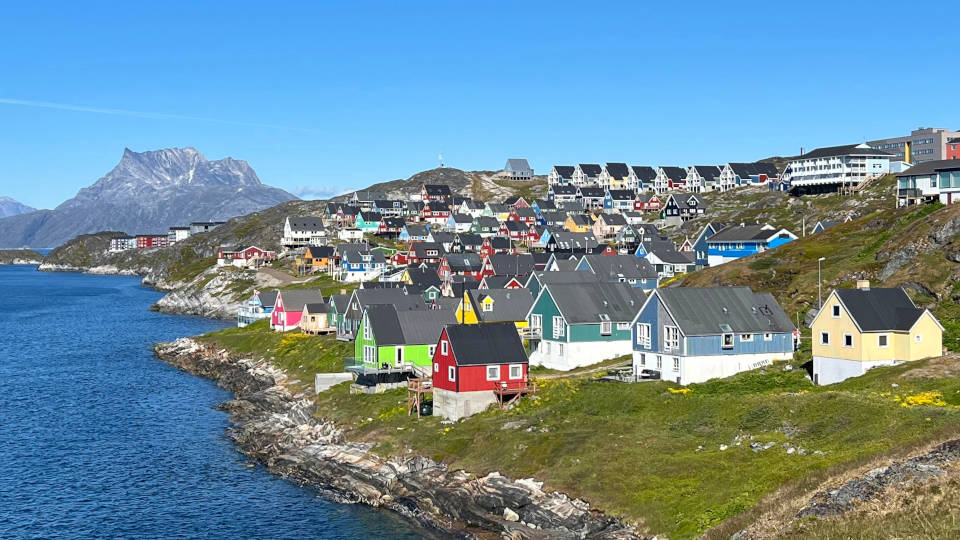
End your day at Myggedalen – or arrive in the late afternoon for the most iconic photo opportunities. This picturesque spot, framed by traditional colourful Greenlandic houses, is a famous viewpoint popular with many Instagrammers.
Myggedalen viewpoint.
Frequently Asked Questions
What is Nuuk best known for?
Nuuk is best known for its Arctic scenery, Inuit culture, and colonial heritage, combined with modern Greenlandic life. It is also a gateway to ice fjord tours and wildlife experiences.
How many days do you need in Nuuk?
Most visitors need two to four days to explore Nuuk attractions, museums, and nearby fjord tours. Longer stays allow deeper exploration of surrounding nature.
What are the top attractions in Nuuk?
Top attractions include the Colonial Harbour, Greenland National Museum, Nuuk Art Museum, and the Hans Egede landmarks. Ice fjord boat tours are also a major highlight.
Can you see icebergs near Nuuk?
Yes, icebergs are often visible in the fjord surrounding Nuuk, especially during warmer months. Boat tours offer the best views of drifting ice formations.
What cultural experiences can you have in Nuuk?
Visitors can experience Inuit traditions, local markets, Greenlandic cuisine, and museums showcasing Arctic history. Cultural centres also host exhibitions and events.
Is Nuuk easy to explore for visitors?
Nuuk is compact and walkable, making it easy to explore key attractions on foot. Some natural sites and fjords require guided tours or boat transport.
When is the best time to visit Nuuk?
The best time to visit Nuuk is during summer, from June to September, when temperatures are milder and boat tours operate regularly. Winter offers northern lights experiences.
Other cultural attractions and things to do in Nuuk include, for example, the Nuussuaq neighbourhood, offering an authentic local experience, and the architecturally striking public swimming pool Malik (Malik means ‘wave’), which, with its wave-shaped design, is beautifully integrated into the surrounding sea and landscape.
For inspiration on what to explore in Greenland, you may want to read our guide: Visit Greenland: Discover the Cultural Heritage
Read next: Iconic Glendalough Monastery in the Wicklow Mountains, Ireland and Flensburg: West Indian Trade, Historic Ships & Sightseeing
