


Tivoli Gardens Copenhagen: Historic Amusement Park Guide
By ANL | UPDATED:
1. Tivoli Gardens’ History
2. The Garden Setting and Music Scene
3. What Not to Miss in Tivoli
4. The Tivoli Seasons – Christmas
5. Where to Stay near Tivoli
Tivoli Gardens Copenhagen is a historic amusement park and cultural landmark located beside Copenhagen Central Station. Founded in 1843, Tivoli blends nostalgic charm with modern attractions, making it one of the most popular things to do in Copenhagen for families, couples and culture lovers alike.
Visitors can enjoy traditional wooden roller coasters, illuminated gardens, concerts, theatre performances and seasonal celebrations ranging from summer fireworks to Tivoli Christmas. Beyond the rides, Tivoli Gardens is famous for its elegant landscaping, lakeside scenery, restaurants and rich cultural history connected to Danish music, theatre and fairy tales. Whether you visit for the thrilling attractions, the festive atmosphere or the historic setting, Tivoli remains one of Copenhagen’s most iconic and unforgettable experiences. Travellers interested in discovering authentic local culture and historic attractions may also enjoy this guide to cultural travel.
The Tivoli Gardens in Copenhagen is a world-famous amusement park full of traditions, original ambience and historical elements – and, at the same time, a modern amusement park with top attractions, a venue for live performances, diverting activities for all ages and awesome rides that adapt to current trends and constantly undergo renewals to meet the visitors’ demands.

The Nimb Hotel inside Tivoli Gardens Copenhagen | Photo: Travel In Culture
Why was Tivoli Gardens important to the Danes of Copenhagen? The spectacular Tivoli Gardens was founded by Georg Carstensen (1812-1857) in 1843. At first, the amusement park was named Tivoli & Vauxhall. It soon became a blossoming flower park featuring enticing attractions, musical events and other popular entertainment, and favoured restaurants to complete the Tivoli experience.
It was none other than the Danish King Christian VIII (1839-1848) who provided Georg Carstensen with the necessary license to found the amusement park on a suitable piece of land right at Vesterport in Copenhagen.
The traditional roller coaster is still in operation, Tivoli Gardens Denmark.
A wooden roller coaster was introduced that same year, and it soon became a great success! It was replaced by a new one in 1914, and this is remarkably the very same roller coaster being in operation today!
The oldest building parts that still exist are the iconic main entrance portal at Vesterbrogade and the outstanding Pantomime Theatre, dating from 1874. Traditional characters who play at this small theatre include Pierrot, Harlequin and Columbine.
The Pantomime Theatre, Tivoli Denmark.
Another iconic element in Tivoli is the Pierrot statue from 1896, sculptured by Aksel Hansen. It commemorates the first human Pierrot, Niels Henrik Volkersen, who played the Pierrot part at the Pantomime Theatre from 1843 until 1893. Today, the monument is a preferred meeting point inside the Tivoli Gardens.
Also, the Tivoli Boys Guard, dating back to 1844, is an iconic feature in the Copenhagen amusement park.
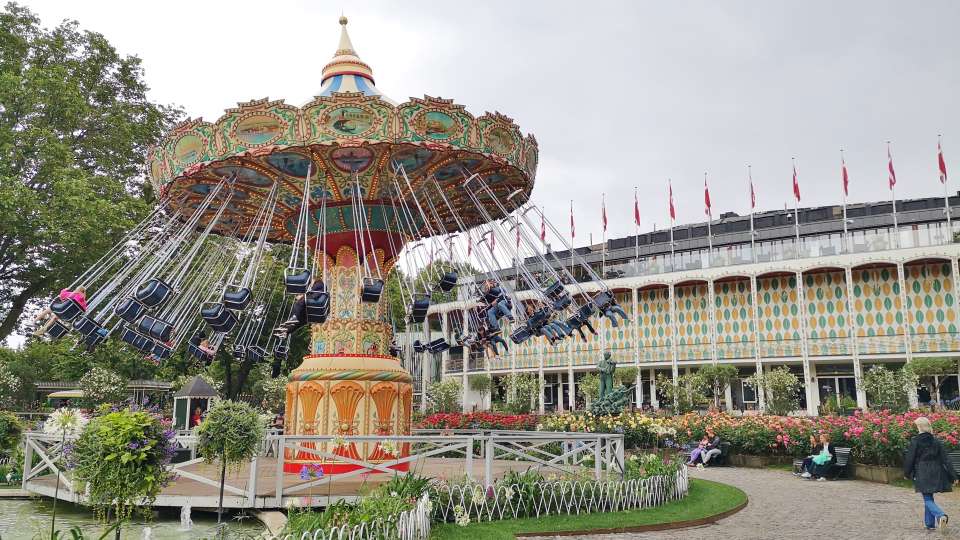
There is no doubt that the Tivoli amusement park is much more than attractions, exhilarating rides, and dining places. Tivoli is also the place in Copenhagen where you will stroll in the picturesque gardens to enjoy the flowers, the fountains and even a boat ride on the Tivoli Lake.
The Tivoli Garden is a nearly magical garden characterised by decorative flower arrangements, small fountains, and, not least, thousands of lights enchanting the park as darkness falls. An absolute highlight is the Tivoli Lake illuminated at night – with the midnight fireworks as the icing on the cake!
The lovely Tivoli Lake | Photo: Travel In Culture
Scenic water arrangements appear in several parts of the park. One of the most eye-catching and iconic fountain setups is the fountain in front of the Tivoli Concert Hall (dating from 1956).
The idyllic setting everywhere in Tivoli emphasises the fairy-tale elements and Tivoli’s historical background from a time when artistic entertainment became a public and very popular thing in Copenhagen.
Take a ride around Tivoli Copenhagen | Photo: Travel In Culture
Still today, Tivoli contributes considerably to Copenhagen’s music and theatre scene, brimming with rock, jazz, classical dance, ballet and theatre performances.
First and foremost, hop on the old roller coaster from 1914. It is among the oldest roller coasters in the world and is one of the most popular rides in the amusement park.
The traditional Chinese-style Pantomime Theatre has a decorative peacock tail serving as a curtain which folds to each side like a fan. It is, therefore, also known as the Chinese Peacock Theatre, erected in 1874 by the architect Vilhelm Dahlerup. Do include watching a performance here during your Tivoli visit!
The Pierrot statue, which you will most likely pass several times when strolling around the gardens, is unique. Use it as a meeting point, which is easy to locate amongst the many attractions.

The Ferris Wheel from where you can enjoy glimpses of Copenhagen city | Photo: Travel In Culture
When looking for panoramic views of the city, jump on the Ferris Wheel, Ballongyngen, where you, from the cabin positioned at the very top, will be able to enjoy scenic views of the Copenhagen cityscape.
The Flying Trunk, Den Flyvende Kuffert, having Hans Christian Andersen and his fairy tales as a theme, is a gem of a fairy-tale world. Discover over 30 of the author’s world-famous fairy-tale universes during the ride. By the way Hans Christian Andersen found inspiration here in Tivoli to write the fairy tale The Nightingale. You can learn more about the famous Danish author in this article about Hans Christian Andersen in Odense.

Den Flyvende Kuffert – The Flying Trunk | Photo: Travel In Culture
When hungry, head for one of the iconic restaurants such as The Chinese Tower, the Nimb Hotel and Restaurant, the Brdr. Price restaurant, or Grøften – where you may want to try some Danish open sandwiches ‘smørrebrød’.
If you have young children, a must-do is the Classic Carousel, where you can ride on an elephant or a giraffe. And if you are a bit older, one of Europe’s highest carousels, The Star Flyer from 2006, is a fun experience which swings you thrillingly around 80 metres above the ground!
If you are up to a wild ride, The Demon will be another good option – it is not for the fainthearted!
Of course, there is so much more: the Bumper Cars, the Vintage Cars, the Galley Ships, the Milky Way Express, the Mine, the Dragon Boats on the Tivoli Lake etc.
The Tivoli park Copenhagen by night – concert on Plænen.
In the evening, attend a concert or other event on Plænen, the central open-air stage in Tivoli. The open-air performances are popular, and you should arrive early to ensure a chair on the lawn. During the last decades, the popular Friday Rock has been tremendously successful here.
Finally, watch the nocturnal Tivoli fireworks – a spectacular show in the sky above Copenhagen city.
The summer season in Tivoli is between April and September. Nevertheless, Tivoli now operates with four seasons. In recent years, Tivoli has added an Easter season in spring, a Halloween season in October and November, and a Christmas season in November and December.
The Copenhagen Tivoli Park at Christmas | Photo: Travel In Culture
The Tivoli Park is a unique experience in Copenhagen around Christmas when it is transformed into a Christmas theme park with a cosy Christmas market. That includes an encounter with ‘Father Christmas’ at the Pantomime Theatre and ‘The Snow Queen’ at the Tivoli Concert Hall.
Moreover, there are many entertaining events, concerts, performances, workshops, gift shops, and a wide variety of enticing restaurants with a Christmas-like atmosphere around the long-established garden. It is the perfect place to get a taste of Christmas in Copenhagen! Many visitors combine Tivoli with nearby attractions featured in this guide to 3 days in Copenhagen.
Frequently Asked Questions about Tivoli Gardens in Copenhagen
Where is Tivoli Gardens located?
Tivoli Gardens is located in central Copenhagen beside Copenhagen Central Station and close to City Hall Square.
When did Tivoli Gardens open?
Tivoli Gardens opened in 1843 and is one of the oldest amusement parks in the world still operating today.
What are the most popular rides in Tivoli Gardens?
Popular attractions include the historic wooden roller coaster from 1914, The Demon roller coaster, the Star Flyer and the Ferris Wheel.
Is Tivoli Gardens suitable for children?
Yes, Tivoli offers rides, playgrounds, carousels and performances suitable for both young children and teenagers.
How much time do you need in Tivoli Gardens?
Most visitors spend between three and six hours in Tivoli, although many stay longer during concerts, evening events or seasonal celebrations.
When is the best time to visit Tivoli Gardens?
Summer is ideal for rides and outdoor concerts, while Christmas is especially popular for festive lights, markets and decorations.
Does Tivoli Gardens have concerts and live performances?
Yes, Tivoli regularly hosts concerts, ballet, theatre, pantomime performances and the famous Friday Rock events.
Can you visit Tivoli Gardens at Christmas?
Yes, Tivoli transforms into a Christmas-themed park with festive lights, Christmas markets, seasonal food and holiday entertainment.
Are there restaurants inside Tivoli Gardens?
Tivoli has a large selection of restaurants, cafés and food stalls ranging from Danish smørrebrød to fine dining experiences.
Is Tivoli Gardens worth visiting in Copenhagen?
Tivoli is considered one of Copenhagen’s top attractions thanks to its historic atmosphere, gardens, rides and cultural entertainment.
Read next: The Secrets of Frederiksberg Gardens and Climb the Cliffs of Møn
Find useful travel gear: Travel Essentials
Accommodation / Tours: Check Hotels, Tours & Activities
