


3-Day Crete Itinerary: Heraklion, Knossos Palace & Archanes
By ANL | UPDATED:
This 3-day Crete itinerary is designed for travellers who want to experience the island’s rich history, archaeology and living traditions. Combining Heraklion, Knossos Palace and Archanes, it brings together some of the most important cultural attractions in Crete within an easy and rewarding route.
Over three days, you will explore Venetian fortifications, world-class museums, the legendary Palace of Knossos, and one of Crete’s most charming mountain villages. Along the way, you will encounter Minoan heritage, local food traditions, scenic landscapes and authentic Cretan culture. If you are searching for things to do in Heraklion, cultural things to do in Crete, or a well-balanced itinerary that combines history and local character, this guide offers an ideal introduction to historic Crete.
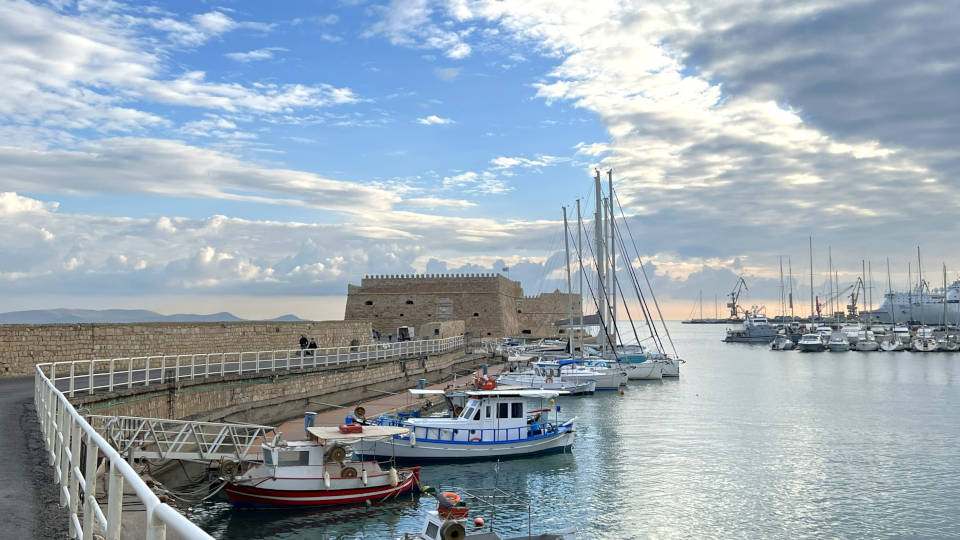
If you want to stay close to Heraklion’s cultural sights and the Venetian fortress of Koules, you might consider the Kronos Hotel, which we found very convenient for a stroll along the pier both in the morning and in the evening – each offering a fascinatingly different experience. In Archanes, you might consider the Carpe Diem Hotel.
What to See in Heraklion: Top Things to Do in Historic Eastern Crete
If you are seeking the cultural soul of Crete, this thoughtfully crafted three-day journey through Heraklion, Knossos and Archanes may offer just the inspiration you need. Drawing on our own visit, this itinerary gives you the chance to wander through ancient Minoan ruins, lively markets and villages full of local character, where tradition is very much alive.

Photo: Travel In Culture
From the legendary Knossos Palace to walking trails overlooking vineyards, olive groves, and the scenic Cretan landscape, each day reveals a different side of the island’s heritage. If you are drawn to Crete’s rich past and vibrant culture, this itinerary offers an immersive introduction to authentic island life. Carefully planned to explore the most rewarding cultural experiences, it brings together the best things to do in Heraklion and beyond, with a focus on Crete’s most iconic historic sites.
For readers interested in exploring destinations through history, architecture and local traditions, our cultural travel method explains the approach behind our itineraries and travel guides.
Day 1 of Crete Itinerary: Heraklion’s Cultural Sights

The Venetian fortress.
Arriving in Heraklion, we are eager to explore a city shaped by many eras. The calm sea and fishing boats lie on one side of the harbour walls, while the centuries-old Venetian fortress of Koules rises on the other. It feels as though modern Heraklion meets another age. The boats rock gently below, and we pause to watch men mending their nets and selling the morning’s catch along the pier.

The Venetian fortress of Koules
Walking through the arched entrance of the fortress, we sense the weight of centuries in its cool, vaulted passages. Built by the Venetians after their conquest of Crete in 1211, it once defended what was then Candia, one of the most important ports in the eastern Mediterranean. From the top level, we look across the harbour towards the historic Venetian docks, once alive with ships trading olive oil, wine and grain. Inside, Rhodian amphorae recovered from shipwrecks evoke the city’s long maritime past. At the same time, the massive bastions hint at the Ottoman occupation that followed Venice’s fall in 1669.
The centuries-old Venetian fortress of Koules.
Standing on the ramparts, it becomes clear how deeply Heraklion’s story is bound to this fortress and its harbour. Ottoman rule also left its mark on the city, as the Ottomans made changes to both the Venetian walls and gates, such as St George’s Gate (Agios Georgios) and Porta Guora.

Archaeological Museum of Heraklion.
The itinerary then continues to the Archaeological Museum of Heraklion to explore Crete’s oldest history, the world the Minoans created. Frescoes, jewellery and pottery fragments tell the story of Knossos Palace and the ancient civilisation of Crete we will delve deeper into tomorrow at Knossos. As one of the most important cultural things to do in Crete, the museum offers a compelling introduction to historic Crete through the Knossos Palace, Phaistos, and other excavations.
Morosini Fountain.
From there, we wander through the heart of the city: Lions Square, home to the ornate Morosini Fountain, built by the Venetians in the early 17th century. Passing the Venetian Loggia, once an important meeting place for nobles and merchants and now serving as the city hall, the Loggia’s elegant arches reveal just how significant Heraklion once was as a centre of Venetian power and culture.
The Venetian Loggia.
The Greek Orthodox Church of Saint Titus is another must-see on the Heraklion itinerary, a reminder that Heraklion is not only a modern capital of Crete but also a city layered with different faiths throughout its history.
When hunger strikes, it feels natural to stop around 1866 Street Market, where the scent of grilled meat and herbs fills the air around the small tavernas.

Photo: Travel In Culture.
The street’s lively mix of market stalls filled with herbs, olives and handmade goods is a reminder that traditional market culture still thrives in Heraklion, making a visit here one of the most characterful things to do in the city.
The Historical Museum of Crete, which spans the Byzantine to modern eras and highlights the island’s rich cultural heritage, could be included in the Day 1 itinerary, although it might be better saved for an additional day.

The Venetian Harbour in Heraklion, Crete.
As evening falls, one of the most unforgettable views that captures Crete’s cultural heart is the Venetian harbour. Heraklion reveals itself not only as a gateway to Crete’s most famous cultural sites but also as a vibrant city in its own right. Strolling along the walls overlooking the Venetian port, among locals and visitors alike, remains one of the most atmospheric experiences in Heraklion.
Day 2: Knossos Palace & Archanes Village
Knossos Palace excavations, Crete
Day 2 is devoted to ancient history and Cretan tradition. Early in the morning, we set out for Knossos Palace, one of the most important cultural sites in Crete and a key stop on any Crete itinerary. Arriving as the gates open means we have the site almost to ourselves. Although the sun is still behind the mountains, the ruins soon catch the first rays of the day and appear at their most beautiful.
Knossos Palace, Crete.
Exploring the Palace of Knossos, once the ceremonial and political heart of the Minoan civilisation, feels like stepping into the earliest chapter of historic Crete. The reconstructed frescoes and throne room bring the past vividly to life. Knossos’s labyrinthine layout recalls the legend of the Minotaur. Recognising that these spaces once housed the artefacts now admired in the Archaeological Museum of Heraklion adds an extra dimension of interest. Exploring Knossos is one of the unmissable cultural things to do in Crete, offering a fascinating glimpse into the island’s ancient past.
Visitors interested in the wider story of ancient Greece may also enjoy exploring the Oracle of Delphi, one of the most important religious sites of the ancient Greek world.

Knossos Palace, Crete.
Afterwards, we drive south into the hills to Archanes, a mountain village surrounded by olive groves and grapevines. The road winds through fertile countryside, with mountains rising in the distance. In Archanes, narrow lanes shaded by grapevines, citrus and pomegranate trees, cats resting in the sun, and older men gathered at cafés playing cards create a timeless scene. Now and then, a car powers its way up the steep streets, searching for a parking spot wherever space allows.
Photo: Travel In Culture
Known for its long tradition of viticulture dating back to Minoan times, Archanes is a rewarding stop for experiencing Crete’s living culture. The village boasts several excellent tavernas serving traditional dishes made from local produce, often paired with regional wines. Local specialities include goat in tomato sauce, lamb cooked in white wine, and small meze such as fava, dolmades, local sausages and feta, all served generously. Just as our meal comes to an end, dessert, often a surprise in Crete, arrives unbidden. It might be grapes, a slice of cake or creamy flan, offered on the house and served with small glasses of the digestive raki.

Photo: Travel In Culture.
There is the opportunity to explore further in Archanes, which has its own Archaeological Museum displaying finds from the nearby Minoan necropolis of Phourni, as well as the Folklore and Historical Museum, which tells the story of village life through the centuries. Later, walking through the neoclassical streets lined with pastel façades and flowering balconies, we get a sense of a village that has preserved its soul while quietly embracing modernity.

The restaurant Istorikón.
You can easily spend part of the afternoon strolling through the village’s well-preserved streets before choosing a local Cretan taverna for dinner. As the day fades, we notice that it is now October, when the evenings and nights turn cooler. Archanes feels like the perfect counterpoint to Knossos, both offering authentic things to do in Crete beyond exploring Heraklion and providing insight into the island’s cultural heritage.
Day 3: Archanes, Phourni Necropolis & Hiking
Local Archanes house.
On Day 3, there is time to slow down and enjoy the gentler pace of rural Cretan life. Archanes makes an excellent base for nature lovers and hikers. As we stay in a small, rented house, we take the time to pick up breakfast from a local bakery just a few hundred metres away: cheese pies and cream pies.
Church of the Panayia.
On Sundays, Archanes hosts a market offering local cheeses, olives and handmade crafts. After a coffee and perhaps some loukoumades in a village café, conveniently shaded by plane trees, it is time to prepare for a countryside hike that will take us to several cultural and historic sites in this part of Crete.
Hiking in the Youchtas Mountains to the Phourni Necropolis.
Then, lacing up our walking shoes, we set off for a hike in the Youchtas Mountains, which are clearly visible from Archanes. According to legend, this mountain was revered by the Minoans as the resting place of Zeus. Several hiking trails lead to panoramic viewpoints and chapels hidden among the hills. We choose to hike to the Phourni Necropolis, which served as a burial site for over a thousand years, then continue past the local amphitheatre and the Venetian aqueduct.
The Phourni Theatre.
Venetian aqueduct.
Olive groves and vineyards stretch out around us, and local farmers are out tending their fields. We hear goats with bells tinkling as they move along. The views are spectacular, including far-reaching sights all the way to Heraklion and the sea. Rocky outcrops punctuate the landscape, with fig trees and several small churches adding to the charm of the route.
Photo: Travel In Culture
Photo: Travel In Culture
Back in Archanes, we realise that local farmers sell their produce straight from the flatbed of a lorry, with loudspeakers announcing their goods: bananas, onions, potatoes, and more. In the village square, we pick up a couple of generous bunches of white grapes from a winegrower, who sits beside two crates overflowing with fruit, offering it to passers-by.
Photo: Travel In Culture
A load of citrus and pomegranate trees fill the gardens, while grape clusters hang from pergolas and terraces as we make our way through Archanes. A walk down to the vineyards at the bottom of the village, then back up to the upper part of Archanes, provides the perfect end to the day before darkness falls and we find a new restaurant serving enticing Cretan dishes.
The restaurant Agora, Archanes.
How to Plan a 3-Day Crete Itinerary
A trip focusing on the historical and authentic aspects of Heraklion, including Minoan and Venetian culture, as well as a visit to an idyllic mountain village, is perfect for a few days in eastern Crete.
Photo: Travel In Culture
This 3-day Crete itinerary offers a rich blend of archaeology, local tradition, and scenic beauty. From the awe-inspiring ruins of Knossos Palace to the narrow, cobbled streets of Archanes, you will gain a deeper appreciation of historic Crete and its fascinating cultural legacy. Whether you are searching for things to do in Heraklion or looking to connect with Crete’s ancient past, this trip offers a deeply engaging experience.
If your journey continues to mainland Greece, you may also find inspiration in our guide to where to stay in Athens near the historic Plaka district.
Photo: Travel In Culture
Frequently Asked Questions
How many days do you need for Heraklion, Knossos and Archanes?
Three days allows enough time to explore Heraklion’s main sights, visit Knossos Palace, and experience the culture and countryside around Archanes at a relaxed pace.
Is Knossos Palace worth visiting?
Yes. Knossos Palace is the most important Minoan archaeological site in Crete and provides a fascinating insight into one of Europe’s earliest civilisations.
What are the best cultural things to do in Heraklion?
Highlights include the Venetian fortress of Koules, the Archaeological Museum of Heraklion, Saint Titus Church, the Venetian Loggia, and the historic market streets.
Can you visit Knossos Palace from Heraklion?
Yes. Knossos Palace is located about 5 kilometres south of Heraklion and can be reached easily by bus, taxi, rental car, or organised tour.
What is Archanes known for?
Archanes is known for its traditional village atmosphere, vineyards, local gastronomy, Minoan heritage, and scenic location near the Youchtas Mountains.
When is the best time to follow this Crete itinerary?
Spring and autumn offer pleasant temperatures, fewer crowds, and excellent conditions for sightseeing, hiking, and exploring archaeological sites.
Are the main sites in this itinerary suitable for independent travellers?
Yes. Heraklion, Knossos and Archanes are easy to visit independently using public transport, rental cars, or organised excursions.
What should you not miss at the Archaeological Museum of Heraklion?
The museum’s Minoan frescoes, jewellery, pottery, and artefacts from Knossos are among its most important and memorable exhibits.
Can you combine hiking with cultural sightseeing in Archanes?
Yes. Several trails around Archanes connect historical sites, chapels, vineyards and viewpoints in the Youchtas Mountains.
Is this itinerary suitable for first-time visitors to Crete?
Yes. It combines some of the island’s most important archaeological sites, cultural attractions and authentic local experiences within a manageable route.
Beyond the 3-day Crete itinerary, you may also like to explore the culture and history of Rethymno – find inspiration in this guide: 7 Windows into the Historic Town of Rethymno.
You may also want to visit Santorini or take a Road Trip to Peloponnese.
Read next: Explore Ancient Corinth & Historic Canal in Greece
