


Best Things to Do in Bergamo: A Cultural Guide to Città Alta & Beyond
By ANL | UPDATED:
Based on our first-hand exploration of Bergamo, this article covers Città Alta, the Venetian Walls, San Vigilio and Città Bassa. The photographs were taken by Travel In Culture.
This guide covers the best things to do in Bergamo, from exploring the medieval streets of Città Alta and its magnificent churches to walking the Venetian Walls, discovering panoramic viewpoints, and experiencing the cultural character of Città Bassa. It also includes a practical one-day itinerary and travel tips to help you make the most of your visit.
Best known for: Città Alta, Piazza Vecchia, Venetian Walls, historic churches, Renaissance art, and spectacular views across Lombardy.
Time needed: One full day covers the principal sights. Stay overnight to experience Città Alta after the day-trippers have left.
Best for: History, architecture, art, photography, Italian food, and cultural travel.
Best way to explore: On foot, with the funiculars making it easy to reach the upper city and San Vigilio.
Easy day trip from: Milan (around 50 minutes by direct train), Brescia (around 1 hour by direct train), and Lake Como via Lecco (around 40 minutes by direct train).
Do not miss: Piazza Vecchia, Basilica di Santa Maria Maggiore, Cappella Colleoni, the Venetian Walls, Campanone, and the view from San Vigilio.
Why Visit Bergamo?
- 🏰 A remarkable medieval city — Explore Città Alta, where narrow streets, historic buildings, towers, and ancient squares preserve the atmosphere of Bergamo’s medieval past.
- 🧱 UNESCO-listed Venetian fortifications — Walk along the Venetian Walls, part of the Fortified City of Bergamo, one of the six components of the UNESCO World Heritage property dedicated to the Venetian Works of Defence.
- ⛪ Extraordinary churches and art — Admire the Basilica di Santa Maria Maggiore, Cappella Colleoni, Bergamo Cathedral, and the remarkable artistic heritage of the city.
- 🌄 Spectacular views — Look across the rooftops of Bergamo, the Lombard plain, and the distant Alps from the Venetian Walls, Campanone, and San Vigilio.
- 🍝 A distinctive local culture — Discover Bergamo through its food, cafés, traditions, architecture, and the everyday life that continues beyond the historic centre.
Bergamo is one of those Italian cities that rewards curiosity. Its most famous sights are concentrated in Città Alta, but the city becomes even more interesting when you look beyond the postcard views and discover the layers of history, art, architecture, and everyday life that connect the upper and lower city.
🏰 Selected for its historic-centre location → Hotel Piazza Vecchia
⭐ Selected for first-time visitors → Hotel Excelsior San Marco
For a full comparison of Bergamo’s best areas and hotel recommendations, see our dedicated Where to Stay in Bergamo guide.
Our cultural travel method looks beyond Bergamo’s famous landmarks to reveal the forces that have shaped the city, from its Roman beginnings and medieval centre to centuries of Venetian rule and the striking divide between Città Alta and Città Bassa.
A visit to Bergamo can be as much about atmosphere and discovery as it is about sightseeing. From fortified walls and ornate churches to mountain views, local food, and lively streets, the city offers layers of culture to uncover at every turn.
To appreciate what makes Bergamo distinctive, it is worth first looking at the historical chapters that have left their mark on its streets, buildings, and skyline.
| Period | Historical Chapter |
|---|---|
| Roman Bergomum 1st century BC onwards | The Roman settlement of Bergomum developed on the hill, establishing foundations that still influence the historic city’s layout. |
| Medieval Bergamo 6th–15th centuries | Bergamo developed into an important medieval centre, with Città Alta emerging as the fortified heart of the city. |
| Venetian rule 1428–1797 | Bergamo became part of the Republic of Venice, transforming its skyline and defences and giving rise to the monumental Venetian Walls. |
| Napoleonic and Austrian eras 1797–1859 | After the fall of the Venetian Republic, Bergamo passed through French and Austrian rule before becoming part of the Kingdom of Italy. |
| Modern Bergamo 19th century onwards | Città Bassa expanded as the modern city developed, creating the distinctive relationship between Bergamo’s historic upper city and its contemporary lower city. |
Discover Città Alta, Bergamo’s Medieval Heart
Arriving in Città Alta, the character of Bergamo begins to change. The streets narrow, stone stairways start climbing between old buildings, and the modern city gradually falls away behind the walls. Whether walking upwards or arriving by funicular, there is a distinct sense of entering somewhere that has been shaped by centuries rather than designed for visitors.
Città Alta occupies the historic hilltop heart of Bergamo, with its medieval streets and buildings still forming a remarkably coherent urban landscape. Yet beneath this medieval appearance are much older layers. The Roman settlement of Bergomum was established here after the Romans arrived in 49 BC, developing around the traditional cardo and decumanus. Over the centuries, Lombard and Frankish rule gave way to the medieval communes, when the hilltop settlement grew into the city we are still experiencing today.
Walking through Città Alta means therefore walking through several versions of Bergamo at once. Medieval towers and houses are standing alongside Renaissance palazzos, churches, later civic buildings, and traces of the city’s Roman past. It is this continuity, rather than any single monument, that makes the historic centre so fascinating.
Entering the old city
There is something particularly revealing about approaching Città Alta through one of its historic gateways. The Venetian Walls have four monumental entrances, each once connecting Bergamo with a different direction and destination. Porta San Giacomo, with its gleaming white Zandobbio marble and stone viaduct, was the route for travellers arriving from Milan. Porta Sant’Alessandro faced towards Lecco and Como, Porta San Lorenzo served travellers arriving from the valleys and beyond the Alps, while Porta Sant’Agostino connected the city with the road towards Venice. The Lion of St Mark, appearing above the gates, is a reminder of the centuries when Bergamo formed the western outpost of the Republic of Venice.

Porta San Giacomo, the monumental gateway to Città Alta in Bergamo | Photo: Travel In Culture
Among them, Porta San Giacomo is perhaps the most theatrical introduction. Crossing its bridge, with the white marble contrasting against the grey stone of the fortifications, we are already looking across the lower city and the plain. It is one of those places where architecture and landscape meet in a single view.
For a quieter entrance, the old stairways are worth seeking out.
The historic Monastero di Sant’Agostino in Città Alta, Bergamo.
Climbing towards Città Alta rather than simply arriving by road allows the city to display itself gradually, with walls, gardens, archways, and unexpected glimpses appearing between the steps. There is no need to hurry.
Just beyond the main sights, Piazza Mercato del Fieno preserves three adjoining medieval tower-houses. Bergamo was once known for its many towers, built by powerful families as symbols of status and defence. Most have disappeared, making these survivors a rare glimpse of Città Alta’s once more vertical and fortified skyline.
Three adjoining medieval tower-houses in Piazza Mercato del Fieno, a reminder of Bergamo’s once tower-filled skyline.
Reaching Città Alta by funicular
The historic funicular provides a very different kind of arrival. Connecting Città Bassa with Piazza Mercato delle Scarpe, it has been carrying people up to the upper city since 1887 and remains part of everyday urban life rather than being merely a tourist attraction. Emerging through the Venetian Walls and arriving among the old buildings, we are moving quite literally from one layer of Bergamo into another.
And there are actually two funiculars. After reaching Città Alta, the second continues towards San Vigilio, the highest of Bergamo’s hills. That second journey deserves its own place later in this guide, particularly for the changing views and the green landscape around the hill.
Città Alta is not a museum frozen in the past. People are still living here, cafés are opening onto old streets, students are moving through historic spaces, and everyday life is continuing among buildings that have witnessed several centuries of change. That living presence is perhaps the most compelling part of exploring Bergamo’s medieval heart.
Explore Piazza Vecchia and Bergamo’s Historic Centre
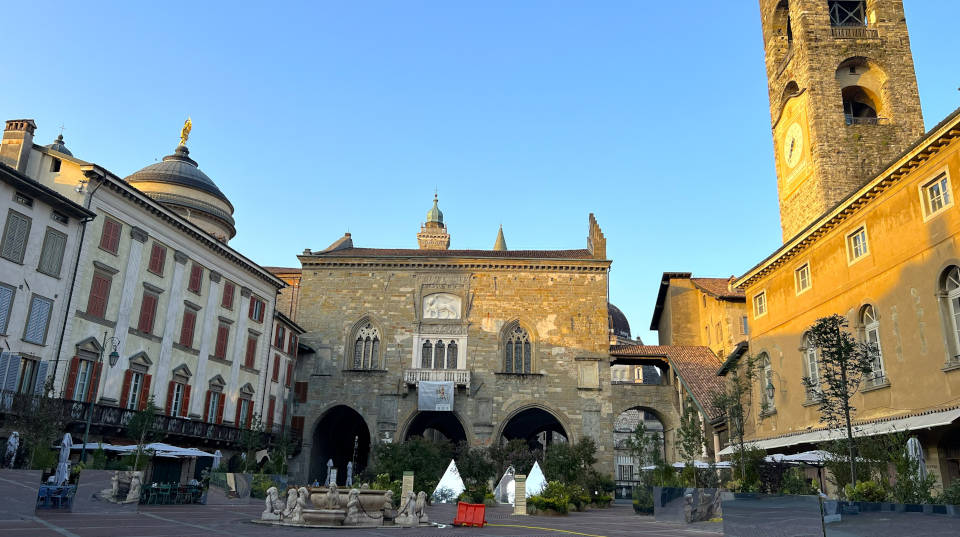
At the centre of Città Alta, Piazza Vecchia is where Bergamo’s history seems to gather around a single space. After following the narrower streets and passages of the upper city, the square suddenly opens out, revealing a remarkable ensemble of medieval, Renaissance, and later architecture.
View over Piazza Vecchia from the steps of Palazzo della Ragione | Photo: Travel In Culture
For centuries, this has been the civic heart of Bergamo. Rather than being dominated by a single monument, Piazza Vecchia is shaped by the relationship between its buildings, arcades, tower, fountain, and the streets leading towards Piazza del Duomo.
Palazzo della Ragione
Standing along the southern side of the square, Palazzo della Ragione is one of Bergamo’s most important medieval buildings. Its origins date to the 12th century, and its loggia has long provided a passage between Piazza Vecchia and Piazza del Duomo.
The vaulted loggia of Palazzo della Ragione connecting Piazza Vecchia with Piazza del Duomo | Photo: Travel In Culture
Civic life was unfolding here long before the square became one of Bergamo’s most photographed places. Justice, administration, and public affairs were taking place beneath the loggia, while the Lion of Saint Mark on the façade recalls the centuries of Venetian rule that began in 1428.
Walking beneath the vaulted passage, we are moving almost imperceptibly from the political heart of the medieval city towards its religious centre.
Palazzo Nuovo and the Biblioteca Civica
Facing Palazzo della Ragione, Palazzo Nuovo brings a very different architectural presence to the square. Construction began in the early 17th century, and its elegant white façade creates a striking contrast with the medieval buildings opposite.
Today, the palace houses the Biblioteca Civica Angelo Mai, preserving an extraordinary collection of manuscripts, early printed books, and historical documents. A building once associated with civic ambition therefore continues to serve Bergamo’s cultural life through its role as a library.
The historic Biblioteca Civica Angelo Mai inside Palazzo Nuovo on Piazza Vecchia.
The Baptistery and Piazza del Duomo
Just beyond Palazzo della Ragione, the smaller Piazza del Duomo offers glimpses of another layer of Bergamo. The Baptistery stands alongside the Cathedral, Basilica di Santa Maria Maggiore, and Cappella Colleoni, creating one of the city’s most remarkable concentrations of historic architecture. Current opening hours and access information are worth checking before your visit.
Dating from the 14th century, the Baptistery has been dismantled and reconstructed several times before reaching its present position. Its octagonal form and sculptural decoration reward closer inspection, particularly as the surrounding monumental buildings make it easy to overlook.
The Basilica and Cappella Colleoni deserve more attention of their own, and will be explored in the following section.
The Campanone
Rising above Piazza Vecchia, the Campanone gives the square its unmistakable vertical presence. The medieval Civic Tower has been altered over the centuries, while its bells remain closely associated with Bergamo.
The Campanone is also part of one of Bergamo’s most enduring daily rituals. At 22:00 each evening, its bells ring 100 times, recalling the days when the city gates were closed at night and residents had to be back inside the walls. What was once a practical warning is now a distinctive part of Bergamo’s evening atmosphere.
Climbing the tower reveals the relationship between Città Alta, the Venetian Walls, Città Bassa, and the Lombard landscape. If you are staying overnight in Città Alta, listen for the bells at 22:00. It is easy to miss on a day trip, but the ritual helps the old city feel unexpectedly alive after dark.
Looking beyond Piazza Vecchia
Piazza Vecchia is most rewarding when we allow ourselves to wander beyond its principal monuments.
At the centre of the square, the Fontana Contarini can easily fade into the background, yet it has been part of Piazza Vecchia since the Renaissance. Its white marble basin and sphinxes form a graceful focal point among the surrounding palazzos, showing how carefully even the smaller details of the square were designed.
Streets lead beneath arches and along old palazzos, opening onto stone portals, decorative façades, courtyards, and details that are easy to miss when following a fixed sightseeing route. Among them is the historic solar dial in Piazza Vecchia, an understated feature that rewards a closer look.

The historic solar dial in Piazza Vecchia, one of the square’s details worth noticing.
The square is therefore more than a collection of attractions. It is where Bergamo’s political, cultural, and architectural history comes together, while everyday life continues around it.
Step Inside Bergamo’s Extraordinary Churches
Bergamo’s churches tell a story that extends well beyond religious architecture. They show how faith, civic identity, artistic patronage, and personal ambition have shaped the city for centuries. Moving between the monumental churches around Piazza del Duomo and the quieter buildings encountered along the old streets, we begin to see how deeply this history remains embedded in Città Alta.
Santa Maria Maggiore, Cappella Colleoni and the Baptistery gathered around Piazza del Duomo in Città Alta | Photo: Travel In Culture
Santa Maria Maggiore: Bergamo’s Sacred Heart
Santa Maria Maggiore has been standing at the centre of Bergamo’s religious and civic life since the 12th century. Its restrained Romanesque exterior gives relatively little indication of the richness within.
Before entering, it is worth looking towards the equestrian monument to Bartolomeo Colleoni, the powerful Bergamese condottiero whose presence is so closely connected with this part of Città Alta. The original bronze statue was created by Andrea del Verrocchio in Venice in the late 15th century. The monument here is a later copy. With Colleoni on horseback standing beside the basilica and his funerary chapel, the relationship between personal power, public reputation, and religious devotion becomes unusually visible.
Inside, the atmosphere changes completely. Marble, carved wood, tapestries, paintings, and intricate decorative details have accumulated over centuries, reflecting the wealth and devotion invested in the basilica.
Intricate animal carvings among the decorative details inside Basilica di Santa Maria Maggiore | Photo: Travel In Culture
Among the most remarkable elements are the intarsia panels based on designs by Lorenzo Lotto, while the church also preserves the tomb of composer Gaetano Donizetti.
What makes Santa Maria Maggiore so compelling is this accumulation of history. Rather than belonging to one period, the basilica carries the presence of successive generations, from medieval devotion to Renaissance artistry and later cultural memory.
Cappella Colleoni: Power Beside the Basilica
Immediately beside Santa Maria Maggiore, Cappella Colleoni introduces a more personal story. Bartolomeo Colleoni, the powerful Bergamese condottiero of the 15th century, chose this prominent position for his funerary chapel, creating one of the most extraordinary examples of Renaissance architecture in the city.
The decision was significant. The chapel was not simply being added to the religious landscape of Bergamo. Its construction altered part of the existing basilica complex, creating a highly visible monument to one man’s wealth, status, and memory.
The elaborate marble façade is already announcing this ambition before we enter. Inside, sculpture, coloured marble, carved details, and the tombs of Colleoni and his daughter Medea create an intensely personal space.
Standing here beside the much older basilica, two different forms of presence meet: centuries of collective devotion on one side, and the carefully constructed memory of an individual on the other.
Colleoni’s legacy continues nearby. The Luogo Pio Colleoni, founded by Bartolomeo Colleoni, offers another glimpse into the world of the powerful condottiero. Its historic rooms and collections remain part of Bergamo’s cultural life and are sometimes used for temporary exhibitions and cultural events.
Bergamo Cathedral and the Layers Beneath
Across Piazza del Duomo, the Cathedral of Sant’Alessandro offers another perspective on Bergamo’s religious history. Its story reaches back through earlier places of worship on the site, while the present building contains artworks and architectural elements accumulated over successive periods.
The richly decorated ceiling of Bergamo Cathedral of Sant’Alessandro.
Rather than competing visually with the richly decorated Cappella Colleoni, the cathedral rewards a slower kind of looking. Moving through its interior, details begin to emerge gradually, disclosing how the city’s religious life has been changing while remaining rooted in the same historic centre.
The cathedral is also a reminder that Bergamo’s history is not confined to what can be seen above ground. Beneath Piazza del Duomo and the surrounding buildings, archaeological remains reveal earlier phases of the city, making this small area one of the places where Bergamo’s different historical layers are particularly close together.
San Pancrazio and Sant’Andrea: The Quieter Churches
Leaving the monumental centre behind, the character of Città Alta becomes quieter. San Pancrazio is standing along its own small piazza, while Sant’Andrea is encountered among the streets and buildings of the historic city.
San Pancrazio has particularly deep roots, with its presence documented in Bergamo as early as the 9th century. Its history has continued through later enlargement and rebuilding, leaving a building that is less immediately spectacular than the great basilica but deeply connected to the long religious life of the neighbourhood.
Do not rush through these churches. Their importance is partly in what they communicate about everyday Bergamo, away from the great monuments and the crowds gathered around Piazza Vecchia. Entering a quieter church while walking through Città Alta, discovering an unexpected artwork or architectural detail, and then continuing through the old streets all add to the richness of exploring Bergamo.
Walk the Venetian Walls and Discover Bergamo from Above
Walking along the Venetian Walls is one of the best ways to understand Bergamo’s unusual position. From the elevated edge of Città Alta, the historic city opens towards Città Bassa, the Lombard plain, and, on clearer days, the mountains beyond. The walls are therefore not simply a monument to military history. They also create one of the city’s most distinctive promenades.
The Venetian Walls overlooking Città Bassa and the landscape beyond Bergamo.
The fortifications were built by the Republic of Venice between the 16th and 17th centuries, transforming the existing medieval defences into a much more ambitious defensive system. Bergamo was occupying an important position on the western edge of the Venetian mainland territories, making its protection strategically significant.
Today, walking along the walls reveals how closely defence and landscape were once connected. Bastions, gateways, stone passages, and changes in level follow the contours of the hill, while viewpoints repeatedly open towards the countryside below.
A UNESCO-listed fortified city
The Venetian Walls form part of the UNESCO World Heritage property Venetian Works of Defence between the 16th and 17th Centuries: Stato da Terra – Western Stato da Mar, inscribed in 2017. Bergamo is represented within this transnational property by its historic fortified city.
The UNESCO recognition reflects the wider importance of the Venetian defensive system rather than simply celebrating a single stretch of wall. Walking here, its scale becomes easier to appreciate.
From Porta San Giacomo to the old city
Porta San Giacomo is perhaps the most recognisable gateway, with its white Zandobbio marble façade standing out against the darker stone of the fortifications. The Lion of Saint Mark above the entrance recalls Bergamo’s centuries under Venetian rule. Another remarkable gateway to the old city is Porta Sant’Agostino.
Porta Sant’Agostino, one of the historic gateways through Bergamo’s Venetian Walls.
Continuing along the walls, the city takes on a different character. Rooftops appear below, church towers rise between the old buildings, and the view extends far beyond Bergamo itself. This is a place for slowing down rather than simply reaching the next landmark.
The walls are perhaps most memorable towards evening, when the light changes across the plain and the historic buildings of Città Alta take on warmer tones. At that moment, the defensive structure becomes something quite different: a place for walking, looking, and experiencing the landscape that has shaped Bergamo’s history.
Bergamo’s Venetian Walls are part of the UNESCO World Heritage property Venetian Works of Defence between the 16th and 17th Centuries: Stato da Terra – Western Stato da Mar, recognising a wider transnational system of fortified sites created by the Republic of Venice.
Take the Funicular to San Vigilio
The second funicular takes us above Città Alta and into a very different landscape. From the upper station, the streets of Bergamo give way to greenery, gardens, and the slopes of San Vigilio, where the city begins to feel much closer to the surrounding countryside.
The funicular to San Vigilio, connecting Città Alta with the hilltop above Bergamo.
The journey itself is part of the experience. Leaving the dense historic centre behind and climbing towards the hill, we are watching the rooftops of Città Alta gradually opening out below. It is a remarkably short transition, yet the sense of place is changing quickly.
Castello di San Vigilio
At the summit, the remains of the Castello di San Vigilio recall the strategic importance of the hill. The fortress protected the approach to Bergamo from above, and its position makes the reason immediately apparent. Even today, the elevated setting provides a natural sense of command over the surrounding landscape.
Walking among the remaining walls and earthworks, the castle is less about a perfectly preserved monument than about understanding its position. The fortifications become a viewpoint from which the geography of Bergamo can be read.
One of Bergamo’s finest views
From San Vigilio, Città Alta is appearing almost as a landscape in itself.
View across Città Alta, Città Bassa and the Lombard plain from San Vigilio.
The Venetian Walls trace the contours of the hill, church towers and campaniles rise above the rooftops, and the historic centre spreads below in a dense pattern of stone and terracotta.
Beyond it, the view opens across Città Bassa and the Lombard plain, with the mountains forming the distant horizon. On a clear day, the scale is extraordinary. What seemed like a compact historic city when walking through its streets presents itself as part of a much larger geographical setting.
This is one of the places where it is worth simply staying for a while. Rather than moving immediately towards the next sight, we can watch the light changing across the plain and the rooftops of Città Alta, experiencing Bergamo from a distance after having spent days walking through its historic centre.
Discover Bergamo Through Art, Food, and Everyday Life
Some of the most interesting parts of Bergamo appear once we stop moving from one major monument to another. Città Alta is full of buildings and spaces that uncover how the city has been lived in, studied, traded, washed, prayed in, and enjoyed across generations.
Walking away from Piazza Vecchia, the streets become quieter, and the architecture begins to tell smaller stories.
Palazzos and the presence of Bergamo’s old families
The historic centre is filled with palazzos whose façades can be easy to overlook while moving between the principal sights.
Statues at the entrance to Palazzo Terzi in Città Alta.
Behind their doors, however, were residences belonging to families whose wealth helped shape Bergamo’s cultural and political life.
One of the most interesting examples is Palazzo e Giardini Moroni.
Palazzo e Giardini Moroni, an historic aristocratic residence in Bergamo.
Rather than being simply another grand urban residence, Palazzo Moroni offers a glimpse of how an aristocratic family could inhabit the city while maintaining a surprising connection with the countryside. Its historic rooms lead towards gardens and agricultural land, creating an unusual transition from the dense medieval city to greenery within the urban fabric.
This contrast is one of the pleasures of wandering Città Alta. A decorated doorway can be opening onto a palace, while a narrow passage can suddenly unveil a garden.
From convent to university
Elsewhere, former religious spaces continue to have a life beyond their original purpose. The former cloister of the Convento di San Francesco, close to the Venetian Walls, is now part of the University of Bergamo.
There is something particularly revealing about seeing students moving through a space created for a very different kind of community. The cloister no longer serves the rhythm of a medieval religious house, yet its architecture still shapes the experience of those who use it. History here is not preserved behind glass. It is incorporated into contemporary life.
Further uphill, the old Antico Lavatoio offers a much more modest reminder of everyday life Bergamo.
The Antico Lavatoio, a modest reminder of everyday life in historic Bergamo.
The stone washing place belonged to the practical life of the neighbourhood, when water, laundry, and domestic routines were forming part of the rhythm of the city.
Bergamo on the plate
The same sense of continuity can be found in Bergamo’s food.
Traditional Bergamasque dishes reflecting the culinary traditions of the region.
Local specialities reflect the traditions and geography of the surrounding territory, from casoncelli alla bergamasca and polenta taragna to mountain cheeses and butter.
One of Bergamo’s most famous food stories is much more recent. At La Marianna in Città Alta, Enrico Panattoni created stracciatella in 1961 by adding melted dark chocolate to white fiordilatte gelato. The chocolate hardened during churning, creating the characteristic chocolate pieces. The name was inspired by stracciatella alla romana, a soup served at the restaurant.
A scoop of stracciatella at La Marianna is therefore a taste of Bergamo’s modern cultural history, born in Città Alta and now enjoyed around the world.
Experience Bergamo Beyond Città Alta
It is easy to spend an entire visit in Città Alta and leave without really seeing the city below. Yet descending into Città Bassa brings another Bergamo into view, one that is less medieval in appearance but equally important to understanding how the city has developed.
The contrast is immediate. The compact streets of the upper city give way to wider avenues, elegant 19th-century buildings, shops, cafés, and the everyday movement of a modern Lombard city. Città Bassa grew substantially as Bergamo expanded beyond its historic hill, particularly during the 19th and early 20th centuries.
From the old city to the modern centre
The descent itself is part of the experience. Looking back towards Città Alta, the Venetian Walls form a dramatic boundary between the two parts of Bergamo. From below, the upper city appears almost suspended above the modern streets, with its towers and church domes marking the skyline.
Torre dei Caduti in Città Bassa, with the historic Città Alta rising in the distance.
At street level, however, the relationship feels less absolute. The two parts are connected by roads, stairways, buses, and the funicular, while people move between them throughout the day.
The area around Porta Nuova and the Sentierone provides a very different sense of scale from Piazza Vecchia. The broad streets and open spaces belong to the expanding modern city, while theatres, cafés, shops, and civic buildings reflect Bergamo’s continuing cultural life.
The Quadriportico del Sentierone, part of Bergamo’s modern Piacentiniano centre.
Bergamo’s quieter urban pleasures
Città Bassa is also where it becomes easier to experience Bergamo without constantly looking for a historic landmark. Sitting at a café, browsing local shops, walking beneath the arcades, or simply watching people crossing the streets can be as revealing as visiting another monument.
Città Bassa is also home to important cultural institutions, including the Accademia Carrara, whose collections add another dimension to Bergamo’s artistic identity.
The Accademia Carrara, one of Bergamo’s most important art museums.
For photography, the lower city offers a different palette too. Historic façades stand beside contemporary buildings, traffic moves beneath the hill, and the profile of Città Alta repeatedly appears at the end of streets.
This is perhaps the most useful reason for coming down from the walls: the view changes, and with it our understanding of Bergamo. Città Alta is not an isolated medieval city above a modern one. The two form a single urban landscape, with centuries of history continuing into the streets of the present.
For anyone staying overnight, Città Bassa is particularly rewarding in the evening, when the pace of the city changes and the illuminated outline of Città Alta begins to dominate the skyline once again.
A mostly walkable route through Città Alta, with the funiculars providing optional connections to Città Bassa and San Vigilio.
Porta San Giacomo
↓
Piazza Vecchia
↓
Piazza del Duomo
↓
Venetian Walls
↓
San Vigilio
Perfect One-Day Bergamo Itinerary
- 🌅 09:00: Enter Città Alta through Porta San Giacomo and walk towards Piazza Vecchia, taking in the first views across the lower city.
- 🏛️ 09:30: Explore Piazza Vecchia and Piazza del Duomo, including Palazzo della Ragione, Santa Maria Maggiore, Cappella Colleoni, the Baptistery, and the Cathedral.
- ☕ 12:00: Wander beyond the main squares, discovering quieter streets, historic palazzos, and smaller churches before stopping for lunch.
- 🍝 13:00: Try a local speciality, such as casoncelli alla bergamasca, polenta, or Bergamasque cheeses.
- 🚶 14:30: Walk along the Venetian Walls, pausing at the gateways and viewpoints.
- 🌄 16:00: Take the funicular to San Vigilio and walk to the castle for exceptional views over Città Alta, Città Bassa, the plain, and the mountains.
- 🍷 18:00: Return to Bergamo for an aperitivo or dinner, perhaps continuing into Città Bassa for a different perspective on the city.
If Bergamo is part of a longer Italian journey, our Tuscany itineraries offer ideas for extending your trip into another of Italy’s major cultural regions, from Florence and Siena to Lucca and the Tuscan hill towns.
Planning Your Visit to Bergamo
How long do you need? One full day covers the principal sights, but an overnight stay is preferable if you want time for the smaller churches, palazzos, museums, food, and quieter corners of Città Alta.
Getting around: Città Alta is compact and best explored on foot, although there are slopes and steps. The funicular provides an easy connection between Città Bassa and Città Alta, while the second funicular continues to San Vigilio.
Best time to explore: Start early around Piazza Vecchia and Piazza del Duomo. Late afternoon is particularly rewarding on the Venetian Walls and at San Vigilio, when the changing light can transform the views.
For a slower visit: Allow extra time for Palazzo e Giardini Moroni, the Colleoni Museum, the former Convento di San Francesco, smaller churches, and the historic streets away from the principal squares.
Where to Stay in Bergamo
For a detailed comparison of Bergamo’s best neighbourhoods and hotel recommendations, see our dedicated Where to Stay in Bergamo guide.
Frequently Asked Questions about Bergamo
Is Bergamo worth visiting if you only have one day?
Yes. One day is enough for Bergamo’s principal sights, including Città Alta, Piazza Vecchia, the historic churches, Venetian Walls, and main viewpoints. An overnight stay gives you more time for San Vigilio, Città Bassa, and the quieter corners of the old city.
Is Bergamo a good alternative to Milan for a city break?
Yes, if you prefer history, architecture, art, and a more compact historic setting. Bergamo’s medieval Città Alta and Venetian Walls offer a very different experience from Milan’s larger metropolitan atmosphere and contemporary cultural scene.
How do you get from Bergamo Airport (Orio al Serio) to Città Alta?
The easiest option is the ATB Airport Bus, which connects Milan Bergamo Airport (BGY) with Bergamo and Città Alta. Check the current timetable and fares before travelling, as services can change.
- 🇮🇹 Italy Travel Guide – Explore Italy through its cities, regions, cultural heritage, and travel ideas.
- 🌿 Tuscany Travel Guide – Continue beyond Lombardy with Florence, Siena, Lucca, San Gimignano, Volterra, and Tuscany’s cultural landscapes.
