


Tuscany Itineraries: 3, 5 and 7 Days + Road Trips
By ANL | UPDATED:
All photographs in this article were taken by Travel In Culture.
Tuscany Itineraries and Road Trips
Tuscany offers many ways to explore, from short city breaks centred on Florence or Siena to slower road trips through hill towns, vineyards, and the Val d’Orcia. The best itinerary depends on how much time you have and whether you want to focus on art and historic cities, countryside, food and wine, or a combination of all three.
This guide brings together practical Tuscany itineraries for 3, 4, and 5 days, including options by car and without a car, with suggestions for Florence, Siena, Lucca, Pisa, San Gimignano, Chianti, and the Val d’Orcia.
🗺️ Why visit: Renaissance cities, medieval hill towns, vineyards, landscapes, historic villages, Tuscan food, and wine
📍 Location: Central Italy, with Florence, Siena, Lucca, Pisa, Chianti, and the Val d’Orcia among the main areas to explore
⏱️ Time needed: 3–5 days for a highlights itinerary. A week or longer allows for a slower road trip and more countryside
🚗 Best for: City breaks, road trips, cultural travel, food and wine, landscapes, history, and slow travel
🏛️ Combine: Florence, Siena, Lucca, Pisa, San Gimignano, Chianti, Val d’Orcia, and other Tuscan towns
🏛️ Selected for Florence → Hotel Spadai
⛪ Selected for Siena → Hotel Duomo
🏰 Selected for a medieval hill town → Leon Bianco
Whether you are planning a first visit to Tuscany or returning to explore beyond Florence, a well-planned itinerary can combine the region’s major cities with smaller towns and scenic countryside. Travelling by car gives you greater flexibility in rural areas, while trains and buses make several of the major destinations accessible without driving.
The itineraries below are designed to help you choose the right route for your available time, whether you want a 3-day Tuscany itinerary, a 4-day or 5-day itinerary, or a longer Tuscany road trip. If you are deciding where to base yourself along the route, see our guide to where to stay in Tuscany for the best towns, cities and countryside areas for different types of trips.
Planning a Tuscany Itinerary
Tuscany is one of Italy’s most rewarding regions to explore, but the distances between its cities, hill towns, and countryside mean that choosing the right itinerary is important. Florence, Siena, Pisa, Lucca, San Gimignano, Arezzo, and the towns of the Val d’Orcia each offer a different experience, while Chianti, Maremma, and the surrounding countryside are best explored at a slower pace.
The amount of time you have will largely determine how much of Tuscany you can see. With three days, it is best to concentrate on the major highlights. Five days allow you to combine historic cities with hill towns and countryside, while seven days give you more time for southern Tuscany, the Val d’Orcia, or a longer road trip. You can also adapt these itineraries according to whether you are travelling by car or relying on trains and buses.
⏱️ 3 days: Focus on Florence, Siena, San Gimignano, and one nearby area rather than trying to cover the whole region
🏛️ 5 days: Combine Florence and Siena with hill towns, Chianti, Pisa, Lucca, or another part of Tuscany
🌿 7 days: Allow more time for the countryside, Arezzo, Montepulciano, Pienza, the Val d’Orcia, or Maremma
🚗 By car: Best for combining smaller towns, vineyards, countryside, and scenic routes, particularly in Chianti and southern Tuscany
🚆 Without a car: Concentrate on destinations with good train or bus connections, such as Florence, Pisa, Lucca, Siena, and Arezzo
There is no single best Tuscany itinerary. A first-time visitor may prefer to combine Florence with Siena and the famous hill towns, while returning visitors may want to spend more time in the countryside or explore less-visited areas such as Arezzo, Vinci, and Maremma. If you are particularly interested in landscapes, food, and wine, the Val d’Orcia and Chianti are especially well suited to a slower road trip.
If you prefer to explore beyond the main sights, consider using a cultural travel method, looking at Tuscany through its architecture, landscapes, historic traditions, and everyday life rather than simply following a list of attractions.
The itineraries below are therefore designed as starting points rather than fixed schedules. You can combine or adapt the routes depending on your interests, whether you want to prioritise art and architecture, medieval towns, Tuscan landscapes, food and wine, or the coast.
If you prefer not to drive, or would like to make the most of limited time, organised tours can be a practical way to visit some of Tuscany’s hill towns and countryside, as well as major cities, historic sites, and other attractions.
The itineraries below are flexible and can easily be adapted to suit your interests and travel style. Florence is a natural starting point for a first visit, while travelling by car allows you to explore more of Tuscany’s hill towns, vineyards, and countryside.
3 days: Florence → Siena → San Gimignano
5 days: Florence → Siena & San Gimignano → Chianti → Pisa & Lucca
7 days: Florence → Pisa & Lucca → Chianti & Siena → Val d’Orcia → Arezzo & Cortona
Chianti • San Gimignano • Volterra • Val d’Orcia • Maremma
3 Days in Tuscany
With only three days in Tuscany, it is best to concentrate on a small part of the region rather than trying to visit too many towns. Florence is the obvious starting point for a first visit, while Siena and San Gimignano provide a taste of Tuscany’s medieval hill-town heritage.
If you are travelling without a car, this itinerary is particularly convenient because Florence, Siena, and several other major destinations can be reached by public transport. With a car, you can add a short drive through the Chianti countryside or adjust the route to spend more time in smaller towns.
🏛️ Day 1: Florence – Explore the historic centre, Piazza del Duomo, the Uffizi area, Piazza della Signoria, and the Ponte Vecchio
⛪ Day 2: Siena – Visit Piazza del Campo, Siena Cathedral, and the historic centre, with time for a relaxed evening in the city
🌿 Day 3: San Gimignano and the Tuscan countryside – Explore the medieval towers and streets of San Gimignano, with an optional stop in the Chianti countryside
Day 1: Florence
Begin in Florence, the cultural heart of Tuscany and one of Italy’s great historic cities. Depending on your interests, you can visit the Cathedral of Santa Maria del Fiore, explore Piazza della Signoria, see the Ponte Vecchio, and spend time in one or two of the city’s major museums.
If you are already familiar with Florence, you could instead use the first day for a slower exploration of the Oltrarno, the Boboli Gardens, or one of the city’s less-visited museums.
Day 2: Siena
Travel to Siena for the second day. The historic centre is compact and well suited to exploring on foot. Start at Piazza del Campo, the city’s distinctive shell-shaped main square, before visiting Siena Cathedral and wandering through the surrounding medieval streets.

Piazza del Campo and Torre del Mangia seen from a side street in the historic centre of Siena | Photo: Travel In Culture
Siena also works well as an overnight stop if you prefer not to return to Florence each evening. Staying in the city gives you more time to experience its historic centre after the main daytime visitors have departed.
Day 3: San Gimignano and the Countryside
Spend the final day exploring San Gimignano, one of Tuscany’s most recognisable medieval hill towns. Its historic centre is famous for its surviving medieval towers, narrow streets, stone buildings, and views across the surrounding countryside.
With a car, you can combine San Gimignano with a scenic drive through the Tuscan countryside or a short visit to the Chianti area. Without a car, it is better to allow enough time for the journey to and from San Gimignano rather than trying to add several additional destinations.
If you prefer landscapes and smaller towns to Florence, another option is to adapt this three-day itinerary around Siena and the Val d’Orcia. However, that route works better with a car and is more suitable for travellers who have already visited Florence.
5 Days in Tuscany
With five days in Tuscany, you can move beyond the main cities and combine Florence and Siena with medieval hill towns, the Tuscan countryside, and one or two destinations in western or central Tuscany. A car gives you greater flexibility, particularly if you want to include Chianti, San Gimignano, or smaller countryside villages.
This itinerary is designed for a first or second visit and balances major sights with slower travel. It can also be adapted according to your interests. For example, Pisa and Lucca can be substituted for some of the hill towns, while travellers interested in landscapes and wine can spend more time in Chianti.
🏛️ Day 1: Florence – Explore the historic centre, Piazza del Duomo, Piazza della Signoria, and the Ponte Vecchio
🎨 Day 2: Florence – Continue with the Uffizi Gallery, Accademia Gallery, Oltrarno, or the Boboli Gardens
🏰 Day 3: Siena and San Gimignano – Explore Siena in the morning and continue to San Gimignano in the afternoon
🍇 Day 4: Chianti – Drive through the Chianti countryside, visiting vineyards, villages, and scenic viewpoints
🌊 Day 5: Pisa and Lucca – See the Leaning Tower and Piazza dei Miracoli in Pisa, then explore the historic centre of Lucca
Day 1: Florence
Begin your five-day Tuscany itinerary in Florence. Spend the day exploring the historic centre, including Piazza del Duomo, the Cathedral of Santa Maria del Fiore, Piazza della Signoria, and the Ponte Vecchio.
Allow time simply to walk through the historic streets rather than filling the day with museums. Florence is compact, but there is enough to see that rushing between attractions can make the experience less enjoyable.
Day 2: Florence
Use a second day to explore more of Florence. The Uffizi Gallery and Accademia Gallery are obvious choices for art lovers, while the Oltrarno offers a different atmosphere with artisan workshops, smaller streets, gardens, and historic buildings.
If you prefer architecture and panoramic views, you can also cross the Arno and walk towards Piazzale Michelangelo for one of the classic views over Florence.
Day 3: Siena and San Gimignano
Leave Florence and head towards Siena. Spend the morning exploring Piazza del Campo, Siena Cathedral, and the medieval streets of the historic centre.
Continue to San Gimignano later in the day. The hill town is known for its medieval towers and distinctive skyline, and its elevated position provides broad views across the surrounding Tuscan landscape.
If you are travelling by car, this is a convenient point in the itinerary to stay overnight outside Florence and closer to the Tuscan countryside.
Day 4: Chianti
Spend the fourth day exploring the Chianti countryside between Florence and Siena. The area is characterised by vineyards, olive groves, wooded hills, and small historic settlements.

Rolling Chianti countryside with vineyards, olive groves, small forests, and a hilltop village in the distance.
With a car, you can take a slower route through the countryside, stopping in villages and at viewpoints along the way. This is also a good day to experience Tuscan food and wine, although you should plan carefully if you are driving.
If wine is not a particular interest, Chianti can instead be treated as a scenic countryside day, with time for walking, photography, and exploring small villages.
Day 5: Pisa and Lucca
On the final day, head towards western Tuscany and visit Pisa and Lucca. Pisa is best known for the Leaning Tower and Piazza dei Miracoli, where the cathedral, baptistery, and monumental cemetery form one of Tuscany’s most important architectural ensembles.
Continue to Lucca, whose compact historic centre is surrounded by remarkably well-preserved Renaissance walls. Walking or cycling along the walls is one of the best ways to appreciate the city, while the streets within them are ideal for a slower afternoon.
Piazza dell’Anfiteatro in Lucca, with its distinctive curved façades and outdoor restaurants | Photo: Travel In Culture
If you prefer the Tuscan coast, you can replace Lucca with Viareggio. This makes the itinerary particularly appealing in warmer months, when you can combine Tuscany’s historic cities with some time by the sea.
Alternative: Five Days in Southern Tuscany
If you have already visited Florence, consider using your five days to explore southern Tuscany instead. A route incorporating Siena, Montepulciano, Pienza, and the Val d’Orcia provides a very different experience, centred on hill towns, vineyards, historic landscapes, and rural scenery.
This alternative works best by car and allows you to travel at a slower pace. It also provides a natural introduction to the longer seven-day itinerary below.
7 Days in Tuscany
A week in Tuscany gives you enough time to combine the region’s major historic cities with hill towns, wine country, and the Tuscan countryside. This itinerary works particularly well as a road trip, allowing you to move between Florence, Siena, the Val d’Orcia, and smaller towns at your own pace.
📍 Days 1–2: Florence – historic centre, Renaissance highlights, museums, and viewpoints
🏛️ Day 3: Pisa and Lucca
🍷 Day 4: Chianti and Siena
🌿 Day 5: Val d’Orcia – Montepulciano, Pienza, and the countryside
🏘️ Day 6: Arezzo and Cortona, or a slower day in the Val d’Orcia
🌊 Day 7: Viareggio and the Tuscan coast, or an alternative countryside day
Days 1–2: Florence – Renaissance Florence
Begin your Tuscany itinerary in Florence, the region’s great Renaissance city. Spend the first day exploring the historic centre, including the Duomo, Piazza della Signoria, Palazzo Vecchio, and Ponte Vecchio. Allow time simply to walk through the historic streets and squares rather than trying to see every museum in one day.
If you are particularly interested in Renaissance art, reserve time for the Uffizi Gallery or the Accademia Gallery. Otherwise, keep the first day relatively relaxed and enjoy Florence’s architecture, cafés, and evening atmosphere.
Use the second day to explore more of Florence at a slower pace. Depending on your interests, visit the Uffizi, Palazzo Pitti, or the Basilica of Santa Croce, or explore the Oltrarno district.
For a panoramic view over the city, walk or travel up to Piazzale Michelangelo. The view across Florence and the surrounding Tuscan hills is particularly attractive towards the end of the day.
Day 3: Pisa and Lucca
Leave Florence for a day combining two of Tuscany’s most distinctive historic cities. Begin in Pisa, where the Piazza dei Miracoli brings together the Cathedral, Baptistery, and famous Leaning Tower. The historic centre beyond the square is also worth exploring if you have time.
Continue to Lucca, one of Tuscany’s most attractive walled cities. Walk or cycle along the Renaissance walls, explore the historic centre, and visit Piazza dell’Anfiteatro and the Cathedral of San Martino.
If you prefer a slower pace, choose either Pisa or Lucca rather than trying to see both in detail.
Day 4: Chianti and Siena
Head into the Chianti countryside, where vineyards, olive groves, cypress-lined roads, and small villages create one of Tuscany’s classic landscapes. This is one of the days when having a car makes the itinerary considerably more flexible.
Continue to Siena, whose historic centre is one of the highlights of southern Tuscany. Explore Piazza del Campo, the Cathedral, and the medieval streets around the city centre. If possible, stay overnight in or near Siena so that you can experience the city after the main daytime crowds have departed.
Day 5: Montepulciano, Pienza, and the Val d’Orcia
Spend the day exploring the Val d’Orcia, one of Tuscany’s most celebrated landscapes and a UNESCO World Heritage site. The area is characterised by rolling hills, vineyards, cypress trees, farmhouses, and historic hill towns.
Begin with Montepulciano, dramatically situated on a ridge above the surrounding countryside. Continue to Pienza, whose Renaissance town centre was planned as an ideal city under Pope Pius II. Between the two towns, allow time to enjoy the countryside rather than treating the day as a sequence of sightseeing stops.
If time allows, include a scenic drive through the Val d’Orcia, with viewpoints and smaller villages along the way. This is one of the strongest days of the itinerary for experiencing the landscapes that have come to define Tuscany.

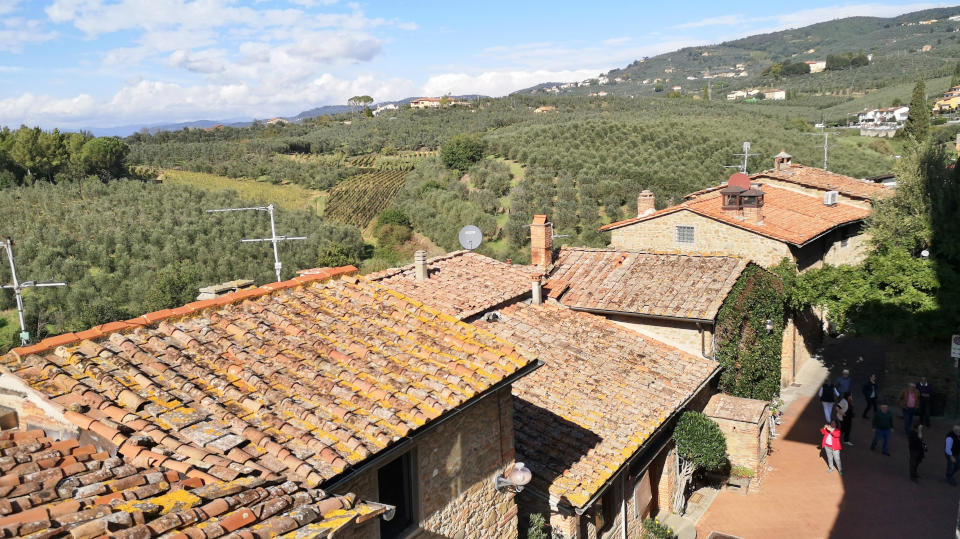
A hilltop village surrounded by olive groves in the Tuscan countryside.
Day 6: Arezzo and Cortona
On the sixth day, explore eastern Tuscany with visits to Arezzo and Cortona. Arezzo has a particularly rich medieval and Renaissance heritage, with an attractive historic centre, churches, and the Piazza Grande.
Continue to Cortona, a hill town overlooking the Val di Chiana. Its steep historic streets, stone buildings, and views across the surrounding landscape make it a good complement to the larger cities visited earlier in the itinerary.
Alternatively, if you prefer a slower road trip, use this day for more time in the Val d’Orcia, visiting smaller villages, wineries, and countryside viewpoints.
Day 7: Viareggio and the Tuscan Coast
For the final day, head towards the coast and Viareggio. The seaside resort is known for its long sandy beach, Art Nouveau and Liberty architecture, and historic connection with Tuscany’s summer culture.
A coastal day provides a change of scenery after several days among Tuscany’s historic cities and hill towns. You can spend time on the seafront, explore the town, or simply enjoy a slower final day before returning to Florence or continuing your journey.
If the coast does not appeal to you, replace Viareggio with another day in the Tuscan countryside. The flexibility of a road trip makes it possible to spend more time in Chianti or the Val d’Orcia, or to visit additional smaller towns.
🚗 Best approach: Florence is easiest to explore without a car, so consider collecting your rental car only when leaving the city. A car is particularly useful for Chianti, the Val d’Orcia, Montepulciano, Pienza, and the smaller countryside destinations.
🏨 Where to stay: Rather than changing hotels every night, consider using Florence, Siena, or another central Tuscan base for part of the trip, combined with one or two nights in the Val d’Orcia or countryside.
🗺️ Keep it flexible: The itinerary includes both major destinations and optional stops. If you prefer historic towns, spend more time in Siena, Arezzo, or Cortona. If landscapes and food are more important, allow more time for Chianti and the Val d’Orcia.
Alternative: Cinque Terre Extension
If you would rather extend your trip beyond Tuscany, consider adding the Cinque Terre in neighbouring Liguria. The five coastal villages of Monterosso al Mare, Vernazza, Corniglia, Manarola, and Riomaggiore make a spectacular addition for travellers interested in coastal scenery and hiking. The villages are best explored by train, boat, or on foot rather than by car.
Tuscany Road Trip
A road trip is one of the best ways to experience Tuscany beyond its major cities. Having a car gives you the freedom to combine hill towns, vineyards, countryside viewpoints, historic villages, and rural attractions that are difficult to reach by public transport.
🚗 Best for: Hill towns, vineyards, countryside, scenic drives, and southern Tuscany
🗺️ Ideal route: Florence → Chianti → San Gimignano → Siena → Val d’Orcia → Montepulciano → Pienza → Arezzo
⏱️ Recommended time: 5–7 days, although shorter versions are possible
🌿 Best experience: Allow time for unplanned stops, viewpoints, villages, wineries, and countryside walks
🏨 Accommodation: Combine city hotels with a countryside agriturismo or accommodation in a historic hill town
For a first Tuscany road trip, a particularly rewarding route is to combine Florence with Chianti, Siena, and the Val d’Orcia. The scenic Chiantigiana road connects Florence and Siena through the Chianti countryside, passing places such as Greve, Panzano, Castellina, Radda, and Gaiole in Chianti.
The Best Areas for a Tuscany Road Trip
🍷 Chianti: Vineyards, olive groves, castles, small villages, and scenic roads between Florence and Siena
🏛️ Siena: An ideal stop between northern and southern Tuscany, with a historic centre that deserves at least several hours
🌿 Val d’Orcia: Rolling hills, cypress-lined roads, vineyards, and beautiful hill towns including Pienza and Montepulciano
🏰 Hill towns: San Gimignano, Volterra, Cortona, Arezzo, and other smaller towns can be added according to your route
🌊 Maremma and the coast: A good choice if you want to extend the road trip towards southern Tuscany and the Mediterranean coast
How to Structure a Tuscany Road Trip
Rather than changing accommodation every night, consider dividing your journey between two or three bases. For example, you could begin with several nights in Florence, continue to Siena or the Chianti area, and then spend two or three nights in or near the Val d’Orcia.
This approach gives you more time to explore the countryside without spending much of the day packing and driving to the next hotel. It also allows you to return to the same base after visiting nearby towns.
The Val d’Orcia is particularly well suited to this slower approach. Montepulciano, Pienza, San Quirico d’Orcia, Montalcino, and other villages can be combined into scenic day routes, while the landscape itself is an important part of the experience.
A Classic Tuscany Road Trip Route
For a trip of around five to seven days, one possible route is:
📍 Florence: 2 days
🍷 Chianti: 1 day, travelling south towards Siena
🏛️ Siena: 1 day or overnight stop
🌿 Val d’Orcia: 2 days, including Pienza and Montepulciano
🏘️ Optional extension: Arezzo, Cortona, Maremma, Viareggio, or another Tuscan destination
This route can be shortened or extended according to your interests. Travellers who are particularly interested in wine and landscapes can spend more time in Chianti and the Val d’Orcia, while those more interested in art and history can add Arezzo, Cortona, Volterra, or additional time in Siena.
Rolling Tuscan landscape towards the coast, seen from the town walls of Volterra.
Driving in the Tuscan Countryside
The most enjoyable part of driving in Tuscany is often not reaching a particular attraction but following the smaller roads between towns and allowing time for unexpected stops. Chianti, for example, is crossed by a network of roads connecting larger towns with villages, castles, wineries, and rural landscapes.
Do not try to fit too many destinations into a single day. Tuscany is a region where a scenic drive, a long lunch, a village walk, or a countryside viewpoint can be as rewarding as another major sightseeing stop.
If you plan to visit wineries, check opening arrangements in advance, particularly if a tasting or guided visit is important to you. Likewise, allow extra time for parking outside historic centres and walking into the old town.
Where to Pick Up a Rental Car
If you are beginning your trip in Florence, it is usually more convenient to explore the city without a car and collect your rental car when you leave. Florence is well suited to walking and public transport, while a car becomes much more useful once you head towards Chianti and the countryside.
For the same reason, you do not necessarily need to return to Florence every night. A one-way route through Tuscany, with accommodation in different parts of the region, can make better use of your time.
A road trip therefore works best when you treat Tuscany as a collection of landscapes and areas to explore rather than as a checklist of towns. The combination of Florence, Chianti, Siena, and the Val d’Orcia is a particularly strong starting point, but Arezzo, Cortona, Volterra, Maremma, and the Tuscan coast can all be incorporated into a longer journey.
Tuscany Without a Car
Tuscany can be explored without a car, particularly if you concentrate on the larger cities and towns with good bus or rail connections, see also Trenitalia. Florence, Pisa, Lucca, Siena, and Arezzo are among the easiest destinations to combine using public transport.
The main challenge is reaching the smaller hill towns and countryside areas. Chianti, the Val d’Orcia, and parts of southern Tuscany are much easier to explore by car, while destinations such as San Gimignano, Montepulciano, and Pienza require more careful planning by bus or a combination of transport.
🚆 Best for: Florence, Pisa, Lucca, Siena, and Arezzo
🏛️ Best approach: Base yourself in one or two well-connected towns and take day trips
🚌 Hill towns: San Gimignano, Montepulciano, and Pienza require more planning
🌿 Countryside: Chianti and the Val d’Orcia are easier to explore by car or organised tour
🚗 Alternative: Combine trains and buses with occasional organised excursions or taxis
The Best Tuscany Destinations Without a Car
| Destination | Getting there without a car | Best for |
|---|---|---|
| Florence | Train, with frequent connections to other major Tuscan cities | Renaissance art, museums, architecture, and historic streets |
| Pisa | Train from Florence and other major Tuscan cities | Piazza dei Miracoli, the Leaning Tower, and the historic centre |
| Lucca | Train, including direct services from Florence and Pisa | Historic centre, Renaissance walls, and relaxed city walks |
| Siena | Bus or train from Florence | Piazza del Campo, Siena Cathedral, and medieval architecture |
| Arezzo | Train, including direct services from Florence | Historic centre, medieval and Renaissance art, and churches |
| San Gimignano | Bus, usually via Poggibonsi | Medieval towers, historic streets, and hill-town scenery |
| Montepulciano | Train to Chiusi-Chianciano Terme, followed by a bus connection | Renaissance architecture, wine, and views across southern Tuscany |
| Pienza | Bus connections, usually requiring careful timetable planning | Renaissance architecture, local food, and Val d’Orcia scenery |
Florence is the easiest base for a first Tuscany trip without a car, while Siena and Lucca can also work well for a slower itinerary.
Ponte Vecchio spanning the Arno River in Florence | Photo: Travel In Culture
If you want to explore the countryside, an organised excursion can be a practical alternative to hiring a car.
The important thing is not to try to reproduce a car-based itinerary using public transport. Instead, concentrate on well-connected cities and towns, and select a few excursions to places that are harder to reach independently.
For example, you can explore San Gimignano and Volterra on a full-day tour from Siena, making it easier to visit two of Tuscany’s most atmospheric hill towns without a car. The tour below includes an expert guide who provides insight into the history and culture of both towns.
Siena – Volterra – San Gimignano (advertisement – affiliate link)
Where to Stay in Tuscany
Where you stay in Tuscany depends on your itinerary. Florence is the easiest base for a first visit and for travelling without a car, while Siena works particularly well for exploring central Tuscany. For a road trip, consider spending a few nights in a historic hill town or countryside property, particularly in Chianti or the Val d’Orcia.
You do not necessarily need to change hotels every night. Staying for two or three nights in one location can make a Tuscany trip more relaxed and gives you time to explore nearby towns without constantly packing and unpacking. The hotels below are selected for their character and location.
For more options, see also our Florence Accommodation Guide and Siena Accommodation Guide.
Looking for somewhere else to stay? Use the search box below to explore accommodation options in Tuscany for your preferred dates.
For a short Tuscany itinerary, Florence and Siena are the most practical bases, particularly if you are not hiring a car. With five or seven days, consider adding a countryside or hill-town stay to experience a quieter side of Tuscany.
For further destination information and regional travel inspiration, see the official Visit Tuscany tourism website.
Tuscany Itinerary FAQs
How many days do you need in Tuscany?
Three to five days are enough for a highlights itinerary covering destinations such as Florence, Siena, San Gimignano, Pisa, or Lucca. Seven days or more allow you to travel at a slower pace and include areas such as Chianti, the Val d’Orcia, Arezzo, or the Tuscan countryside. If you want to combine major cities with several hill towns and countryside areas, a week gives you considerably more flexibility.
What is the best Tuscany itinerary for first-time visitors?
For a first visit, a good Tuscany itinerary combines Florence with Siena and one or two medieval hill towns. With three days, you could spend time in Florence, visit Siena, and explore San Gimignano. With five to seven days, you can add Chianti, Pisa and Lucca, or continue south towards Montepulciano, Pienza, and the Val d’Orcia. The best route depends on whether you are more interested in art and architecture, historic towns, landscapes, food and wine, or a combination of these.
Is Tuscany better by car or without a car?
Tuscany can be explored both by car and without a car, but the best option depends on your itinerary. Public transport works particularly well for Florence, Pisa, Lucca, Siena, and Arezzo. A car provides much greater flexibility for Chianti, San Gimignano, the Val d’Orcia, smaller hill towns, vineyards, and countryside areas. If you are visiting Florence first, consider exploring the city without a car and hiring one only when you leave for the countryside.
What is the best Tuscany road trip route?
A classic Tuscany road trip can begin in Florence and continue through Chianti to Siena, before heading south towards the Val d’Orcia and towns such as Montepulciano and Pienza. Depending on how much time you have, you can also include San Gimignano, Volterra, Arezzo, or Cortona. A five- to seven-day road trip gives you enough time to combine major towns with scenic drives and slower days in the countryside.
Can you visit Tuscany without a car?
Yes, although you will need to plan your route differently. Florence, Pisa, Lucca, Siena, and Arezzo are among the easiest Tuscan destinations to visit by train or bus. Smaller hill towns and countryside areas are more challenging, so consider using organised day trips for destinations that are difficult to reach independently. San Gimignano, Montepulciano, and Pienza can be visited without a car, but connections require more careful planning.
Is the Val d’Orcia worth including in a Tuscany itinerary?
Yes, particularly if you have five days or more and are interested in landscapes, hill towns, wine, and slower travel. The Val d’Orcia is known for its rolling countryside, vineyards, cypress trees, and historic towns such as Pienza and Montepulciano. It is especially well suited to a road trip, as having a car makes it easier to explore the countryside and combine several towns and scenic viewpoints in the same day.
