


Odaiba Tokyo: Attractions, Waterfront Views and Things to Do
By ANL | UPDATED:
→ Explore the full guide to Odaiba, top viewpoints, and insider tips
See the Japan travel guide for broader travel planning across the country.
Selected for Bay Views & Disney Access → Sotetsu Grand Fresa Tokyo-Bay Ariake
Selected for Luxury Waterfront Views → Grand Nikko Tokyo Daiba
Selected for a Refined Retreat → Mitsui Garden Hotel Toyosu Premier – Tokyo
Odaiba Tokyo: An Overview of the Modern Bay District
Odaiba sits in Tokyo Bay, where futuristic architecture, wide waterfront spaces, and skyline views create a noticeably slower rhythm than central Tokyo. It is one of the few places in Tokyo where the city feels both vast and calm at the same time.
Wandering along its wide promenades, it is easy to sense a calm contrast to the hustle of central Tokyo, approached through a cultural travel perspective that focuses on deeper context and experience. The district is known for combining leisure, shopping, and entertainment, offering a striking cityscape framed by the shimmering waters of Tokyo Bay. With its proximity to central Tokyo districts such as Shibuya and other major landmarks, Odaiba is a perfect destination for exploring the city from a bay perspective. As the lights come on across the skyline, the area shifts from a quiet waterfront into one of Tokyo’s most cinematic nightscapes.

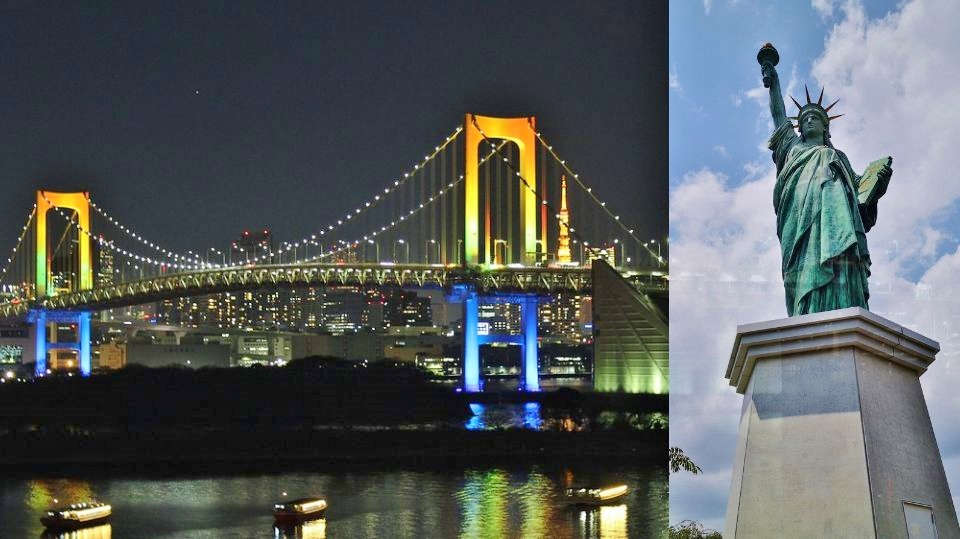
Night view of the Rainbow Bridge near Odaiba, spanning Tokyo Bay.
If you are planning a broader trip, our Tokyo travel guide and 2–3 day Tokyo itineraries help place Odaiba in a wider city route.
Top Things to Do in Odaiba
Odaiba is best experienced through a few key highlights that define its character:
- 🌉 Walk along Tokyo Bay at Odaiba Marine Park
- 🤖 Watch the Unicorn Gundam transformation show
- 🗽 Photograph the Statue of Liberty with Rainbow Bridge
- 🌇 Experience sunset and night skyline views
- 🏙️ Explore futuristic architecture and waterfront malls
Each of these highlights is part of a wider story. Odaiba’s transformation into Tokyo’s waterfront escape begins with its origins.
1. Discovering Odaiba
Today, Odaiba is a Tokyo entertainment district popular with Tokyoites and tourists. We move between quiet waterfront paths and open bayside views at Marine Park, where the sound of traffic fades and Tokyo feels unexpectedly distant. From there, the route continues past the iconic Japanese Statue of Liberty, the original Gundam statue, interactive museums, and sprawling shopping complexes that feel almost like self-contained cities. However, this man-made island linking Odaiba to the city via the Rainbow Bridge was not always a leisure area. The Edo shogunate created it in the mid-1800s to protect Tokyo from enemy attacks by sea.

View over the container port from the Rainbow Bridge, linking Odaiba with Shibaura Pier across Tokyo Bay | Photo: Travel In Culture
Originally, Odaiba was a collection of small islands built as coastal defenses toward the end of the Edo Period (1603 to 1868). Cannons were placed on these separate fort islands off the coast of Shinagawa to protect the city from attacks by sea. Much later, the batteries were united by artificial land, and Odaiba was born. The area served many purposes, from being a significant port and shipyard location to a production site of seaweed.
In the 1980s and 1990s, a spectacular redevelopment took off. The district was planned and reborn as a futuristic city. In 1993, the area was linked to Shibaura Pier with the Rainbow Bridge, opening new opportunities for Tokyoites. Shopping malls such as Aqua City Odaiba, hotels, businesses, and tourist attractions flourished. With the opening of the Yurikamome elevated train line, Odaiba became one of the most attractive parts of Tokyo.
View from Rainbow Bridge over Tokyo Bay and the small piers below.
Even today, visitors and locals alike are drawn to its eye-catching futuristic architecture, elevated walkways, laid-back waterfront beach, and Daiba Park built on the Third Battery of the former fortifications. For many years, the iconic Daikanransha Ferris wheel from 1999, one of Japan’s largest, was a landmark of Odaiba, though it ceased operations in 2022 and no longer illuminates the waterfront. What makes Odaiba unusual is not just its attractions, but the feeling of stepping into a version of Tokyo that is deliberately slower, wider, and more open than the city most visitors expect.
From its historical foundations, Odaiba connects directly to one of Tokyo’s most iconic engineering landmarks: the Rainbow Bridge. To understand Odaiba’s scale, we start by crossing into it – and that journey is part of the experience itself.
2. Getting There and Experiencing the Rainbow Bridge
The Rainbow Bridge spanning Tokyo Bay between central Tokyo and Odaiba.
To reach Odaiba from central Tokyo, visitors can take the Yurikamome elevated train across the Rainbow Bridge or walk across it. Choosing to walk turns the journey into part of the experience, offering uninterrupted views along the way.
The Rainbow Bridge spans approximately 798 metres across Tokyo Bay and carries the fully automated Yurikamome line, one of Tokyo’s few driverless train systems. From the pedestrian walkway, there are panoramic views of the Tokyo skyline, the harbour, Odaiba’s beach, futuristic architecture, and the small fort islands scattered across the bay. For a different perspective, the bridge can also be experienced from the water on a cruise passing beneath it.

Tokyo skyline seen from Rainbow Bridge over Tokyo Bay.
Arching gracefully over Tokyo Bay, the Rainbow Bridge has become an iconic symbol of both Odaiba and Tokyo. At night, the bridge is illuminated with a spectrum of colours. Its upper and lower decks carry car traffic, the Yurikamome line, and the Rainbow Promenade, which connects Tokyo City to Odaiba. Walking the promenade, we are treated to approximately half an hour of continuous views of the harbour, the skyline, old fort islands, Odaiba’s architecture, and the beachfront with its marine park. The pedestrian walkway is typically open from morning until evening, with seasonal variations, inviting visitors to spend the day or even stay in Odaiba.
Once we step off the bridge, the district reveals a completely different rhythm. It is more open, slower, and unexpectedly relaxed.
- Time Your Visit for Sunset and Beyond: Arrive in the late afternoon and stay into the evening, when Odaiba shifts from calm waterfront to a luminous skyline reflected across Tokyo Bay.
- Walk the Rainbow Bridge: Crossing the Rainbow Promenade offers sweeping views of the harbour, skyline, and Odaiba’s futuristic architecture, making the journey part of the experience.
- Catch the Gundam Transformation: Plan your visit around the Unicorn Gundam Statue’s scheduled light and transformation shows, especially after dark.
💡 Pro tip: For one of the most striking perspectives, head to Odaiba Marine Park just after sunset, where the Statue of Liberty, Rainbow Bridge, and Tokyo skyline align in a single frame.
3. The Statue of Liberty in Odaiba
Is there a Statue of Liberty in Japan? Indeed, there is. The Statue of Liberty is not unique to New York. Several replicas exist worldwide. In Tokyo, a well-known version stands in front of the Rainbow Bridge in Odaiba. This Japanese Statue of Liberty has been there since 1998, when the original statue in Paris was temporarily moved to Japan to celebrate the friendship between the two nations.
Odaiba Statue of Liberty replica in Tokyo Bay | Photo: Travel In Culture
The replica quickly became popular, prompting the erection of a permanent version in 2000. With the Rainbow Bridge forming a dramatic backdrop, it has become an iconic Tokyo landmark and a favourite spot for photography. Standing below it, we feel a quiet sense of surprise, a small piece of France seamlessly integrated into the Japanese metropolis. Beyond Odaiba, at least two other Japanese Statues of Liberty exist, one in Shimoda and another in Osaka.
From symbolic landmarks, Odaiba shifts into something more immersive, where scale and spectacle take over.
4. The Unicorn Gundam Statue

Unicorn Gundam Statue in Odaiba seen from below and behind | Photo: Travel In Culture
One of the most fascinating things to do in Odaiba is visiting its iconic giant robot statue. The Unicorn Gundam Statue in front of DiverCity Tokyo Plaza is a symbol of Japanese anime and otaku culture. Gundam, introduced in 1979 as a television series set in the future, has grown into a global phenomenon.
As we line up alongside dozens of other spectators, drawn by curiosity, we sense the excitement building in the crowd, all waiting to see the statue in action. Standing approximately 19.7 metres tall, the Unicorn Gundam is one of the largest life-size anime statues in the world.

Unicorn Gundam Statue in Odaiba in Unicorn mode.
What stands here today is not the first Gundam to occupy this space. The original RX-78-2 Gundam Statue appeared in 2009 to mark the 30th anniversary of Mobile Suit Gundam and to support the Green Tokyo Gundam Project. It stood in Shiokaze Park in Odaiba, as the DiverCity Tokyo Plaza was not built at the time.
Unicorn Gundam Statue in Odaiba during its Destroyer mode transformation.
Today, the RX-0 Unicorn Gundam Statue, nearly 20 metres high, transforms several times daily between Unicorn mode (with one horn) and Destroyer mode (with two antennas and glowing red panels). In the evenings, light and sound shows entertain the crowds. A café and themed shop nearby allow visitors to continue the experience beyond the statue itself.
Iconic Odaiba Landmarks at a Glance
| Attraction | What it feels like |
|---|---|
| Unicorn Gundam Statue | A towering 20-metre transforming robot that lights up and shifts between modes – a dramatic showcase of Japan’s anime culture in action. |
| Odaiba Statue of Liberty | A quiet surprise on the waterfront, framed by skyline reflections at sunset. |
| Rainbow Bridge | A cinematic gateway between Tokyo and Odaiba, especially powerful at night when the skyline lights up. |
| Fuji Television Building | A futuristic architectural landmark with a spherical observation deck that frames panoramic views across Tokyo Bay. |
| Tokyo Big Sight | A futuristic inverted pyramid that feels more sci-fi set than convention centre. |
| National Museum of Emerging Science and Innovation | An interactive science museum where robotics, space, and technology come alive through hands-on exhibits. |
But Odaiba is not just spectacle, as it is also designed for space, movement, and pause.
5. Odaiba Marine Park
One of the summer oases in Tokyo is Odaiba Marine Park, with its 800-metre-long artificial sandy beach. Although swimming is not permitted, the peaceful waterfront beach area is ideal for a stroll, games, or simply relaxing by the water, a rare contrast to busier areas like Shibuya with the famous Shibuya Crossing. Locals often visit Odaiba not as a checklist destination, but as a place to reset by the water after work. The beach area is free to access and open year-round.
Odaiba Marine Park and its waterfront promenade, with Rainbow Bridge in the background, one of the most iconic views in Tokyo Bay.
Wide promenades connect the parks, attractions, and waterfront, allowing us to wander at our own pace and discover something new around every corner.
In the quiet of the waterfront, visitors pause to photograph the Statue of Liberty framed by Rainbow Bridge and the distant city lights. Pausing to admire the views or the futuristic architecture, each step offers a new perspective of Tokyo Bay. For a different perspective, a short cruise provides a view of the skyline and Tokyo landmarks from the water. This offers a completely different way to appreciate the scale and design of the district. At night, the illuminated skyline creates one of the most striking views in the city.
As daylight fades here, the district begins to change character entirely.
6. Daiba Park
Daiba Park in Odaiba, home to historic coastal fortifications that once protected Tokyo Bay.
The area was originally part of Edo-era coastal defense batteries. Daiba Park opened in 1928 on the site of the Third Battery, part of the former fortifications built by the Edo shogunate. Visitors can walk among the stone walls, powder warehouses, and barracks, gaining a quiet sense of connection to Tokyo’s history. In spring, the park comes alive with cherry blossoms, inviting visitors to linger under the soft pink petals. The setting combines tranquillity with panoramic views of Tokyo Bay, adding another reason to include Odaiba in a Tokyo itinerary.
7. Science Museums
Beyond its waterfront scenery, Odaiba also has a strong cultural layer. The Museum of Maritime Science is shaped like a ship docked in the harbour and modelled after the Queen Elizabeth 2 ocean liner, offering insight into Japan’s seafaring history. Another top-class museum is the National Museum of Emerging Science and Innovation, which explores robotics, information technology, space science, and biological phenomena. Walking through these spaces, the exhibitions make technology and science accessible and engaging for visitors of all ages.
8. Futuristic Architecture
Fuji Television Building in Odaiba Tokyo.
Odaiba’s architecture leans toward the bold and experimental. The Fuji Television Building stands out with its spherical observation deck, offering sweeping views of Tokyo Bay and the city skyline from a unique vantage point. The Telecom Center Observatory impresses with its sleek, modern lines and panoramic outlooks, giving a sense of the city’s energy and innovation. Tokyo Big Sight, Japan’s largest exhibition and convention centre, adds to the city’s sci-fi-like skyline with its striking inverted-pyramid design. Walking among these Odaiba district landmarks, you cannot help but feel the futuristic heartbeat of the area. It is a blend of creativity, ambition, and playful design that defines this remarkable part of Tokyo.
Odaiba offers a wide range of experiences that are even easier to enjoy with a guided tour or activity. From evening cruises on Tokyo Bay to sightseeing experiences around the city, these options provide a different perspective on Odaiba and its surroundings. And this is where the district fully reveals itself – not as a collection of attractions, but as a designed experience.
How Much Time to Spend in Odaiba
Odaiba can be explored in half a day, but it rewards a full day visit. A shorter visit covers the Gundam Statue, Rainbow Bridge views, and Marine Park, while a full-day stay allows time for museums, shopping, and sunset photography along the bay.
Suggested Odaiba Route (Half-Day / Full-Day)
Common Mistakes Visitors Make in Odaiba
To get the most out of Odaiba, avoid these common mistakes:
| Mistake | Why it matters |
|---|---|
| Arriving too early and leaving before sunset | You miss the Rainbow Bridge illumination and Tokyo Bay night skyline, which are among Odaiba’s most memorable views. |
| Not staying after dark | The district transforms at night with reflections, illuminated bridges, and a cinematic waterfront atmosphere. |
| Missing the Gundam transformation schedule | The Unicorn Gundam’s light and movement shows happen at set times and are easy to miss without planning. |
| Underestimating walking distances | Attractions are spread across the waterfront, and walking between them can take longer than expected. |
| Skipping ferry or bay cruise options | Seeing Odaiba from the water gives one of the best panoramic views of Tokyo Bay and the skyline. |
| Not planning golden hour photo stops | Marine Park and the Statue of Liberty are significantly more striking during sunset light. |
How to Plan Your Route in Odaiba
Odaiba is best discovered on foot, with most major attractions within easy reach. A practical route begins near DiverCity Tokyo Plaza and continues past the Unicorn Gundam Statue toward Odaiba Marine Park. From there, the path leads to the Statue of Liberty and opens up toward Rainbow Bridge at sunset.
Practical Information for Visiting Odaiba
- 📍 Location: Tokyo Bay (Minato and Koto wards, Tokyo)
- 🌇 Best time to visit: Late afternoon to evening for sunset and night views
- 🚆 Getting around: Easily walkable, connected by the Yurikamome Line
- 🎟️ Entry: Free access to most outdoor areas and promenades
Where the District Fits in Tokyo
Odaiba represents a different layer of Tokyo compared to districts like Shinjuku or Shibuya. While central Tokyo is defined by density, speed, and vertical urban life, Odaiba was designed as a spacious waterfront environment focused on leisure, architecture, and views. This contrast makes it one of the most distinctive districts in the city, especially for visitors seeking a slower and more visual Tokyo experience.
Odaiba is best explored at an unhurried pace. With major attractions within walking distance, it is easy to spend a full day moving between waterfront views, cultural landmarks, and entertainment districts. If you stay longer, several excellent hotels nearby offer comfort and outstanding views over Tokyo Bay.
Where to Stay in Odaiba (Tokyo Bay)
Odaiba offers a range of accommodation, from luxury waterfront resorts to well-connected city hotels, making it easy to experience the area at its best.
Prefer more options? Check availability for your travel dates.
For more hotels in other districts of Tokyo, see our ultimate accommodation guide for Tokyo.
After exploring its landmarks and waterfront spaces, it becomes clear that Odaiba is not just a destination. It is a different rhythm of Tokyo itself.
Why Visit Odaiba
Odaiba reveals a Tokyo shaped by space, light, and distance from the city’s intensity. It is where the city slows just enough for its scale, history, and imagination to come into focus. Whether walking along the bay, exploring museums, or watching city lights reflect across the water, Odaiba reveals a quieter yet compelling side of Tokyo. Here, the scale of Tokyo becomes easier to take in. It is where Tokyo slows down just enough for its scale, history, and imagination to feel visible all at once.
What makes Odaiba stand out is not just its attractions, but the sense of openness it creates. In a city known for density and movement, Odaiba creates space, physical and mental, allowing Tokyo to be experienced in a slower, more reflective way.
Is Odaiba worth visiting for your trip style?
- ✔ First-time Tokyo visitors → YES
- ✔ Limited time → half-day only
- ✔ Night photography → HIGHLY recommended
- ✔ Culture-only travellers → optional
Frequently Asked Questions about Odaiba
Is Odaiba worth visiting?
Yes, Odaiba is worth visiting if you want a different side of Tokyo that combines waterfront scenery, futuristic architecture, and entertainment. It is especially rewarding at sunset and in the evening when the Rainbow Bridge and skyline are illuminated.
How much time should you spend in Odaiba?
Most visitors spend half a day in Odaiba, but a full day is ideal if you want to include museums, shopping, and sunset views along Tokyo Bay.
What is Odaiba best known for?
Odaiba is best known for its waterfront views, the Rainbow Bridge, the Unicorn Gundam Statue, the Statue of Liberty replica, and its futuristic architecture and entertainment complexes.
How do you get to Odaiba from central Tokyo?
Odaiba can be reached via the Yurikamome driverless train across the Rainbow Bridge or by ferry. Both routes offer scenic views of Tokyo Bay.
Can you walk across Rainbow Bridge to Odaiba?
Yes, the Rainbow Promenade allows pedestrians to walk across part of the bridge, offering panoramic views of Tokyo Bay, though it is only open during specific hours.
Is Odaiba good at night?
Yes, Odaiba Tokyo is one of the most atmospheric nighttime areas in the city, with illuminated bridges, skyline reflections, and light shows at attractions like the Unicorn Gundam Statue.
Is Odaiba good for families?
Yes, Odaiba is particularly family-friendly, with open spaces, interactive museums, and attractions like the Gundam Statue and shopping complexes that appeal to all ages.
Besides the Tokyo Liberty Statue and the Odaiba Rainbow Bridge, what are the must-sees in Tokyo? Where to go in Tokyo to discover the hidden gems?
Explore Tokyo in our Tokyo travel guide and find inspiration in our 2- or 3-day Tokyo itineraries based on your available time and preferences.

Images courtesy of Travel In Culture. Selected images from Pixabay.