


Sacred Valley Peru: Pisac Inca Ruins, Moray Terraces and Maras Salt Pans
By ANL | UPDATED:
The Sacred Valley in Peru: Pisac Inca Ruins, Moray & Maras
1. Introduction to the Sacred Valley of Peru
2. Cochahuasi Animal Sanctuary
3. Pisac Inca Ruins
4. Moray: Agricultural Terraces
5. Maras: The Ancient Salt Pans
6. Ollantaytambo Ceremonial Complex
The second part of our guided two-day tour to Machu Picchu Mountain is covered in our related article: Exploring Machu Picchu
1. Introduction to the Sacred Valley of Peru
He introduces himself as Henry, our guide for the two day journey through the Sacred Valley of Peru. Calm, welcoming, and unmistakably proud of his heritage, he tells us that he is Quechua, descended from the communities who have lived in this valley for centuries. His native name is, as he explains with a smile, far more elaborate than the simple version he offers foreign visitors. A young driver accompanies him, and he is the one responsible for navigating the winding mountain roads that will carry us from Cusco into the heart of the Andean landscape.

Spectacular view of the Urubamba Valley | Photo: Travel In Culture
After thorough online research, we found and booked, through a Peruvian agency, what we believed would be a two-day itinerary in the Sacred Valley, taking in some of the most significant Inca ruins and culminating in a visit to Machu Picchu on the second morning. Experiencing it with attention to history, context, and local traditions reflects a more thoughtful approach to cultural travel. The tour covers several Inca residential and fortress ruins in the Sacred Valley, in addition to the Incan agricultural site of Moray and the Maras salt pans. We are therefore pleasantly surprised to discover that it is, in fact, a private tour for just the five of us.

Photo: Travel In Culture
At exactly 7 a.m. we are collected from our hotel in Cusco. Almost immediately, our driver impresses us. Despite his youth, he handles impossible hairpin bends and chaotic Andean traffic with steady hands and absolute skill. We soon descend into the broader valley, following the curves of the Urubamba River that once nourished the fields of the Inca Empire.
During the drive, Henry begins to unravel the layers of culture that shape life in the Sacred Valley today. He explains how Quechua, once suppressed, is now again compulsory in Peruvian schools. He talks about the determination among local families to preserve their language and traditions, and how this revival connects directly to the cultural landscapes we are about to explore. His explanations link the living Andean world to the ancient terraces and archaeological sites that lie ahead, giving us our first glimpse of how past and present exist side by side in this remarkable valley.

Photo: Travel In Culture
Get inspired by ideas and organised tours for exploring some of the Sacred Valley’s most significant highlights:
2. Cochahuasi Animal Sanctuary and Andean Dyeing and Weaving
The first stop is at the Cochahuasi Animal Sanctuary. We are not really prepared for what we will see here, since our focus has been on the Inca ruins deeper in the Sacred Valley. With genuine astonishment, we step behind the fence and discover an entire world of animals native to Peru. Three lively bears are playing behind a barrier that does not look particularly reassuring, although the staff insist that these bears pose no danger at all. They are entirely vegetarian and, according to the keepers, very friendly by nature.

Getting up close to a playful bear at Cochahuasi Animal Sanctuary, just half an hour’s drive from Cusco.
All of a sudden, the youngest bear climbs onto a wooden frame and begins to jump up and down on the very top. It looks as if the hefty creature might fall through at any moment, but of course, it does not happen.

Admiring an impressive condor at Cochahuasi Animal Sanctuary in the Sacred Valley.

Photo: Travel In Culture
The sanctuary is a small gem, dedicated to rescuing, caring for, and rehabilitating wild animals that have been captured illegally. During the next hour, we marvel at llamas, vicunas, alpacas, colourful birds, a shy puma and, most impressively, Andean condors. The staff encourage the condors to fly from side to side across their enormous enclosure, and for the first time we have the chance to see these extraordinary birds gliding close above us. With their vast wingspan, they soar with such elegance that it is impossible not to feel a sense of awe.

The dyeing process for alpaca and sheep’s wool yarn using natural colours | Photo: Travel In Culture
Around the sanctuary we also notice women from nearby Andean communities working with wool. They sit with baskets of natural pigments, dyeing alpaca and sheep wool in the same way their ancestors did centuries ago, using plants, roots, and minerals from the surrounding landscape. Their traditional weaving is more than craft. It is cultural heritage kept alive through colours, patterns, and techniques passed down through generations. Here, among rescued animals and the dramatic Andean scenery, the connection between the ancient world and present day life in the Sacred Valley becomes strikingly clear.

The dyeing and drying of yarn made from alpaca and sheep’s wool.
To be well located for the Inca cultural sights in Cusco or Machu Picchu, you may wish to consider one of these hotels, all of which are set in traditional surroundings.
3. Pisac: Inca Ruins, Astronomy, Engineering and Burial Traditions in Peru
Pisac in Peru is famous for its Inca ruins, and we are definitely not disappointed. It is a lot harder, though, to climb the hillside than I had expected. Even if I no longer have any altitude problems walking around at a normal pace, physical exercise like climbing in the relatively thin air in Peru at the Pisac ruins challenges me. A few well-deserved stops on the way up are required, but encouraged by the captivating Inca history, we finally reach our target!
Inca terraces at Pisac in the Sacred Valley, Peru.
Pisac is more than just a settlement. It was not only a religious and ceremonial centre but also a strategic military outpost for the Incas, guarding the Sacred Valley. We are walking among mountains that the Incas considered living beings, apus, and every high place here connects the earthly world with the heavens. Positioned above the Urubamba Valley, the citadel seems to guard both the land and the sky, functioning as a fortress, an observatory, and a sacred site all at once. Observing the ruins aligning with mountain horizons, we feel how the Incas’ celestial knowledge shaped their architecture. This strategic and spiritual planning shows how the Incas intertwined defense, agriculture, and religion in one remarkable landscape.

Inca ruins at the archaeological site of Pisac in the Sacred Valley, Peru.
Looking down the slopes below the citadel, we notice hundreds of burial niches, the Pisac cemetery, carved into the rock. Higher openings mark more important burials. These tombs are not just graves but gateways to the afterlife, and it is easy to imagine the ancestors placed here continuing to protect the valley. The burial sites merge seamlessly with the natural landscape, creating a sacred continuum between past and present.
Walking along the hillside, we encounter agricultural terraces, or andenes, sweeping across the slopes. Watching how the Incas engineered these terraces, we notice their brilliance: growing crops, absorbing earthquakes, and preventing erosion.
Pisac Inca ruins.
Some terraces are still cultivated today, blending human ingenuity seamlessly with the mountains. Viewed from above, the terraces resemble geometric patterns, revealing the Incas’ deep understanding of agriculture and environmental adaptation.
Exploring the ruins further, we find ritual baths, lookout posts, and dwellings. Henry’s explanations reveal how the Incas shaped their world and how that world continues shaping the Sacred Valley today.
Explore More of Peru?
Compare Peru with your own country:
Crime Rate in Peru
McMeal Price in Peru
4. Moray: Agricultural Innovation and Inca Scientific Ingenuity
Next, our driver shows his extraordinary skills, taking us up the narrow mountain road towards Maras, Moray, and the Inca heritage in this part of Peru. At one point, we are honestly convinced we will never arrive, blocked by a hopeless line of vehicles. Nevertheless, our young driver works wonders, and ten minutes later, we are miraculously at the entrance of Moray.

Moray agricultural terraces were used for the Incas’ crop experiments in Peru.
Moray sits on a high plateau at 3,500 metres, and we are immediately struck by the terraced circular depressions. Henry explains that the Incas used these rings for agricultural experiments, exploiting the considerable temperature differences between the top and bottom levels, creating microclimates to grow diverse crops. Walking along the terraces, we imagine the Incas testing crops here, even using imported soil to see what would grow best.
Seeing fields where potatoes are drying in the sun, Henry tells us that this ancient preservation method can keep them edible for 500 years. We are reminded that the more than 2,000 Peruvian varieties of potatoes likely owe their existence to such Inca experiments. Observing the terraces’ three-metre vertical spacing, we learn it was designed to prevent llamas from jumping between levels, as the terraces also supported animal husbandry.

Moray agricultural terraces, Peru | Photo: Travel In Culture
While exploring, we notice women shepherds tending flocks of sheep and alpacas, their children playing nearby. Our guide explains that ingenious irrigation systems channel heavy floodwater away almost instantly to preserve the quality of the fertile soil. Walking among the terraces, we feel the same combination of careful observation, experimentation, and engineering that we saw earlier at Pisac, revealing how the Incas lived in harmony with their environment.
5. Maras: The Ancient Salt Pans and Andean Community Heritage

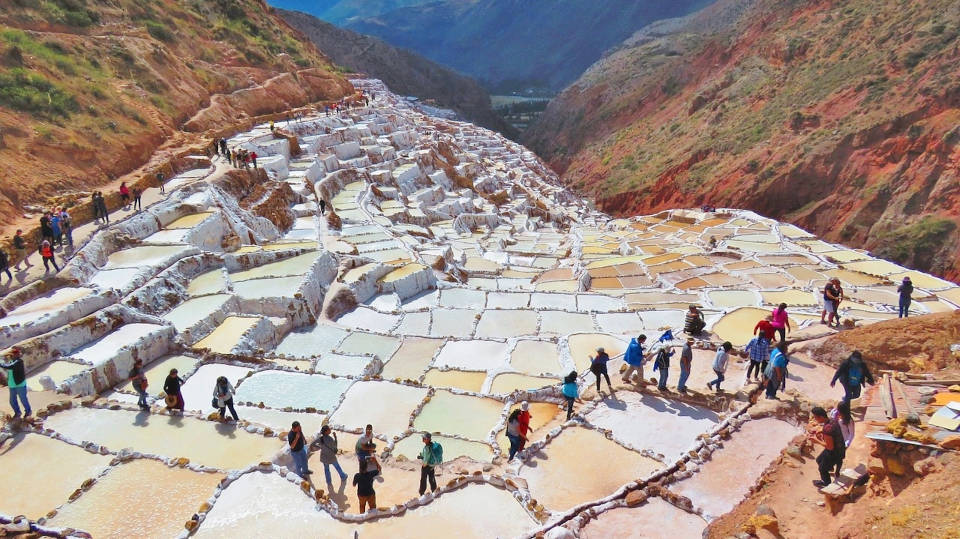
The salt ponds at Maras Salinas, Peru, are only 30 cm deep and are filled with brine channelling down from a subterranean source
Ten minutes’ drive from the picturesque Moray, we arrive at Maras. The salt pans, Salineras de Maras, are extraordinarily beautiful, with basins in all shades of reddish brown. It is a truly intriguing sight, even if each shallow pool is no more than 30 centimetres deep.
The brine comes from a subterranean source, and a clever Inca irrigation system channels the water through all the pools. As the water slowly evaporates, it leaves behind crystallised salt – a process that has existed since the Inca period. Salt was highly valued by the Incas for seasoning, preservation, and trade, making Maras a key economic site in the Sacred Valley. Its continued use today reflects both ancient engineering and enduring cultural practices.

Maras salt pans, Peru | Photo: Travel In Culture
We balance on the narrow edges of the pools, hardly able to stop taking photos. Surrounded by the characteristic mountainsides and peaks, the salt pans feel like the epitome of Andean beauty.

Market at Ollantaytambo | Photo: Ana Arantes
6. Ollantaytambo: Living Inca Town and Ceremonial Complex
We end our Sacred Valley Day 1 itinerary by visiting Ollantaytambo, the site of an impressive Inca military and religious complex. The town itself is remarkable: the only Inca town that remains relatively intact and still partly inhabited by descendants. We notice how the Incas carefully aligned the terraces, temples, and fortifications with the surrounding mountains, blending strategic planning with spiritual symbolism. One intriguing theory suggests that the Incas deliberately decorated the fortress so sumptuously that the Spaniards might have believed they had discovered Machu Picchu, successfully keeping the real citadel hidden.

Ollantaytambo | Photo: Jeremy Nelms
After a full day exploring Pisac, Moray, and Maras, we are struck by the ingenuity and cultural sophistication of the Inca civilisation. Our journey through these sites shows how astronomy, engineering, and agricultural knowledge were combined with daily life and ritual, creating landscapes that remain both functional and sacred today. Learning to travel this way is at the heart of our cultural travel method, which emphasises understanding heritage and uncovering deeper meaning in every destination.
Our driver takes us to Ollantaytambo Station, readying us for the next leg of the journey: the train to Machu Picchu. Continue to Day 2 of the Sacred Valley itinerary, featuring Machu Picchu
Frequently Asked Questions
How much time do you need to visit the Sacred Valley in Peru?
A full day is enough for highlights such as Pisac, Moray and Maras, but two days allows a more relaxed visit with time for Ollantaytambo and local markets. Many travellers combine the Sacred Valley with a visit to Machu Picchu.
What is the best time of year to visit the Sacred Valley?
The dry season from May to October offers the most stable weather and clearer mountain views. The wet season from November to April brings greener landscapes but more frequent rain showers.
How do you get to the Sacred Valley from Cusco?
Most visitors travel by road from Cusco, usually by organised tour, private driver or taxi. The journey typically takes between 1 and 2 hours depending on the destination within the valley.
Do you need tickets for Pisac, Moray and Maras?
Yes, most archaeological sites in the Sacred Valley require a Cusco Tourist Ticket, which covers entry to Pisac and other key ruins. Maras salt pans usually require a separate local entrance fee.
Is the Sacred Valley suitable for altitude sickness concerns?
The Sacred Valley sits at a lower altitude than Cusco, which makes it easier for most travellers to acclimatise. However, some visitors may still feel mild effects, especially during physical activity.
Can you visit Moray and Maras without a guided tour?
Yes, it is possible to visit independently by taxi or rental car, but roads can be narrow and logistics are easier with a guided tour. Many tours combine both sites in a single half day trip.
What is the cultural importance of the Sacred Valley?
The Sacred Valley was a key agricultural and ceremonial region of the Inca Empire, shaped by advanced engineering and spiritual beliefs. Many traditions and Quechua communities remain active in the area today.
How physically demanding is visiting Pisac ruins?
Pisac involves a steep uphill climb with uneven stone paths, which can be challenging at altitude. Visitors should allow time for breaks and proceed at a steady pace.
For a broader overview of Peru’s highlights and a suggested route through the country, you might enjoy reading our Suggested 10-day itinerary for exploring Peru, including Machu Picchu, the Sacred Valley, and beyond.
Read next: The Ultimate Cusco Travel Guide and Exploring the Lake Titicaca Floating Islands

Images courtesy of Travel In Culture. Selected images from Pixabay.