


Sami People in Lapland: Culture, Traditions and Places to Visit
By ANL | UPDATED:
Visiting the Sami people in Lapland offers one of the most authentic cultural experiences in Northern Europe. Across the Arctic landscapes of northern Norway, Sweden and Finland, Sami communities preserve traditions that have shaped life in the far north for generations. From reindeer herding and traditional lavvu tents to colourful clothing, handicrafts and the distinctive joik singing tradition, Sami culture remains an important part of modern Lapland.
Travellers can learn about Sami heritage through museums, cultural centres, festivals and guided experiences in places such as Karasjok, Kautokeino, Alta and Tromsø. Whether you are interested in Indigenous history, Arctic culture or sustainable travel experiences, Lapland provides unique opportunities to discover one of Europe’s oldest living cultures.

Photo: Travel In Culture
Where is Lapland
Political borders do not define Lapland – it is defined by the Sami people in Northern Norway, Northern Sweden and Northern Finland as the region of their natural land. Their culture has existed for thousands of years, and although slightly different, depending on time and location, across the vast Lapland, they are all unified by their simple and nomadic way of life and their addiction to and passion for the reindeer!
Check hotel availability in Tromsø, Alta, Karasjok or Kautokeino here:
The Sami settlements could be found anywhere in the wild landscape characterised by tundra, mountains and snow. That was where reindeer husbandry took place, and the Sami people of Lapland developed their culture. They had and still have traditions of drying, smoking and salting their food. For travellers interested in meaningful cultural encounters, our cultural travel method explains how to engage respectfully with local traditions and heritage.
Also, the traditional Sami song, joik, is still an essential part of the culture – like Sami handicrafts and cooking.
Sami people Norway | Photo: Travel In Culture
The indigenous Sami people are endemic to the northern parts of Scandinavia – Norway, Sweden and Finland, as well as the Kola Peninsula in Russia. This area is also known as Sápmi.
Traditionally, Lapland and the Sami people hold on to their cultural heritage, and the Sami language is also an official language here. When driving around Lapland, you will notice that the signposts are in Norwegian, Swedish or Finnish – and Sami!

Photo: Travel In Culture
The indigenous language is unique. Nine Sami languages are still spoken in Lapland, and they are quite different. A local speaking one language doesn’t necessarily understand Sami people speaking one of the other native languages. For example, ‘greeting’ is dearvvuođaiguin, varrudagáj or jijnjh heelsegh, depending on which Sami language you speak, or where in Lapland you are located. Another example is ‘have fun’, which could be saddá somá, suohtas sjaddá or luste sjædta depending on the specific language.
The original people traditionally followed the animals on their seasonal migrations, having a specific winter location, other calving and autumn grounds, and, again, distinct summer grounds. They brought their mobile tents, lavvus, with them during the eight seasons defined by the reindeer annual cycle (they have twice as many seasons as our four conventional seasons).

Photo: Reijo Telaranta / Pixabay
Another traditional dwelling is a goahti, a permanent cone-shaped structure with a timber frame filled with peat or turf.
In general, there were many rules and customs the family life would follow. Inside the goahtis / lavvus, the goddesses were represented, among others, the hunting goddess. She was also the goddess who saw to the birth of boys! During the reindeer hunting season, children and grandparents stayed at home in the goahtis. Visitors who found their way to the goahti would be seated on the right-hand side of the fireplace.

Photo: Travel In Culture
Until recently, the indigenous culture was suppressed – even in the central parts of Lapland! Nevertheless, it is now considered an important cultural heritage, and original traditions are maintained whenever possible, for instance, at the annual festivals taking place around Lapland. According to some sources, there are still around 30,000 – 40,000 people with Sami roots here in Norwegian Lapland!
Today, the Sami culture has, to some extent, adapted to modern life. Some (a few) are still proper reindeer herders with reindeer husbandry, whereas others have transformed their primary occupation into being farmers, hunters or fishermen.
Photo: Jacqueline Macou / Pixabay
Quite a few of the traditional Sami people have also moved to the towns of Northern Norway, creating a new and different lifestyle there.
The Sami people don’t exclusively exist in the very north of Scandinavia. In Norway, the Southern Sami people live as far to the south as Engerdal, with Snåsa as the main town in the Norwegian Southern Lapland. Travellers exploring central Norway can also discover Indigenous and medieval heritage near Trondheim, one of the country’s most historic cities and a gateway to the Southern Sami region.

Photo: Travel In Culture
Photo: Travel In Culture
Research has revealed that quite a few Norwegians in Northern Norway, even in the Lofoten Islands, have native roots – maybe even without knowing it!
The Sami National Day, Sámi álbmotbeaivi, is celebrated every year on 6th February – an event still uniting the Sami people across Lapland. For this celebration, you can experience the authentic culture, including the traditional joik, a unique indigenous singing style which continues in Lapland as a living tradition.

Photo: Travel In Culture
Options to gain insight into the Sami people and their traditional way of life are, for example, to visit:
Alta is a gateway to the authentic culture and communities in Northern Norway.
Try, for instance, a local experience in Sorrisniva, 20 minutes from the centre of Alta. At the site, you can stay in the world’s northernmost ice hotel, go on a snowmobile safari, stay in a tent in a Lavvu camp, try ice fishing, experience the Northern Lights, jump on a reindeer sleigh and much more.
You could also visit the Sami Siida and try a reindeer ride, experience the traditional joik and storytelling, learn about the Northern Lights and taste traditional food!
Photo: Travel In Culture

Photo: Travel In Culture
Visit the small town Karasjok, southeast of Alta, close to the Finnish border. The community is home to the Norwegian Sami Parliament, Sametinget, which opened in 1989. It provides the native Lapland people with cultural autonomy through 39 representatives.
Kautokeino is one of the traditional Sami towns in Northern Norway, located south of Alta. Visit the Kautokeino Cultural Centre, comprising several cultural institutions, including the Nordic Sami Institute. In Kautokeino, the vast majority speak Sami as their primary language. 90% of the population here are indigenous!
Photo: Travel In Culture
Attend the annual Sami week in Tromsø with reindeer racing through the streets and exciting lasso-throwing contests. Moreover, local language courses, concerts, and lavvus erected in central Tromsø are all part of the winter market taking place here during the week including the 6th of February, the Sami People’s National Day.
If you wish to see reindeer in the wild, you may head to Kvaløya, just off Tromsø. With some luck, it should be possible to spot a few reindeer – even sometimes along the road!
You may also learn about the indigenous culture at Tromsø Museum. If you plan to spend extra time in the Arctic city, see our guide to Tromsø and its cultural attractions.
Visit the Southern Sami cultural centre, the Saemien Sijte in Snåsa. It represents the Southern Sami culture existing in the area between Saltfjellet to the north and Engerdal to the south. Snåsa is the Southern Sami main town, and Sametinget (the parliament) is also represented here.
At the Saemien Sijte, you can learn about indigenous traditions, history and culture and experience the local way of life. There is a museum with an exhibition covering the development of the Sami culture, clothing etc., right from when the people were true bear hunters – till modern times in the Norwegian cities today. The visit includes watching a film about the reindeer and the annual reindeer husbandry cycle. You will also learn about the traditional family life inside a grass hut (‘goahti’).
Photo: Javier Ortincervera / Pixabay
You will find this Sami site near Sortland in Nordland. It is located on the island Hinnøya near the Sortland bridge in the direction of Andenes and Andøya. Visit a Sami family with a 150-year-long tradition of reindeer herding.
Here, you can learn more about the Sami culture and way of life, meet reindeer, experience storytelling, sit at the fireplace in a lavvu, the typical Sami hut, stay overnight and try authentic food.
Hike on Saltfjellet at the Arctic Circle monument. Here, you will find traces of the Sami route when herding the reindeer across the mountains for the annual migration. You will be stunned by the breathtaking landscape.
Many travellers combine a Sami culture itinerary with a wider journey through the country. See our guide to exploring Norway’s fjords, cities and cultural highlights.
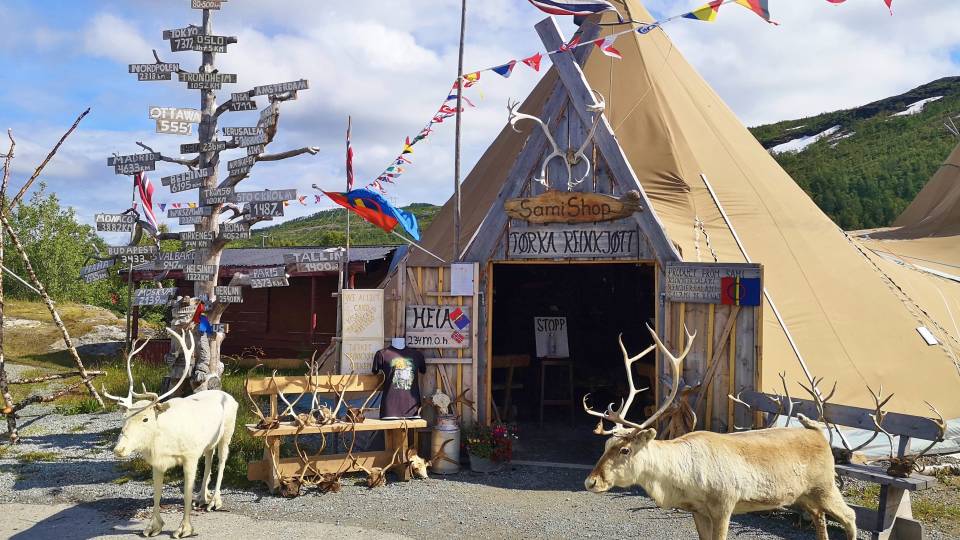
Heia is an awesome shop along the main road at Storsteinnes, selling all kinds of products: reindeer fur, antlers, sausages, clothes, knitwear … you can find anything here! It is an excellent stop on the way to or back from Northern Norway.
Photo: Travel In Culture
For a Sami vacation – participate in one of the annual festivals, either in Tromsø (the Sami week) or the Riddu Riđđu annual July music and culture festival in Manndalen at Kåfjord on the shores of the Lyngenfjord – with workshops, markets, film, theatre and art exhibitions.
Continue to Sweden and visit the winter gathering point in Swedish Lapland, the Jokkmokk winter market. It is a 400-year-old market for the Sami people with folk music, parades, dog sledging, local food and much more. It is known for being very cold – down to 40 degrees centigrade below zero!
Photo: Kenneth Bergdahl / Pixabay

Photo: Travel In Culture
Frequently Asked Questions
Who are the Sami people?
The Sami are the Indigenous people of Sápmi, a cultural region that stretches across northern Norway, Sweden, Finland and part of Russia.
Where can you experience Sami culture in Norway?
Some of the best places include Karasjok, Kautokeino, Alta, Tromsø and the Southern Sami cultural centre at Snåsa.
What is traditional Sami culture known for?
Sami culture is known for reindeer herding, joik singing, handicrafts, traditional clothing and a strong connection to Arctic nature.
Can visitors meet reindeer in Lapland?
Yes, many Sami cultural centres and family-run experiences offer opportunities to meet reindeer and learn about reindeer husbandry.
What is a lavvu?
A lavvu is a traditional Sami tent designed for mobility during seasonal migrations and adapted to Arctic weather conditions.
When is Sami National Day celebrated?
Sami National Day is celebrated every year on 6 February with cultural events, music, festivals and community gatherings across Sápmi.
What language do the Sami people speak?
Several Sami languages are spoken across Lapland, and some are recognised as official minority languages in Nordic countries.
How much time should you allow to explore Sami culture?
One to three days is usually enough for museum visits and cultural experiences, while a longer stay allows deeper exploration of Sami communities and Arctic landscapes.
Is it possible to visit Sami festivals?
Yes, visitors can attend events such as Sami Week in Tromsø and the Riddu Riđđu Festival, which celebrate Indigenous culture, music and traditions.
Read more about Tromso: Tromso Travel Guide
Going to Oslo? Then you may want to read What Are Spectacular Things to Do in Oslo?
Would you like to get inspiration to visit Røros mining town? Then read Explore Røros Mining Town

Images courtesy of Travel In Culture. Selected images from Pixabay.