


9 Best Things to Do in Fukuoka, Japan (Hakata) + Where to Stay
By ANL | UPDATED:
All photographs in this article were taken by Travel In Culture.
Discover the best areas and attractions in Fukuoka (Hakata).
🍜 Famous food: Hakata ramen & yatai street food
🚄 Main transport hub: Hakata Station
🛍️ Shopping & nightlife: Tenjin & Nakasu
⛩️ Top cultural spots: Kushida Shrine & Tochoji Temple
🌳 Best green space: Ohori Park
📍 Ideal stay: 2–4 days
Fukuoka is one of Japan’s most rewarding cities for travellers who want to combine food, history and contemporary urban life. Its eastern side, Hakata, preserves the legacy of a centuries-old trading port, while Tenjin provides the city’s modern shopping and dining centre.
Fukuoka and Hakata are often used interchangeably, which can be confusing for first-time visitors. Hakata is the historic merchant district and eastern part of the city, while Hakata Station is Fukuoka’s main railway hub.
If you are wondering where to stay in Fukuoka, the choice largely comes down to Hakata for transport and historic sights, Tenjin for shopping and dining, or the Nakasu area for nightlife and yatai.
This guide covers the best areas to stay and nine experiences that reveal a different side of Fukuoka – from Hakata’s temples and shrines to Ohori Park, Fukuoka Castle, markets, shopping, and the city’s famous night-time food stalls.
🚄 Transport & first-time visit → Hakata
🏯 Historic temples & Hakata Old Town → Hakata
🛍️ Shopping & city life → Tenjin
🍜 Dining & evening atmosphere → Tenjin or Nakasu
🍢 Yatai & nightlife → Nakasu
🚶 Exploring the city on foot → Hakata or Tenjin
Today, Fukuoka is an exciting city for food, culture, shopping, and nightlife. It combines modern architecture, famous Hakata ramen shops, lively shopping districts, and traditional temples linked to its samurai-era castle history. A stay in Fukuoka is a cultural experience, allowing you to discover the aspects of the city that interest you most. Our cultural travel method focuses on combining local culture, food, architecture, history, and everyday life experiences when exploring destinations such as Fukuoka and Hakata.
Fukuoka or Hakata: What Is the Difference?
Fukuoka and Hakata were historically distinct settlements: Hakata was the merchant town, while Fukuoka developed around the castle and samurai domain. In 1889, they were unified as Fukuoka City. The distinction is still culturally useful today, even though Hakata is now a ward/area within Fukuoka City.
Where should you stay in Fukuoka?
For most visitors, the choice comes down to Hakata, Tenjin or Nakasu. Hakata is particularly convenient for transport and exploring historic sights, Tenjin is the city’s main shopping and dining district, while Nakasu is known for nightlife, restaurants and yatai.
Where to Stay in Fukuoka: Hakata, Tenjin or Nakasu?
| Area | Best for | Why stay here? |
|---|---|---|
| Hakata | Transport & first-time visitors | Hakata Station is Fukuoka’s main transport hub, with Shinkansen connections and easy access to the rest of the city. Historic temples and shrines are also within walking distance. |
| Tenjin | Shopping, dining & city life | Fukuoka’s main commercial centre, with department stores, cafés, restaurants, Daimyo boutiques and the Tenjin Underground Mall. |
| Nakasu | Nightlife & yatai | Located between Hakata and Tenjin, Nakasu comes alive in the evening with restaurants, bars, entertainment and nearby yatai food stalls. |
Notable landmarks include the Hakata Port Tower and the Fukuoka Tower. Kawabata Shopping Arcade is Fukuoka’s oldest shopping street, with 130 shops covering everything from gift shops to ramen shops.
From historic Hakata to modern Tenjin and the green spaces around Ohori Park, Fukuoka is easiest to appreciate by exploring its different neighbourhoods on foot. Here are nine experiences that bring together the city’s history, food, architecture and everyday life.
1. Explore the Colourful Canal City Hakata

Canal City Hakata combines shopping, restaurants, entertainment and an artificial canal in a distinctive, multi-level complex between Hakata and Nakasu | Photo: Travel In Culture
Explore Canal City Hakata, a large entertainment and shopping complex between Hakata and Nakasu. With its 250 shops, restaurants, gaming centre, theatre, and more, it can best be described as an open-air ‘city in the city’. As the name suggests, an artificial canal runs through the entire canyon-like complex, which also includes a trickling fountain. The 180 m long canal was designed by the American architect Jon Jerde in 1977 as one of his many unique urban projects in shopping malls around the world. The architecture is striking, with red, blue and green used throughout the structures, water features and lush planting. Water spray, laser light, and music contribute to the effect.
Canal City Hakata architecture and shopping area in Fukuoka.
Water area inside the Canal City Hakata.
Inside the mall, you will find a plethora of shops that sell both Japanese and international brands. If you are looking for Hakata culinary specialities, Canal City is also the place to visit. You will find a wide variety of restaurants serving Japanese dishes, including the famous Hakata Ramen. The fifth floor has no less than eight ramen shops in the Ramen Stadium!
If you are looking for where to stay in Fukuoka near Canal City Hakata, there are many excellent hotel options close to the shopping and entertainment complex.
2. Walk, Relax and Take a Boat on Ohori Park
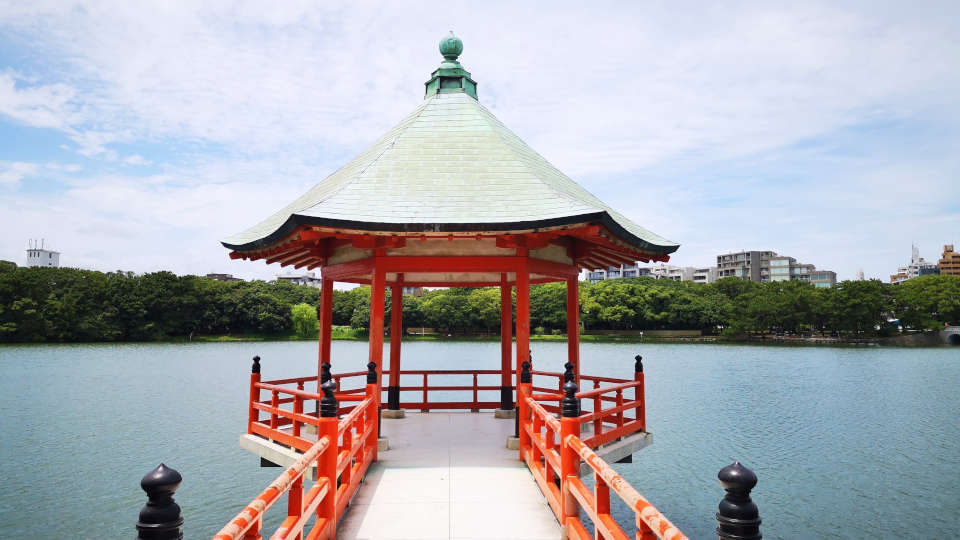
Ohori Park with its lake is a relaxing green space in central Fukuoka | Photo: Travel In Culture
In central Fukuoka, Ohori Park surrounds a large picturesque pond where you can walk, jog, sit by the water or take a boat. Inside the pond, the three islands are connected by bridges and a path, allowing people to get out onto the islands and across the pond.
Right beside Ohori Park, you will find Fukuoka Art Museum, an excellent museum with works by international modern artists such as Joan Miró and Salvador Dalí and exhibits of Buddhist statues.
3. Discover Asian and Modern Art at Fukuoka Art Museum

Fukuoka Art Museum is located next to Ohori Park.
Set beside Ohori Park, Fukuoka Art Museum combines Asian art, Buddhist sculpture and modern works in a building designed by Maekawa Kunio. In addition to Western contemporary art and famous international artists such as Chagall, Miró, and Dalí, Japanese local and absolutely world-class creators, such as Shigeru Aoki and Yayoi Kusama, are represented here.
Many visitors come to see Kusama’s characteristic and fascinating giant pumpkin for themselves. Main works include the 12th-century seated Buddha statue. Other collections, besides Buddhist art, include local works of pre-modern and modern art by recognised or promising regional artists.
4. Walk Among the Ruins of Fukuoka Castle in Maizuru Park
Fukuoka Castle ruins in Maizuru Park.
Maizuru Park surrounds the ruins of Fukuoka Castle and lies immediately beside Ohori Park, making the two parks easy to combine on the same walk. The area is especially atmospheric during cherry-blossom season, when the park becomes a popular hanami spot. Furthermore, it is an attractive place to go for a walk or enjoy the cultural offers in the area.
Fukuoka Castle dates back to the early 17th century when Kuroda Nagamasa built it. His clan remained in power here until the abolition of the Japanese feudal system in the late 1800s. During the Edo period (1603-1868), the massive castle was the largest in Kyushu. However, this did not last, as Fukuoka Castle was demolished as a result of the Meiji Restoration. That explains why only the ruins of the walls remain today. For comparison, Fukuoka offers a very different atmosphere from northern Japanese cities such as Sapporo.
5. Taste Fukuoka’s Seafood at Yanagibashi Market

Yanagibashi Market is famous for fresh seafood and local Fukuoka cuisine | Photo: Travel In Culture
Yanagibashi Market is a 120-metre-long market arcade with over 70 stalls offering fresh, high-quality seafood. It is known as the Fukuoka Kitchen – or rather Hakata’s Kitchen.
Walk through Yanagibashi Market and look for fresh seafood and local specialities before stopping at one of the market’s food stalls or nearby restaurants. Fukuoka has an abundance of fresh fish due to a large variety of fresh fish in the Genkai Sea and the Sea of Japan.
6. Shop Your Way Through Tenjin Underground Mall
Tenjin Underground Mall connects the city’s major shopping and transport areas | Photo: Travel In Culture
Head west from Hakata Station to Tenjin, Fukuoka’s major commercial district, where department stores, cafés, restaurants and underground shopping arcades fill the area. Yatai stalls, pop-up restaurants, and fashionable cafés are favourite places to go after shopping.
Tenjin Underground Mall is a popular shopping arcade.
Tenjin Underground Mall (Tenjin Chikagai) is a gigantic underground mall that offers about 150 stores to the citizens who do not want to leave the area between Tenjin Subway Station and Tenjin-Minami Subway Station – for reasons of convenience (e.g., on rainy days). The mall has existed since 1976 and has become a permanent option in the city.
7. Explore Hakata Old Town’s Temples and Shrines
Hakata Old Town is where Fukuoka’s history as a merchant and trading city becomes particularly tangible. A cluster of temples and shrines, including Tochoji, Jotenji and Shofukuji, can be explored on foot around the streets north-west of Hakata Station.
Start around Tochoji Temple, then continue through Hakata’s historic temple and shrine district towards Jotenji and Shofukuji. This is one of the best areas to understand Hakata’s history as a merchant and trading town.
Tochoji is one of Hakata’s historic temples and one of the most interesting stops on a walk through the old temple district. Its main attraction is the enormous seated wooden Buddha, while the temple grounds also contain a striking five-storey pagoda.
Tochoji Temple in Hakata, Fukuoka.
Tochoji Temple was founded in 806 and is thus one of Japan’s historic Shingon Buddhist temples – it is known in Fukuoka for having the tallest seated wooden Buddha statue in the country. The over 10m tall carved Buddha sits inside a side building of the main hall, where you will also have to find your way through a dark labyrinth to get out – so stay outside if you don’t fancy dark temple corridors! However, the labyrinthine passage used to exit the building has a symbolic significance. Before you enter the darkness, a series of artworks illustrate suffering people in ‘hell’. At the end of the walk, you will reach ‘heaven’ – guided by Buddha in the darkness!
Besides the main building, a beautiful 5-storey pagoda is also on the temple grounds.
8. Discover Hakata’s History at Kushida Shrine
Historic Kushida Shrine in Hakata.
Kushida Shrine in Hakata dates back to 757 when Hakata Port played a significant role in the trade between Japan and China and belongs to the oldest shrines in Fukuoka, now the guardian shrine of Hakata. It is known to be a focal point of the Hakata Gion Yamakasa festival dedicated to this shrine. As the festival’s main venue, it is the starting point for the float race.
View through the wooden gate at Kushida Shrine.

The crane fountain at Kushida Shrine.
Take time to explore the shrine grounds, where you can see the huge kakiyama festival floats, an ancient ginkgo tree, the stones associated with sumo wrestling, and the crane fountain. The shrine is also closely associated with Hakata Gion Yamakasa, one of Fukuoka’s major traditional festivals.

Festival floats at Kushida Shrine.
The huge kakiyama festival floats | Photo: Travel In Culture
9. Spend an Evening in Nakasu and Try a Fukuoka Yatai

Nakasu nightlife district.
Nakasu is a night-time entertainment and dining district on an island between the Nakagawa and Hakata rivers, with restaurants, bars, entertainment venues and yatai. Historically, the island has been a key to the city as the bridge island between the two riverbanks. A total of 3,500 establishments are scattered around the area, so this really is the place to go for a night out and perhaps a karaoke experience!
The Fukuoka speciality Hakata Ramen.
At night, the island is a vibrant area with entertainment and yatai food stalls, the typical eateries that open at the end of the day. In the evening, head towards the riverside areas around Nakasu and nearby districts to experience Fukuoka’s famous yatai, small food stalls that serve dishes such as Hakata ramen, yakitori, motsunabe and oden. Generally, these are small, temporary restaurants that pop up at night and have seating for less than ten people. Typical things to eat here are the Fukuoka speciality Hakata Ramen, the stew motsunabe, yakitori, and oden.


FAQs about Fukuoka (Hakata) in Japan
Is Fukuoka the same as Hakata?
Fukuoka and Hakata are often used interchangeably, but Fukuoka is the modern city name while Hakata refers to the historic district and the main station area. Most visitors stay around Hakata Station for transport convenience.
Where is the best area to stay in Fukuoka?
Hakata is convenient for transport and historic sights, while Tenjin is particularly well suited to shopping, restaurants and city life. Nakasu is convenient for nightlife, restaurants and yatai.
How many days should you spend in Fukuoka?
Most travellers spend two to four days in Fukuoka. This is enough time to explore Hakata, Tenjin, Ohori Park, temples, and enjoy local food such as Hakata ramen and yatai street stalls.
What is Fukuoka famous for?
Fukuoka is known for Hakata ramen, yatai street food stalls, historic temples, shopping districts like Tenjin Underground Mall, and cultural landmarks such as Kushida Shrine and Fukuoka Castle ruins.
How do you get around Fukuoka?
Fukuoka is easy to navigate using the subway, buses, and walking. Hakata and Tenjin are the main transport hubs, and most attractions are within short train or taxi rides.
Take the Shinkansen train to Tokyo and explore the world’s biggest city! Discover the various areas of Tokyo and decide where to stay in Tokyo based on your interests.
Read next: Japan’s Statue of Liberty and Tokyo Rainbow Bridge and Where to Stay in Sapporo
