


One Day in Florence: Best Walking Route & Self-Guided Itinerary
By ANL | UPDATED:
The best way to see Florence in one day is a self-guided walking route starting at the Duomo, continuing through Piazza della Signoria and Mercato del Porcellino, crossing the Ponte Vecchio into the Oltrarno district, and finishing at Boboli Gardens and Piazzale Michelangelo. The full route takes around 6–8 hours and covers Florence’s key Renaissance landmarks on foot.
This self-guided walking route is designed for first-time visitors who want to experience Florence’s most famous landmarks in a single day without using public transport or repeatedly crossing the city. It is part of our Florence itineraries and follows the principles of our cultural travel method, combining logical route planning with historical context and cultural highlights.
Distance: Around 8–10 km on mostly pedestrian streets.
Duration: Allow a full day (6–8 hours), including sightseeing, lunch, and optional museum visits.
Difficulty: Easy to moderate, with one uphill walk to Piazzale Michelangelo.
Best viewpoint: Piazzale Michelangelo offers Florence’s classic skyline panorama and is especially beautiful in the late afternoon or at sunset.
Optional paid attractions: Brunelleschi’s Dome, Palazzo Pitti, Boboli Gardens, and the Bargello National Museum.
Overview: One-Day Walking Route in Florence
Duomo
↓ 8 min
Piazza della Signoria
↓ 4 min
Mercato del Porcellino
↓ 3 min
Uffizi Gallery (Exterior)
↓ 2 min
Ponte Vecchio
↓ 6 min
Palazzo Pitti
↓ 2 min
Boboli Gardens
↓ 20 min uphill
Piazzale Michelangelo
Santa Croce
•
Bargello Museum
| Time | Walking route | Highlights |
|---|---|---|
| Morning | Duomo → Piazza della Signoria → Uffizi exterior | Cathedral complex, Baptistery, Palazzo Vecchio, Renaissance streets |
| Midday | Ponte Vecchio → Oltrarno (Pitti side) | River Arno views, Vasari Corridor, artisan district, lunch area |
| Afternoon | Boboli Gardens → Piazzale Michelangelo | Renaissance gardens, panoramic viewpoints and sweeping views over Florence |
| Optional Stops | Santa Croce (detour) or Bargello Museum | Historic basilica, Renaissance art and sculpture, or an indoor museum to finish the day |
Total walking time: ~4–6 hours excluding museum visits and stops.
Self-guided walking route in Florence
Florence in one day is best experienced on foot by following a structured walking route through the historic centre, allowing you to see the city’s most important landmarks in a logical and efficient order.
This itinerary guides you from the Duomo and Piazza della Signoria to the Uffizi exterior, across the iconic Ponte Vecchio, and into the Oltrarno district before finishing at Piazzale Michelangelo for sweeping panoramic views over Florence.

Panoramic view of the Ponte Vecchio spanning the Arno River | Photo: Travel In Culture
It is designed for first-time visitors who want to experience Florence’s essential highlights in a single day without rushing, backtracking or wasting time on complex planning.
Along the route, you will discover Renaissance churches, elegant piazzas, artisan workshops, lively markets, riverside viewpoints, and some of Florence’s finest architectural landmarks.
Santa Croce works as a short walking detour, while the Bargello National Museum is best saved as an optional indoor stop at the end of the day.
Where to Stay in Florence
Morning: Historic Centre (Duomo & Piazza della Signoria)
Allow: 2–2.5 hours.
Start your day at Piazza del Duomo before walking through Florence’s medieval streets towards Piazza della Signoria. This part of the walk covers Florence’s religious and political heart and is almost entirely pedestrianised. From Piazza della Signoria, continue through the narrow medieval streets to Mercato del Porcellino, where you can browse Florence’s famous leather market and rub the bronze wild boar’s nose before walking a few minutes to Ponte Vecchio.
Duomo Complex
The Florence Duomo dominates Piazza del Duomo and marks the starting point of this self-guided walking route through Florence.
Begin your day at Piazza del Duomo, Florence’s religious heart and one of Italy’s most impressive squares. The vast Cathedral of Santa Maria del Fiore dominates the skyline with Brunelleschi’s famous Renaissance dome, while Giotto’s Bell Tower and the octagonal Baptistery of San Giovanni complete one of the city’s most celebrated architectural ensembles.
Even if you do not plan to climb the dome or visit the cathedral interior, allow time to walk around the square and admire the intricate white, green and pink marble façades. Early morning is usually the quietest time to experience the Duomo before larger tour groups arrive. Discover more details about the Duomo in our 3-day Florence itinerary.
Piazza della Signoria
Continue from the Duomo to Piazza della Signoria, where the replica of Michelangelo’s David welcomes visitors outside the historic Palazzo Vecchio.
A short walk along Via dei Calzaiuoli brings you to Piazza della Signoria, Florence’s historic political centre. The elegant square has served as the city’s civic heart since the Middle Ages and is surrounded by some of Florence’s most important Renaissance buildings.
Dominating the piazza is Palazzo Vecchio, Florence’s historic town hall, while the open-air Loggia dei Lanzi displays remarkable Renaissance sculptures. You will also find a replica of Michelangelo’s David standing outside the palace entrance, making this one of Florence’s best places to appreciate Renaissance art without entering a museum.
From Piazza della Signoria, continue through the narrow medieval streets to Mercato del Porcellino, where Florence’s famous leather market and the bronze wild boar await before the route continues toward Ponte Vecchio.
Mercato del Porcellino

The wild boar at Mercato del Porcellino can bring you good luck if you put a coin into its mouth.
Continue a few hundred metres, and you will find Florence’s leather market at Mercato del Porcellino, also known as Loggia del Mercato Nuovo or Loggia del Porcellino. The Renaissance building is from the 16th century and was intended for the sale of products like silk and other precious goods in Florence.
Even today, it remains a vibrant marketplace filled with leather goods and other souvenirs — you might just find a great deal here!
The author Hans Christian Anderson got inspired by the wild boar and wrote in 1846 a story, The Bronze Hog. In the story, a poor boy falls asleep on the back of the boar, which, at night, comes to life and takes the boy happily through the streets of Florence.
Uffizi Gallery (Exterior)
Before reaching Ponte Vecchio, you will pass the Uffizi Gallery, one of the world’s greatest art museums and home to masterpieces by Botticelli, Leonardo da Vinci, and Michelangelo. Even if you are not visiting the museum on this one-day itinerary, the elegant courtyard and the view toward the Arno are well worth a short stop. See our 3-Day Florence itinerary for a more detailed visit.
Midday: Ponte Vecchio & Oltrarno District
Allow: 1.5–2 hours.
Continue towards the River Arno via the Uffizi area before crossing Florence’s most famous bridge into the artisan quarter of Oltrarno.
Ponte Vecchio
Cross the iconic Ponte Vecchio as you continue your one-day walking itinerary from Florence’s historic centre into the Oltrarno district.
Originally, the bridge was lined with butcher shops. The butchers conveniently dumped the meat waste from the bridge into the River Arno! The architect Vasari brought this to an end by introducing jewellery shops on the bridge instead of the ill-smelling butcher shops.
That was part of the Vasari Corridor project undertaken for the Medici, linking the Palazzo Vecchio to the Palazzo Pitti on the other side of the river through an enclosed, elevated walkway.
When you look at the Ponte Vecchio from the street along the river, notice the small windows on the upper part of the buildings over the bridge. From the Corridor on top of the bridge, the Medici family would get a panoramic view of Florence through these windows! Both Benito Mussolini and Adolf Hitler were impressed by the stunning Ponte Vecchio, and it was, therefore, spared during WWII as the only bridge in Florence!
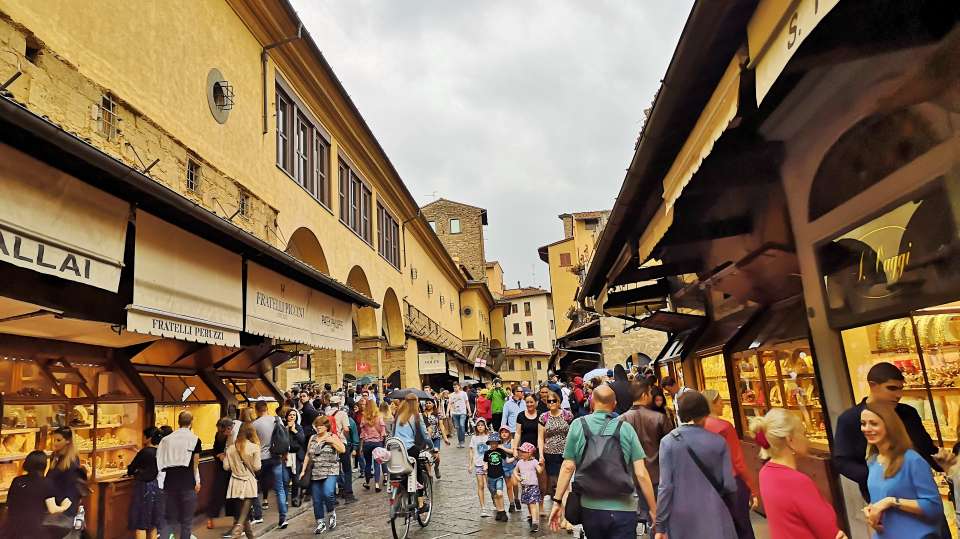
Walk onto the bridge and take your time to people-watch and browse the jewellery shops and souvenir stores. In centuries past, this was where Florence’s butchers sold their meat before they were replaced by goldsmiths and jewellers.
The Ponte Vecchio has been lined with jewellers’ shops for centuries, making it one of the most memorable stops on this one-day Florence walking itinerary | Photo: Travel In Culture
Palazzo Pitti
The Palazzo Pitti from the 15th century is traditionally attributed to Filippo Brunelleschi who designed it for Luca Pitti. It is a grandiose palace, mainly in Renaissance style, on the River Arno south bank.
In 1550, the wife of the Grand Duke Cosimo I de’Medici, Eleonora da Toledo, purchased it and turned it into the Medici family residence. As a curiosity, the left wing belonged to the Grand Duke, and the rooms on the left side of the ground floor were his summer residence.
Today, the palace houses several magnificent museums. It is the largest museum complex in Florence and a must-see for museum lovers. You will find the Imperial and Royal Apartments, the Gallery of Modern Art, the Palatine Gallery with the Medici‘s collection of paintings, the Silver Museum, and the Museum of Costumes and Fashion among them. If time allows, consider visiting one or two of these outstanding museums.
Afternoon: Boboli Gardens & Piazzale Michelangelo Viewpoint
Allow: 2–3 hours.
Spend the afternoon exploring Florence’s grandest Renaissance gardens before climbing to the city’s most famous viewpoint.
Boboli Gardens

Explore the beautiful Boboli Gardens before continuing to Piazzale Michelangelo, the final stop on this one-day Florence walking itinerary.
When entering and exiting the Palazzo Pitti, you will be right at the Boboli Gardens (Giardino di Boboli) – the vast park just in front of the palace, one of the largest Italian-style gardens in the world. The Boboli Gardens later inspired several celebrated European gardens, including those at Versailles.
The Boboli Gardens belongs to the Palazzo Pitti, and there you will buy your tickets to see the most impressive gardens in Florence!
You will soon discover that it is a hilly garden, offering plenty of great spots with excellent views of Florence!
Originally, the park was laid out by Cosimo I de´ Medici and by his wife Eleonora di Toledo when they purchased the Palazzo Pitti in 1550. At the time, architects such as Niccolò Tribolo and Giorgio Vasari were in charge of the design of the park area.
The Medici and, later, the Lorraine families greatly influenced the park character by including small meadows, lush groves and even an outdoor museum of Roman statues. It is a garden that developed throughout four centuries.
Piazzale Michelangelo

Piazzale Michelangelo offers one of Florence’s most famous panoramic views and is the perfect final stop on this self-guided walking route.
For a breathtaking view over Florence, make a stop at the Piazzale Michelangelo viewing platform before heading back down to the River Arno.
The neoclassical terrace was designed by the architect Giuseppe Poggi and constructed in 1869. It is dedicated to the Renaissance sculptor Michelangelo and features bronze copies of his David sculpture and his statues in the Medici Chapel of San Lorenzo. Nine pairs of oxen were needed to bring the massive monument to its elevated location on the hillside.
After enjoying the views and capturing the ultimate photos of Florence, make your way down to the iconic Ponte Vecchio spanning the River Arno.
Optional Stops: Santa Croce (Detour) & Bargello Museum (End-of-Day Option)
Santa Croce (Optional Detour)
Santa Croce is a short detour from the main walking route and works best if you still have energy in the afternoon before heading back toward the city centre.

Basilica di Santa Croce is the largest Franciscan church in the world.
The impressive Basilica di Santa Croce is the principal Franciscan church in Florence and the largest of its kind in the world! It dates back to 1294, rebuilt by Arnolfo di Cambio. In all, it has sixteen chapels. Some of them were owned by noble, wealthy Florentine families who also contributed financially to the church works. Many chapels have fresco decorations which can be attributed to the Florentine painter and architect Giotto.
According to the legend, Santa Croce was founded by St. Francis. Before the construction of the Basilica, this area was outside the city walls and was plain marshland!
There are three cloisters: the Ancient Cloister, the Cloister of the Dead, and the Primo Chiostro, or the main cloister. It features the chapel Cappella dei Pazzi, primarily designed by Filippo Brunelleschi and considered a true masterpiece in Renaissance architecture.
The church is also the burial place of famous people like Michelangelo, Galileo, and Rossini. It is known as ‘The Temple of Italian Glories’. Leonardo da Vinci has a commemorative plaque inside the church. There is also a memorial to Dante, although his sarcophagus is empty as he rests in Ravenna!
Bargello National Museum (End-of-Day Indoor Option)
The Bargello National Museum is a great end-of-day indoor stop if you prefer to finish your itinerary with art and sculpture rather than another outdoor walk.
The Bargello National Museum is inside the impressive Palazzo del Bargello, an old fortress in Florence. It is one of the oldest buildings in Florence, dating back to 1255. In the beginning, it was the headquarters of the Capitano del Popolo (meaning Captain of the People). Later, in the 16th century, it became the residence of the Bargello (the police), and even later, in the 18th century it was being used as a prison!
Today, the old fortress houses the Bargello National Museum with a collection of important Renaissance sculptures and masterpieces by famous artists like Michelangelo (for instance, his renowned David Apollo from 1530), Donatello, Luca della Robbia, Verrocchio, and Cellini. The museum is as significant to sculptures as the Uffizi Gallery is to paintings.
This itinerary is based on a route that can comfortably be completed on foot in one full day while allowing time to enjoy Florence’s historic atmosphere rather than rushing between attractions. Because the route is entirely walkable through Florence’s UNESCO-listed historic centre, it is ideal for first-time visitors who want to experience the city’s Renaissance highlights without relying on public transport.
Florence One-Day Walking Itinerary – FAQ
Is Florence walkable in one day?
Yes, Florence is highly walkable. The historic centre is compact (UNESCO-listed), and this route covers roughly 8–10 km between the Duomo, Piazza della Signoria, Ponte Vecchio, and Piazzale Michelangelo.
How long does it take to walk this Florence itinerary?
The full route takes around 6–8 hours including stops, lunch and short visits. Pure walking time is approximately 4–6 hours depending on pace.
Do I need to book tickets for Florence attractions in advance?
Yes, for popular attractions such as Brunelleschi’s Dome and the Uffizi Gallery, advance booking is strongly recommended, especially between April and October.
What is the best time of day to visit Piazzale Michelangelo?
Late afternoon and sunset are the best times, when the light is soft and Florence’s skyline is most atmospheric.
Can I do this Florence itinerary without a guide?
Yes, this route is designed as a self-guided walking itinerary. Clear signage and compact distances make it easy to follow without a tour guide.
Where should I eat during a one-day Florence visit?
The best area for lunch is the Oltrarno district near Ponte Vecchio and Palazzo Pitti, where you will find traditional trattorias and smaller local restaurants.
Is Boboli Gardens worth it on a short visit?
Yes, but it depends on time. Boboli Gardens are best if you enjoy Renaissance landscapes and viewpoints; otherwise, you may prefer spending more time in the city centre or at Piazzale Michelangelo.
Continue Exploring Florence & Tuscany
Staying for more days in Florence? If you have more time in Florence, you might want to take a look at 3 Days in Florence Itinerary and our Florence Hub for inspiration. For instance, you could consider visiting the Cathedral of Santa Maria del Fiore, Giotto’s Campanile, Baptistery of San Giovanni, Piazza della Signoria or the Uffizi Gallery.
Read more about day trips in Tuscany: Best Itineraries in Tuscany and 5 Easy Day Trips from Florence – and read our Guide to Siena and Guide to Volterra in Tuscany. For other destinations in Tuscany, see our Tuscany Travel Hub
Read next: Where to Stay in Rome – Which Neighbourhood Suits You Best?

Images courtesy of Travel In Culture. Selected images from Pixabay.