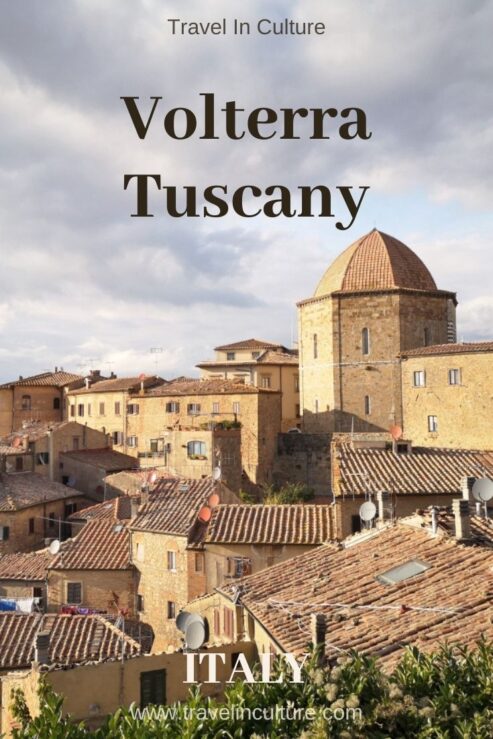




Volterra, Tuscany: A Guide to Italy’s Etruscan Hilltop Town
By ANL | UPDATED:
All photographs in this article were taken by Travel In Culture.
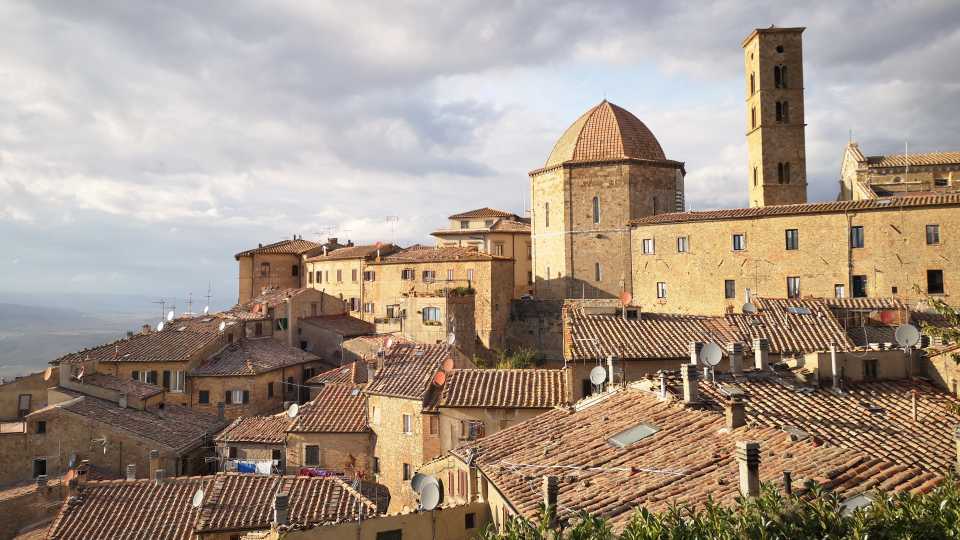
Volterra is not simply another picturesque hill town in Tuscany. Perched on a high ridge between the valleys of the Era and Cecina, it is a place where several thousand years of history remain remarkably visible. Etruscan walls, Roman ruins, medieval streets, Renaissance buildings, and the workshops where local artisans still carve alabaster all form part of the same compact historic town.
From the first approach along the winding Tuscan roads, Volterra has a different feel from the region’s better-known destinations. The town rises dramatically above the surrounding landscape, with sweeping views across the rolling hills and, on exceptionally clear days, towards the Mediterranean. Inside the walls, narrow stone streets lead to archaeological remains, atmospheric piazzas, museums, churches, and small artisan workshops.
🏺 Why visit: Etruscan and Roman archaeology, medieval streets, Renaissance heritage, and Volterra’s famous alabaster tradition
📍 Location: Western Tuscany, between Florence, Siena, and the Mediterranean coast
⏱️ Time needed: A full day for the main sights. Stay overnight to experience the town after the day-trippers leave
🚗 Best for: History, archaeology, architecture, artisan traditions, and Tuscan hill-town scenery
🗺️ Combine with: San Gimignano, Siena, or a wider Tuscany road trip
Selected for Historic Centre Location → Hotel La Locanda
Selected for Value → Albergo Etruria
For a Longer Stay → Toscanamente
If you want to experience Volterra after the day-trippers have left, staying overnight is particularly rewarding. The historic centre becomes quieter in the evening, and you can enjoy its stone streets, restaurants, and piazzas at a much slower pace.
1. Volterra’s Etruscan, Roman and Medieval History
Volterra is one of Tuscany’s most fascinating historic hill towns because its story stretches across more than two thousand years. Etruscan, Roman, medieval and Renaissance layers are still visible in the town today, often within a short walk of one another. This long history is a major part of what makes Volterra feel so different from Tuscany’s better-known hill towns. This layered approach to history is also central to our cultural travel method, which looks beyond individual sights to the historical and cultural forces that shaped a destination.
Volterra’s Etruscan Origins
The origins of Volterra go back to the Villanovan culture of the early Iron Age. By the 7th century BC, the settlement had developed into an important Etruscan city known as Velathri.
Its high position, around 545 metres above sea level, gave the city a naturally defensible location and extensive views across the surrounding countryside. The territory was also rich in natural resources: salt was available from deposits below the town, while the surrounding hills contained iron, tin and lead. These resources helped Volterra become a prosperous Etruscan centre, while its strategic hilltop position strengthened its importance among the communities of ancient Tuscany.
Volterra was not simply a prosperous settlement. By the 7th century BC, it had developed into an important political centre, even striking its own coins at an Etruscan mint.
The Etruscan legacy remains particularly visible in the town’s ancient walls, gates, and burial sites, some of which you can encounter unexpectedly while walking through the historic centre. The area’s abundant alabaster was also used to create beautifully carved funerary urns and sarcophagi, many of which are now displayed in Volterra’s museums.
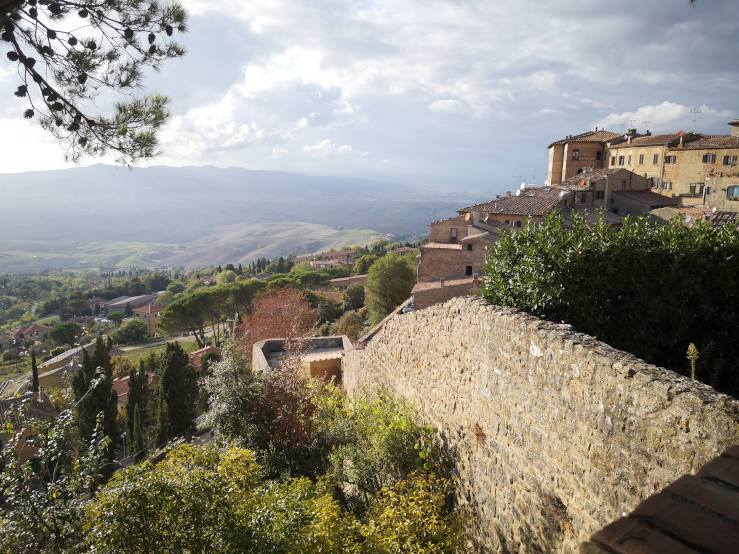
Ancient walls overlooking the Tuscan landscape in Volterra | Photo: Travel In Culture
Volterra Under Roman Rule
Volterra later came under Roman control as Rome expanded across Etruria. The city was gradually transformed, although its earlier Etruscan heritage remained part of the urban landscape.
The most impressive surviving Roman monument is the Roman Theatre, dating from the late 1st century BC. Its remarkably preserved remains, together with nearby Roman baths and other archaeological discoveries, reveal the importance of Volterra during the Roman period.
Today, the archaeological area provides a fascinating contrast between the Roman structures and the much older Etruscan remains that surround them.
From Medieval Power to Medici Rule
After the Roman period, Volterra gradually developed into the medieval hill town visible today. Its religious and political importance grew, and the town centre took shape around landmarks such as Piazza dei Priori and the imposing Palazzo dei Priori, one of Tuscany’s oldest civic palaces.
Volterra eventually came under the influence of Florence. In 1472, Florentine forces conquered the town following a revolt, marking a decisive turning point in its history. The subsequent Medici presence is still symbolised by the imposing Fortezza Medicea above the town.
This extraordinary mixture of Etruscan ruins, Roman archaeology, medieval streets and Medici architecture is what gives Volterra its distinctive character. Volterra is therefore an excellent starting point for understanding a different side of Tuscany, beyond the Renaissance cities and better-known medieval destinations. Rather than representing just one period of Tuscany’s past, the town allows you to experience several historical eras within the same compact hilltop setting.
For ancient history → Volterra’s Etruscan roots are still visible in the town today
For the setting → The hilltop position offers sweeping views across the Tuscan countryside
For local character → Etruscan heritage continues through Volterra’s alabaster tradition
2. Volterra’s Top Landmarks and Things to Do
Volterra is compact enough to explore on foot, but there is far more to see than its atmospheric medieval streets suggest. Within a short distance of the historic centre, you can move from Etruscan treasures to Roman ruins, medieval civic buildings, and imposing Medici fortifications.
For the medieval heart → Piazza dei Priori and Palazzo dei Priori
For Roman history → Roman Theatre and Archaeological Area
For Etruscan heritage → Guarnacci Etruscan Museum
For Medici history → Fortezza Medicea
For atmosphere and views → The old streets and hilltop edges
Explore Piazza dei Priori and Volterra’s Medieval Centre
Begin your visit in Piazza dei Priori, the elegant heart of medieval Volterra. The square is dominated by the Palazzo dei Priori, whose construction began around 1208 and which is regarded as one of Tuscany’s oldest civic palaces.
From here, simply wander through the surrounding stone streets. The historic centre is filled with medieval buildings, small squares, churches and ancient gateways, including the impressive Porta all’Arco, an Etruscan gate incorporated into the later city walls.
The beauty of Volterra is that you do not need to rush from one attraction to another. Some of its most memorable moments come from simply walking through the old town and discovering its layers of history along the way.
Visit the Roman Theatre and Archaeological Area
Below the historic centre lies one of Volterra’s most remarkable archaeological sights: the Roman Theatre. Dating from the early Imperial period, the theatre retains much of its semicircular seating and stage area and provides a vivid reminder of the Roman city that once occupied the hill.
The surrounding archaeological area contains further Roman remains, including the ancient baths. Together, the ruins make this one of the best places in Volterra to see how the Roman city was superimposed on the much older Etruscan settlement.
From the archaeological area, continue into the town, where spaces such as Piazza XX Settembre offer a glimpse of Volterra’s everyday urban character. Its stone buildings and open space provide a pleasant contrast to the ancient ruins.
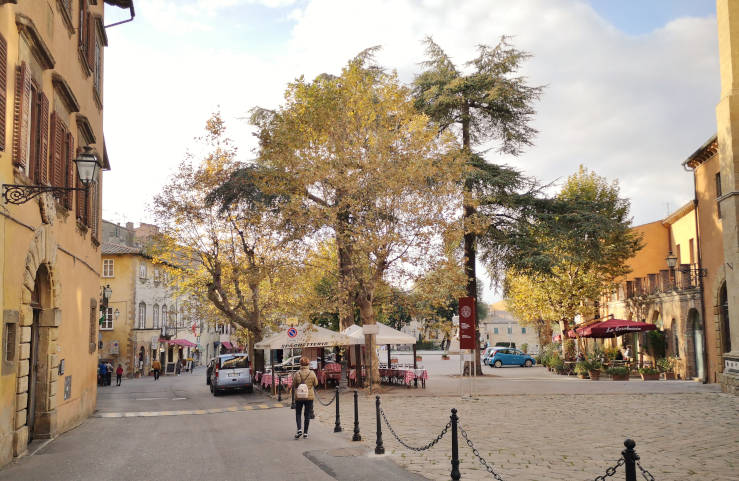
Piazza XX Settembre in Volterra | Photo: Travel In Culture
Discover the Etruscan Treasures at the Guarnacci Museum
If you want to understand why Volterra is considered one of Tuscany’s great Etruscan towns, make time for the Guarnacci Etruscan Museum. Founded in 1761, it is one of Italy’s oldest public archaeological museums and houses an important collection of Etruscan artefacts from Volterra and the surrounding area.
Its collections offer a remarkable insight into Etruscan life, funerary customs and art, with numerous decorated funerary urns, alabaster sarcophagi, and reconstructed tombs. The museum’s funerary collections reflect the importance of cremation in Etruscan traditions, with ashes placed in elaborately decorated urns, many carved from the alabaster for which Volterra became famous. Seeing these objects together makes the connection between the town’s ancient Etruscan heritage and its continuing alabaster tradition particularly clear.
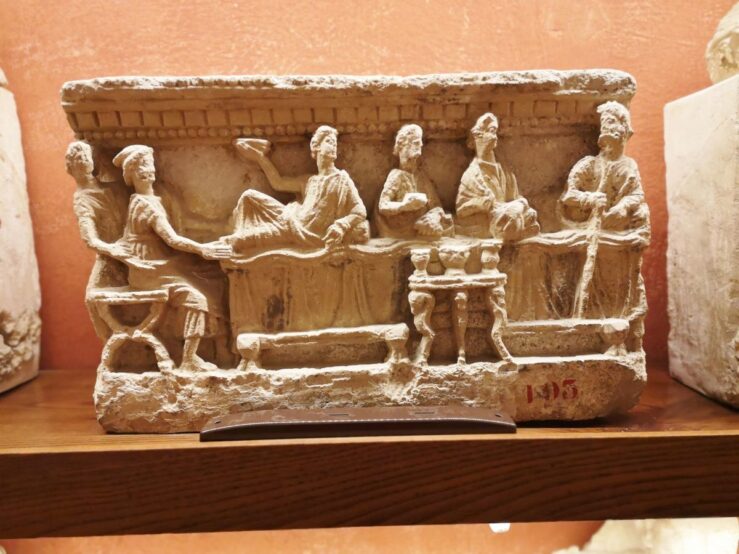
The Guarnacci Museum houses an exceptional collection of Etruscan funerary art | Photo: Travel In Culture
Among the museum’s most recognisable pieces is the elongated bronze figure known as the Ombra della Sera (“Shadow of the Evening”), one of the most distinctive works of Etruscan art associated with Volterra. The collection also extends beyond Etruscan archaeology, with Roman mosaics, bronze figures, and an extensive collection of coins in gold, silver, and bronze. More than three thousand Greek, Roman Republican, and Roman Imperial coins are represented, many alongside other archaeological finds discovered locally.
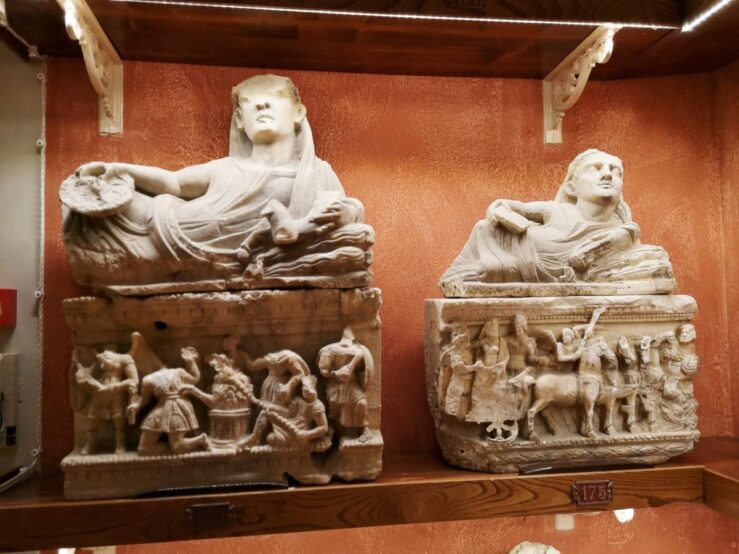
The Etruscan Guarnacci Museum in Volterra displays numerous beautiful funerary urns and sarcophagi.
The Guarnacci Museum therefore brings the Etruscan history described above to life and is particularly worthwhile even if you are not normally a museum enthusiast.
See the Medici Fortress and Volterra’s Panoramic Views
High above the town stands the imposing Fortezza Medicea, built after Florence conquered Volterra in the 15th century. Its position makes it one of the town’s most recognisable features and a powerful reminder of the transition from independent medieval commune to Medici-controlled territory. The fortress is now used as a prison, so access is limited, but its exterior and surrounding area remain an important part of Volterra’s skyline.
For the best sense of Volterra’s dramatic setting, take time to walk towards the edges of the historic centre. From the hilltop, the views open across the valleys and rolling countryside of the Val di Cecina: a fitting reminder that Volterra’s extraordinary location is as important to its character as its monuments.
The Atmosphere of Volterra
Volterra’s appeal is not limited to its museums and monuments. Take time to wander through the historic streets and you will find an atmosphere that feels distinctly local, with small restaurants and cafés tucked into the town’s old stone buildings.
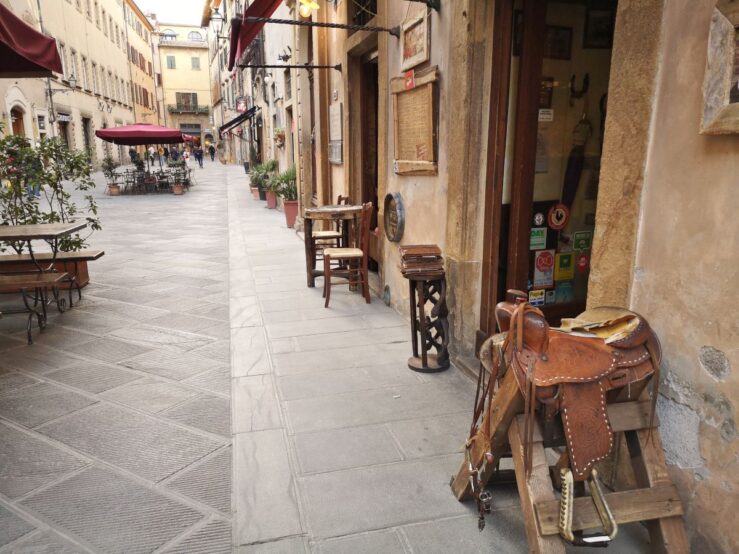
A traditional saddle displayed outside a shop on Via Antonio Gramsci in Volterra.
Compared with Tuscany’s better-known destinations such as Florence and San Gimignano, Volterra can feel remarkably unhurried. The medieval streets, warm stone façades, and quiet corners become particularly atmospheric towards evening, when the day-trippers have left and the town settles back into local life.
This is when Volterra’s layered history is perhaps easiest to appreciate. Walking through the ancient streets in the evening, with the Etruscan, Roman, and medieval past seemingly all around you, is an experience that cannot be captured by simply ticking off the town’s main sights.
Looking for inspiration beyond Volterra’s historic streets? Explore experiences and day trips across the wider Tuscan landscape.
3. Alabaster, Local Life and the Tuscan Landscape
Volterra is not only a town of archaeological treasures and imposing medieval buildings. Its character also comes from the traditions that have survived here, the small workshops tucked into its stone streets, the local food on the tables, and the extraordinary landscape surrounding the hilltop. This is the side of Volterra that rewards slowing down and simply exploring on foot.
For local craftsmanship → Alabaster workshops and artisan shops
For Tuscan flavours → Small restaurants and traditional dishes
For a relaxed break → Cafés around the historic centre
For the landscape → The hilltop viewpoints and surrounding valleys
For a quieter atmosphere → The old town after the day-trippers leave
Discover Volterra’s Alabaster Tradition
One of the traditions most closely associated with Volterra is alabaster carving. The soft, translucent stone has been worked in the area for centuries and was already used by the Etruscans to create funerary objects.
Today, alabaster remains part of the town’s artisan identity. Small workshops and shops display everything from traditional sculptures and decorative pieces to contemporary designs. Exploring these artisan spaces is a chance to see how a craft rooted in Volterra’s ancient past continues as a living tradition today.
If you are interested in seeing how the stone is shaped, look for an artisan workshop where you can watch the carving process. It offers a much more personal experience than simply buying a finished souvenir.
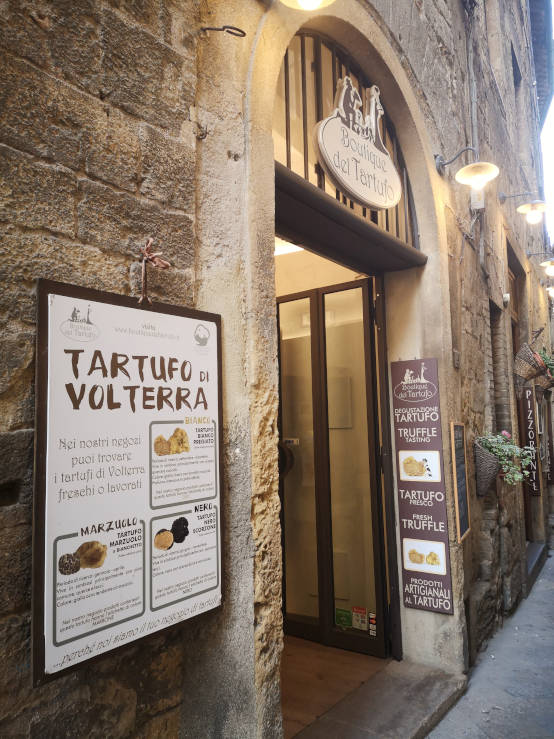
Tartufo di Volterra shop in the historic centre.
Eat, Drink and Wander the Old Streets
Volterra’s historic centre is also a pleasant place to experience everyday Tuscan life. Rather than concentrating solely on its major monuments, take time to explore the narrow streets around the main squares, where small restaurants, cafés, and local shops occupy the old stone buildings.
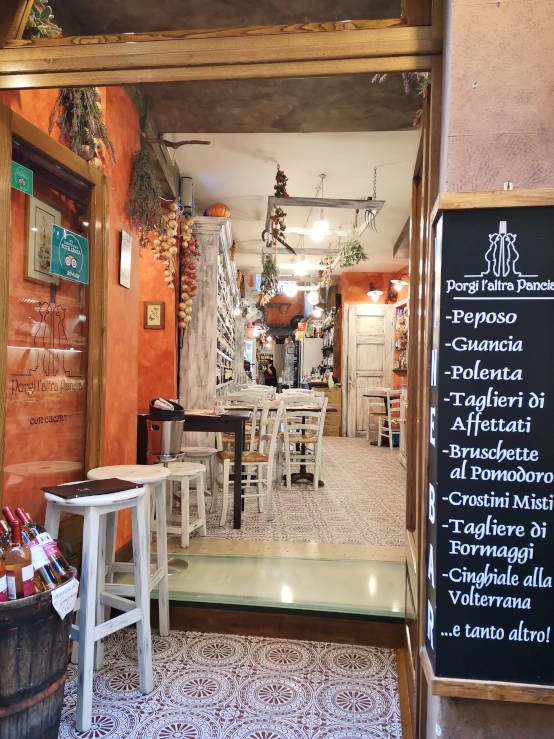
A local restaurant tucked into Volterra’s historic stone buildings.
This is a good place to sample traditional Tuscan food, accompanied by a local wine, before continuing your walk through the historic centre. The surrounding countryside also contributes to Volterra’s cuisine, with ingredients such as seasonal vegetables, game, pecorino, and truffles appearing on local menus.
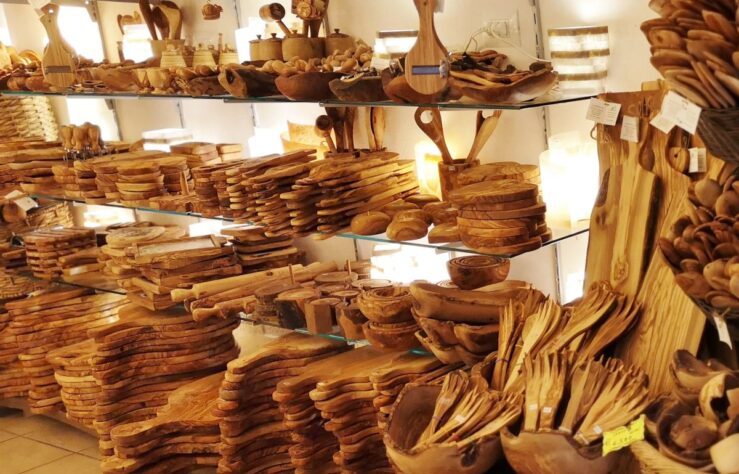
Local shops sell olive wood products and alabaster art works | Photo: Travel In Culture
The atmosphere changes noticeably as the day progresses. In the busiest hours, Volterra attracts visitors exploring Tuscany on day trips; later, the streets become considerably quieter. If you stay overnight, an evening walk through the softly lit medieval centre can therefore reveal a very different side of the town.
Take in the Tuscan Landscape
Volterra’s setting is one of its greatest assets. The town stands high above the Val di Cecina, with the landscape falling away dramatically from the hilltop. From various points around the historic centre, you can look across rolling Tuscan hills, fields and valleys stretching towards the coast.
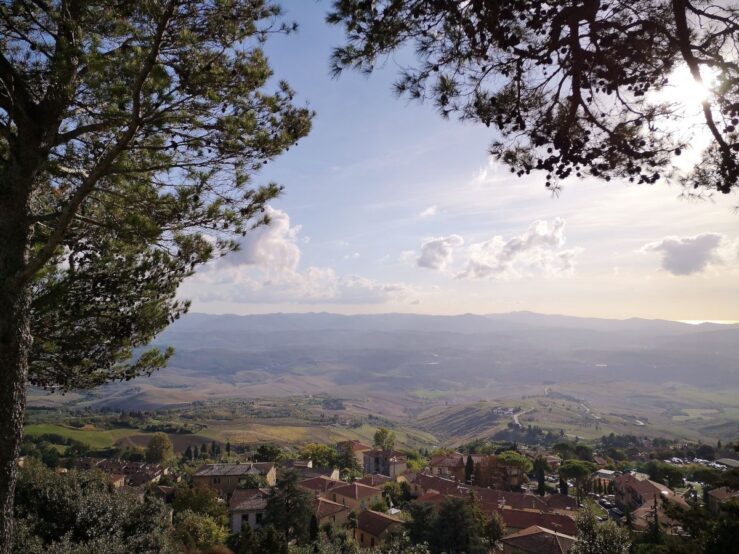
View from Volterra towards the Tuscan coast.
The views are particularly striking around the edges of the old town, where the ancient walls meet the open countryside. On exceptionally clear days, the distant horizon can even extend towards the Mediterranean.
This combination of history and landscape is part of what makes Volterra so appealing. You can spend the morning among Etruscan and Roman remains, stop for lunch in a medieval street and then end the day looking across the Tuscan countryside from the top of the hill. It is this slower, more atmospheric side of Volterra that is easy to miss if you visit only to tick off the main sights.
4. Planning Your Trip to Volterra
Volterra is easy to visit as a day trip, but its hilltop setting and atmospheric historic centre make it particularly rewarding if you can stay overnight. Allow at least half a day for the main sights. A full day gives you time to explore more slowly, visit the museums, and enjoy the town without rushing.
2–3 hours → A quick walk through the historic centre and the main squares
Half a day → Historic centre, Roman Theatre, Etruscan sights and a museum
One full day → The main sights, museums, alabaster workshops, lunch, and time to wander
One or two nights → A slower experience, with quieter streets in the evening and time for the surrounding Tuscan landscape
Getting to Volterra
Volterra is best reached by car, especially if you want to combine it with other Tuscan hill towns or explore the countryside. The final approach winds through the hills, and the town’s elevated position means that the journey itself is part of the experience.
If you are travelling by public transport, connections are possible from larger Tuscan towns, although they generally take longer and require more planning.
When to Visit Volterra
Spring and autumn are particularly pleasant for exploring Volterra, when temperatures are generally more comfortable for walking and the surrounding countryside adds to the experience. Summer brings longer days but also more visitors and hotter afternoons.
Volterra as a Day Trip or Longer Stay?
For a first visit, Volterra works very well as a day trip from elsewhere in Tuscany. However, if you are travelling through Tuscany rather than simply ticking off sights, staying a night or two gives you more time to appreciate its Etruscan heritage, alabaster tradition and hilltop setting.
| If you have… | Prioritise… |
|---|---|
| 2–3 hours | The historic centre, main squares, and a short walk through the medieval streets |
| Half a day | The historic centre plus the Roman and Etruscan highlights |
| One full day | The main sights, a museum, alabaster shops or workshops, lunch, and time to explore at leisure |
| One night | A slower visit, with the historic centre after the day-trippers have gone |
| Two days | Volterra at a relaxed pace combined with the surrounding Tuscan countryside and nearby destinations |
5. Volterra Day Trips and Tuscany Itinerary Ideas
Volterra fits naturally into a Tuscany road trip, particularly if you want to explore beyond the better-known stops of Florence, Siena, and Pisa. Its combination of Etruscan heritage, medieval streets, and spectacular hilltop scenery makes it a rewarding contrast to Tuscany’s more famous destinations.
Volterra as a Day Trip
Volterra is a good choice when you want to experience one of Tuscany’s historic hill towns without spending several days in one place. A day gives you enough time for the historic centre, the principal archaeological sights, and one of the town’s museums, with time left for lunch and a stroll through the quieter streets.
If you are travelling from Florence, Volterra can also be combined with other Tuscan destinations on a longer day trip or itinerary. However, trying to see too many places in one day can make the experience feel rushed.
Florence → Combine Volterra with a wider Tuscany itinerary from the regional capital
San Gimignano → Pair two atmospheric medieval hill towns in one Tuscan journey
Siena → Add Volterra to a route through Siena and central Tuscany
San Vincenzo and the Tuscan Coast → Continue towards the coast after exploring the hills around Volterra
Volterra on a Tuscany Road Trip
Volterra is particularly appealing by car because the surrounding landscape is part of the experience. Instead of treating the town as an isolated stop, you can include it in a route through Tuscany’s smaller historic towns, vineyards, and rolling countryside.
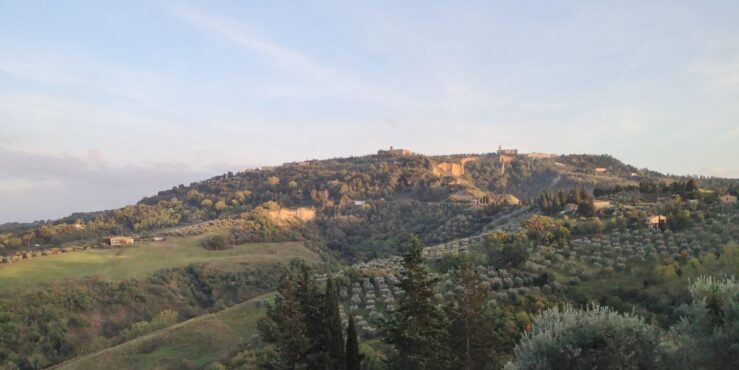
Rolling hills and olive groves in the countryside around Volterra.
For more ideas, see the guide to day trips from Florence, including how Volterra can fit into a wider Tuscany itinerary.
6. Where to Stay in Volterra
Volterra is a good place to stay overnight if you want to experience the town beyond the busiest hours. Staying in or close to the historic centre means you can explore the medieval streets in the evening, when the atmosphere becomes quieter, while also using Volterra as a base for discovering the surrounding Tuscan countryside.
7. Volterra Travel FAQs
Is Volterra worth visiting?
Yes. Volterra is particularly worth visiting if you are interested in Etruscan and Roman history, medieval architecture and the quieter side of Tuscany. Its hilltop setting and distinctive alabaster tradition also make it different from better-known Tuscan towns such as Florence, Siena and San Gimignano.
How much time do you need in Volterra?
Allow at least half a day to see the main sights, while a full day gives you time to visit the museums, explore the historic centre at a slower pace and enjoy lunch or a local wine. Staying overnight is ideal if you want to explore Volterra at a slower pace and enjoy the historic centre in the evening.
Can you visit Volterra as a day trip?
Yes. Volterra works very well as a day trip, particularly as part of a Tuscany road trip. If you have more time, however, staying for one or two nights allows you to explore the town more leisurely and use it as a base for the surrounding countryside.
What is Volterra famous for?
Volterra is best known for its Etruscan heritage, medieval historic centre and traditional alabaster craftsmanship. The town also has important Roman remains, including its ancient theatre, while its hilltop position provides impressive views across the Tuscan landscape.
Is Volterra very touristy?
Volterra is visited by tourists, but it generally feels quieter and less overwhelmed than Tuscany’s most famous destinations. This is one of its attractions. Outside the busiest hours, the historic centre retains a distinctly local atmosphere, particularly in the evening.
Where should you stay in Volterra?
For the most atmospheric experience, staying in or close to the historic centre is a good choice. It puts the main sights, restaurants and medieval streets within easy walking distance and means you can enjoy Volterra after the main daytime crowds have gone. Apartment-style accommodation can be particularly convenient for a longer stay.
Continue Exploring Tuscany
Volterra is ideally placed for exploring Tuscany’s historic cities, medieval hill towns, and beautiful countryside. Continue your journey with our guides to Tuscany’s main destinations and ideas for planning a wider itinerary.
- 🏛️ Florence – Renaissance capital of Tuscany, with world-class art, architecture, museums, and historic streets.
- ⚔️ Siena – Medieval city famous for Piazza del Campo, Gothic architecture, and the historic Palio horse race.
- 🏞️ Lucca – Elegant walled city with Renaissance architecture, historic streets, and tree-lined city walls.
- 🗼 San Gimignano – Iconic medieval hill town famous for its towers, atmospheric streets, and surrounding Tuscan landscape.
- 🍷 Tuscany Travel Guide – Explore Tuscany’s Renaissance cities, medieval towns, vineyards, countryside, and cultural heritage.
- 🚗 5 Top-Tier Day Trips from Florence – Ideas for exploring Tuscany beyond the Renaissance capital, including Volterra and other historic destinations.
- 🗺️ Itineraries in Tuscany – A practical route for combining historic Tuscan towns.