



Best Things to Do in Siena: Complete Guide to Tuscany’s Medieval City
By ANL | UPDATED:
This guide covers the best things to do in Siena, practical travel tips, and suggested walking routes to help you plan your visit.
All photographs in this article were taken by Travel In Culture.
Best known for: UNESCO-listed medieval centre, Piazza del Campo, Siena Cathedral, and the Palio horse race.
Time needed: One full day covers the highlights. Stay overnight for a quieter evening atmosphere and more time to explore.
Best for: Medieval architecture, history, photography, Tuscan food, and slow travel.
Best way to explore: On foot (entire historic centre is car-restricted)
Easy day trip from: Florence (around 1½ hours by train or car).
Don’t miss: Climbing Torre del Mangia, visiting Siena Cathedral, and wandering the narrow medieval streets beyond Piazza del Campo.
Why Visit Siena?
- 🏛️ UNESCO World Heritage Site — One of Europe’s best-preserved medieval city centres.
- 🐎 The Palio — Home to Italy’s most famous historic horse race.
- ⛪ Remarkable architecture — Gothic masterpieces including Siena Cathedral and Palazzo Pubblico.
- 🧱 Atmospheric streets — Medieval city structure almost unchanged since the 13th century.
- 🍝 Authentic Tuscany — Enjoy traditional cuisine, local wines, and a slower pace than Florence.
🏛️ Selected for Historic Centre Location → Albergo Chiusarelli
⭐ Selected for Overall Appeal → Hotel Athena
For a full comparison of Siena’s areas and hotels, see our dedicated Where to Stay in Siena guide.
This guide follows our cultural travel method, focusing on understanding places through their history, architecture, and local identity rather than just listing sights.
Whether you have one day or a weekend, these are the essential things to do in Siena to experience one of Tuscany’s finest medieval cities.
Best Things to Do in Siena: Walking Route & One-Day Itinerary
This walking route is designed to follow Siena’s natural flow, connecting its main landmarks in a compact loop through the historic centre.
Piazza del Campo
↓ 1 min
Palazzo Pubblico
↓ 1 min
Torre del Mangia
↓ 4 min
Siena Cathedral (Duomo)
↓ 2 min
Piccolomini Library
↓ 2 min
Santa Maria della Scala
↓ 8 min
Via di Città
↓ 8 min
Basilica of San Domenico
Fortezza Medicea
•
Facciatone Viewpoint
Perfect One-Day Siena Itinerary
- 🌅 09:00 — Start at Piazza del Campo before the largest crowds arrive and admire Siena’s iconic shell-shaped square.
- 🏰 09:30 — Climb Torre del Mangia for panoramic views across Siena’s terracotta rooftops and the surrounding Tuscan countryside.
- ⛪ 10:45 — Visit Siena Cathedral, including the Piccolomini Library and, if available, the cathedral floor and Facciatone viewpoint.
- 🍝 13:00 — Enjoy lunch at a traditional trattoria and sample Sienese specialities such as pici pasta, wild boar ragù or panforte.
- 🚶 14:30 — Wander through the historic centre, exploring Via di Città, Banchi di Sopra, and the colourful contrade.
- 🏛️ 16:00 — Visit Santa Maria della Scala or browse Siena’s small artisan shops and hidden courtyards.
- 🍷 17:30 — Finish the day with an aperitivo or gelato in Piazza del Campo while watching local life unfold.
Siena’s historic centre remains one of Europe’s best-preserved medieval urban landscapes, where narrow brick streets, Gothic palaces, and hidden courtyards create a remarkably intact cityscape. Walking here feels less like sightseeing and more like stepping directly into the Middle Ages. Explore more of the region in our Tuscany travel guide.

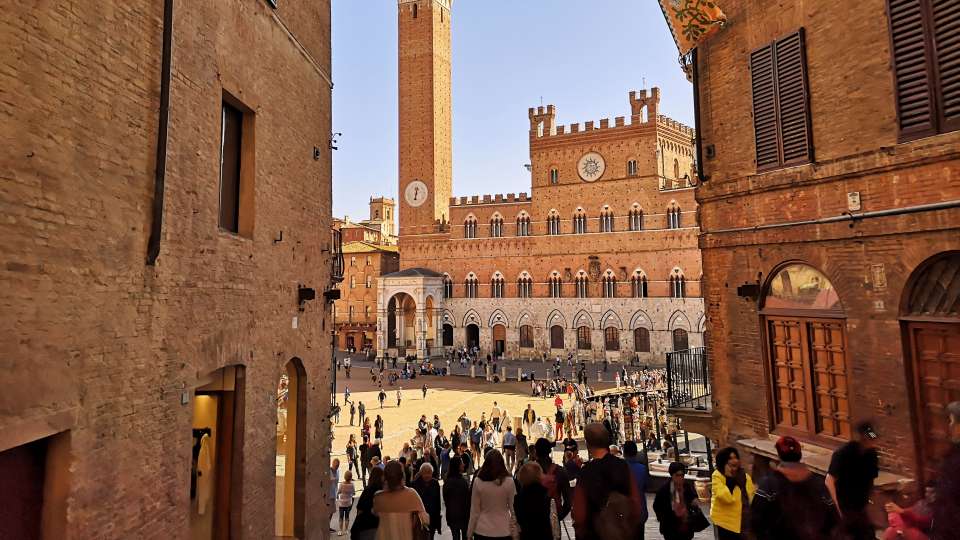
A glimpse through a stone arch reveals Piazza del Campo and the Torre del Mangia, highlighting how Siena’s historic centre unfolds in layers.
Piazza del Campo has served for centuries as Siena’s political and social heart, hosting markets, civic ceremonies, and public celebrations.
Siena’s remarkably preserved cityscape makes it one of Italy’s most authentic historic destinations. Although far smaller than Florence, its concentration of medieval architecture, lively traditions, and walkable streets creates an immersive experience that many travellers find even more memorable. If you are planning a broader Tuscany trip, you can also explore our guide to Florence.
Throughout Siena, warm terracotta brick, ochre façades, and cream-coloured stone create a distinctive colour palette that is especially beautiful in the soft light of early morning and late afternoon.
Piazza del Campo & Torre del Mangia
The gently sloping Piazza del Campo is regarded as one of Italy’s most beautiful squares thanks to its elegant architecture, distinctive shell shape, Palazzo Pubblico, and the soaring Torre del Mangia.
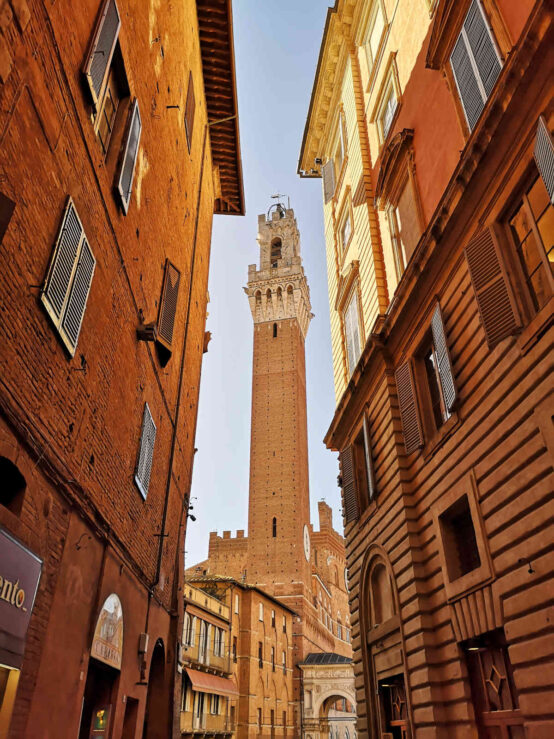
The 102-metre Torre del Mangia has dominated Siena’s skyline since the 14th century and remains one of the city’s most recognisable landmarks.
The square’s gentle slope and fan-like brick paving make the piazza unlike any other in Italy. Its brick paving is divided into nine sections representing the Government of the Nine (Governo dei Nove), whose leaders oversaw Siena’s medieval golden age. Palazzo Pubblico still serves as the city’s town hall, while eleven narrow streets radiate from the square into the surrounding historic centre.
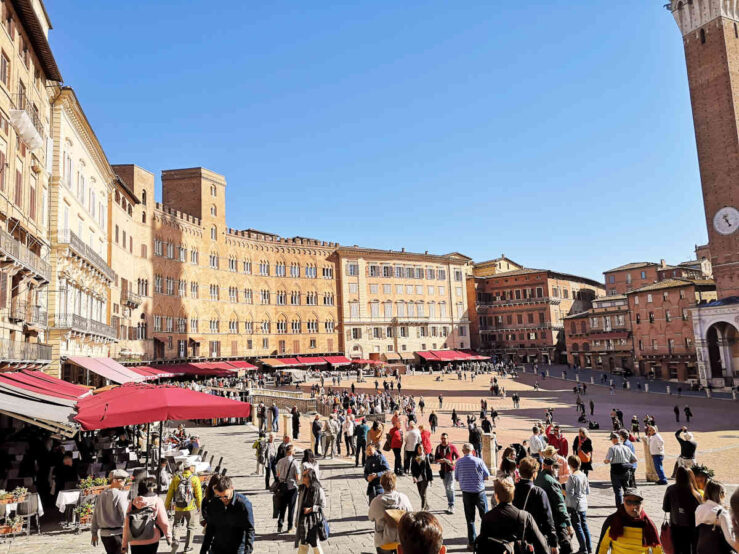
Piazza del Campo’s distinctive shell shape makes it one of the most recognisable and admired medieval squares in Europe.
Palio di Siena: Italy’s Most Famous Horse Race
The Palio di Siena is not simply a horse race, but a deeply rooted civic tradition that reflects the identity and rivalries of Siena’s historic districts.
Twice each summer, Siena’s magnificent Piazza del Campo becomes the stage for the Palio di Siena, one of Italy’s oldest and most famous historic horse races. The palio takes place every year on 2 July and 16 August.

Piazza del Campo serves as Siena’s elegant civic heart for most of the year before being transformed into the racecourse for the famous Palio di Siena each summer.
The spectacular horse race takes place just in front of the Palazzo Pubblico, Siena’s town hall, with its soaring Torre del Mangia. This tower was built not only as one of the tallest secular structures in medieval Italy (102 m / 335 ft), but also to match the height of Siena Cathedral — a deliberate symbol of the equal power of church and state.
Ten horses and jockeys riding bareback represent ten of Siena’s seventeen city wards. The race reflects the centuries-old rivalry between Siena’s historic districts. In preparation for the event, a layer of earth is laid over the surface of the Piazza del Campo to create the racetrack. On race day, jockeys compete bareback in a dramatic three-lap circuit of the square. Although the race usually lasts less than 90 seconds, it is renowned for its speed, intensity, and unpredictability.
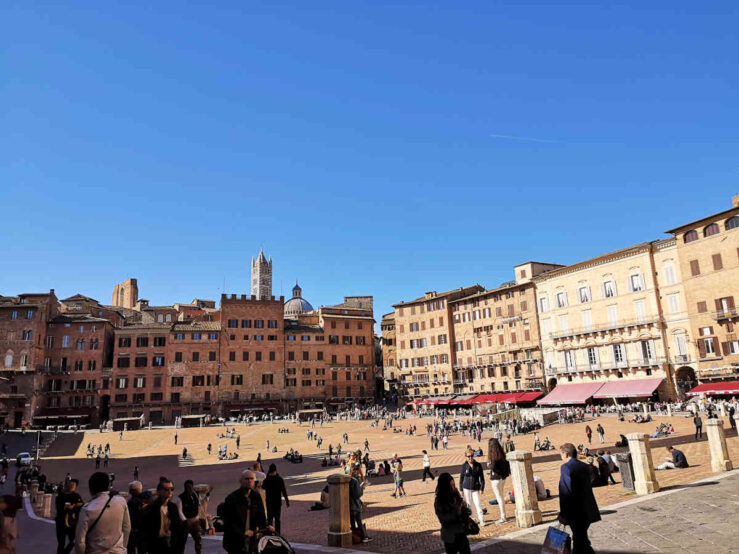
For most of the year, Piazza del Campo is a peaceful public square before being transformed into the dramatic setting for the Palio di Siena.
During the fast-paced and hazardous race, horses sometimes throw their riders. Nonetheless, the winner is the horse that crosses the finish line first — with or without a jockey.
The Palio dates back to medieval Siena. Before the modern horse race became established, Piazza del Campo also hosted bullfights and donkey races as part of the city’s public celebrations.
Siena Cathedral (Duomo)
Siena Cathedral (Duomo di Siena) is one of Italy’s most important Gothic churches, known for its striped marble façade and richly decorated interior. Built between the 12th and 14th centuries, it contains masterpieces by major artists and some of the city’s best viewpoints. Allow 1½ to 2 hours to explore the cathedral complex.
If you are visiting only one paid attraction in Siena, the cathedral complex offers the city’s richest combination of architecture, art, history, and panoramic views.
The Cathedral Exterior
Siena Cathedral is a masterpiece of Romanesque-Gothic architecture, instantly recognisable by its alternating bands of white and dark greenish-black marble. The richly decorated façade, elegant bell tower, and hexagonal dome make it one of Italy’s finest medieval churches.

The cathedral’s distinctive white and dark greenish-black striped marble continues across its elegant bell tower, one of Siena’s defining architectural features.
During the 14th century, Siena planned a vast expansion that would have created one of Europe’s largest churches. Construction stopped after the Black Death and financial difficulties, leaving the ambitious project unfinished. Nevertheless, it is still truly impressive and offers a magnificent view of the city when you climb the stairs.

Visitors approach Siena Cathedral via its richly decorated Gothic façade, adorned with sculptures, mosaics, and intricate marble details.
Inside the Duomo
The interior is every bit as spectacular as the exterior, including an octagonal pulpit with lion pedestals from the 13th century. Slender striped columns rise towards a deep blue ceiling decorated with golden stars, while chapels, sculptures, and works by leading Renaissance artists line the nave. Among the cathedral’s artistic treasures are masterpieces by Nicola Pisano, Donatello, and Michelangelo, making the Duomo one of Tuscany’s most rewarding cultural attractions.
The cathedral’s distinctive black and white marble symbolises the black and white horses of Siena’s legendary founders, Senius and Aschius, who according to local tradition were the sons of Remus, one of the mythical founders of Rome. Throughout Siena you’ll notice the city’s emblem, the Capitoline Wolf nursing Romulus and Remus, a reminder of this enduring foundation legend.

According to local tradition, Siena was founded by Senius and Aschius, the sons of Remus, making the she-wolf one of the city’s enduring symbols.
Baptistery & Crypt
If you purchase the OPA SI Pass, do not overlook the Baptistery of San Giovanni and the Cathedral Crypt. The Baptistery is home to an impressive marble baptismal font decorated by leading Renaissance sculptors, while the Crypt preserves remarkably vivid 13th-century frescoes that remained hidden for centuries beneath the cathedral.
- ⭐ The spectacular black and white striped marble interior.
- 🎨 Pinturicchio’s colourful frescoes in the Piccolomini Library.
- 🪨 One of Italy’s finest marble floors.
- 👀 Panoramic views from the Facciatone.
Piccolomini Library
One of the cathedral’s greatest highlights is the Piccolomini Library. Commissioned by Cardinal Francesco Piccolomini, who later became Pope Pius III, the library is renowned for its brilliantly coloured Renaissance frescoes painted by Pinturicchio and his workshop. Although originally intended to house the manuscript collection of Pope Pius II, visitors today come mainly to admire the vibrant frescoes, richly decorated ceiling, and remarkably well-preserved interior.
The Marble Floor
Siena Cathedral’s marble floor is considered one of the most extraordinary in Italy. Comprising more than 50 intricately designed marble panels created over several centuries, it depicts biblical scenes, allegories, and classical figures. To protect this unique masterpiece, much of the floor is usually covered for most of the year, with larger sections unveiled only during selected weeks, typically from late summer into autumn.
Facciatone Viewpoint
For many visitors, the highlight of the cathedral complex is climbing to the Facciatone. This unfinished façade was intended to become part of an ambitious expansion that would have transformed Siena Cathedral into one of the largest churches in Europe, before construction was halted by plague and financial difficulties. Today, the elevated terrace offers one of Siena’s finest panoramic views, overlooking the city’s terracotta rooftops, Piazza del Campo, and the rolling Tuscan countryside.
- ⏰ Allow 1½ to 2 hours to explore the cathedral complex.
- 🎟️ OPA SI Pass: Includes the cathedral, Piccolomini Library, Baptistery, Crypt and, when open, the Facciatone viewpoint.
- 📅 Best time to visit: The famous marble floor is fully uncovered only during selected weeks, usually between late summer and early autumn.
- 👕 Dress respectfully: As Siena Cathedral is an active place of worship, modest clothing is recommended.
Explore Siena Beyond the Main Sights
Siena is one of Italy’s most walkable historic cities, and much of its charm lies beyond the famous landmarks: in its narrow brick streets, steep medieval lanes, and quiet piazzas where everyday life continues much as it has for centuries.
To help you structure your time, Siena can be experienced through three distinct layers:
| Experience | Best For | What You Experience |
|---|---|---|
| Siena Walking Loop (Self-Guided Route) | First-time visitors and efficient sightseeing | A natural circular route connecting Piazza del Campo → Torre del Mangia → Siena Cathedral → Via di Città → San Domenico → hidden medieval streets, all within a compact walkable centre |
| Morning in Siena | Photography, calm exploration, and sightseeing | Quiet streets, soft golden light on brick façades, and empty piazzas before day-trippers arrive — ideal for climbing viewpoints and visiting the Duomo |
| Evening in Siena | Atmosphere, food, and local life | Warm sunset light over terracotta rooftops, lively Piazza del Campo, aperitivo culture, and a noticeably slower, more authentic medieval city feel |
Did You Know?
Siena’s entire historic centre has been a UNESCO World Heritage Site since 1995 because of its exceptional preservation as a medieval city planned around civic rather than religious power.
Wander the Historic Centre
Siena’s UNESCO-listed historic centre is compact enough to explore on foot, yet full of unexpected discoveries. Leave Piazza del Campo behind and wander along elegant streets such as Via di Città and Banchi di Sopra, where Gothic palaces, medieval towers, and handsome brick façades create one of Italy’s most atmospheric cityscapes. Many of Siena’s streets are steep and narrow, opening unexpectedly onto quiet squares, historic churches, and lively cafés. Rather than following a strict itinerary, allow yourself time to get pleasantly lost. It is one of the best ways to experience the city’s unique character.

Siena’s historic centre is filled with narrow alleyways and stone arches, reflecting its densely built medieval urban structure.
Discover the Contrade
Siena is divided into 17 historic contrade (districts), each with its own emblem, colours, traditions, and fierce local pride. The contrade are much more than neighbourhoods. They organise festivals, preserve centuries-old customs, and compete in the famous Palio di Siena horse race held twice each year. As you explore the city, look out for colourful flags, fountains decorated with animal symbols and small museums that celebrate each district’s history. Understanding the contrade adds another layer to any visit and helps explain why the Palio remains such an important part of Sienese life.
Admire Siena from Above
One of the highlights of visiting Siena is seeing its sea of terracotta rooftops from above. The climb up Torre del Mangia rewards you with spectacular panoramic views across the medieval city and the rolling Tuscan countryside beyond. Another excellent viewpoint is the Facciatone, the unfinished façade of Siena’s ambitious cathedral expansion, which offers a unique perspective over the striped marble cathedral and the historic centre. Early morning and late afternoon provide the best light for photography, while sunset bathes the city in warm golden tones.

The imposing Basilica of San Domenico dominates Siena’s western skyline and is one of the city’s most recognisable landmarks.
From the Facciatone or Torre del Mangia, panoramic views reveal Siena’s sea of terracotta rooftops stretching towards the imposing Basilica of San Domenico, whose fortress-like brick silhouette dominates the city’s western skyline. From above, the city’s remarkably intact medieval street plan becomes especially apparent.
Find Hidden Alleys & Quiet Corners
Some of Siena’s greatest pleasures lie away from the busiest streets. Wander through narrow medieval passageways, discover peaceful courtyards tucked behind historic buildings and pause in small piazzas where locals gather. Along the way you will come across artisan workshops, ivy-covered walls, tiny churches, and unexpected viewpoints that many visitors overlook.
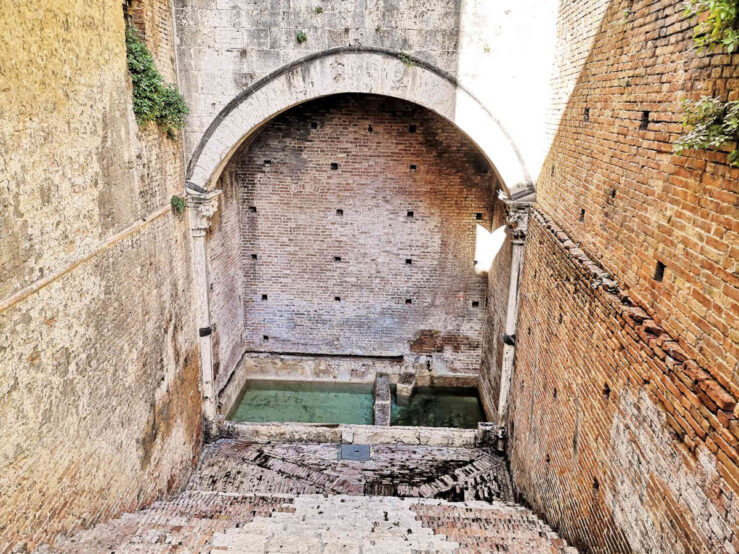
Small fountains like this reflect Siena’s medieval urban design, when neighbourhood water sources were an essential part of daily life | Photo: Travel In Culture
Even during the busiest months, it rarely takes more than a few minutes’ walk from Piazza del Campo to find a quieter corner where the city’s timeless atmosphere can truly be appreciated.
Just behind Piazza del Campo lies Piazza del Mercato, Siena’s former market square. Although part of the square now serves as a car park, it is still worth the short detour to admire the rear façade of the Palazzo Pubblico and the views across the surrounding Tuscan countryside.

Behind Piazza del Campo, Piazza del Mercato reveals the rear of the Palazzo Pubblico and Siena’s layered medieval history.
Planning Your Visit to Siena
Best time: April to June and September to October offer pleasant weather and fewer crowds.
Time required: Allow at least one full day to experience Siena’s main attractions.
Getting around: The historic centre is compact and best explored on foot.
Good to know: Siena’s streets are steep in places, so comfortable walking shoes are recommended.
Official tourism: Siena official tourism information
- 💳 Tickets — Most major attractions, including Siena Cathedral and Torre del Mangia, require paid admission.
- 🎟️ Save money — The OPA SI Pass provides access to several cathedral attractions and is worth considering if you plan to visit them all.
- 👟 Wear comfortable shoes — Expect steep streets, uneven paving and plenty of walking throughout the historic centre.
- 🚗 Driving — Much of Siena’s historic centre is a restricted traffic zone (ZTL). If arriving by car, use one of the public car parks outside the city walls.
- 📅 Visiting during the Palio? — Book accommodation several months in advance if you plan to visit during the Palio, as hotels fill quickly.
Why Stay Overnight in Siena?
Many visitors see Siena as a day trip from Florence, but spending a night here reveals a completely different side of the city. Once the tour groups leave, Siena becomes quieter, making it easier to appreciate its medieval streets and relaxed atmosphere. Siena is also one of the best bases for exploring central and southern Tuscany. See our guide to where to stay in Tuscany for a comparison of Siena with Florence, Chianti and the Val d’Orcia.
- 🌅 Peaceful evenings — Experience Piazza del Campo after the day-trippers have gone.
- 🍷 Tuscan dining — Enjoy local restaurants and wine bars without watching the clock.
- 📸 Better photography — Early morning and sunset offer the best light and the fewest crowds.
- 🚶 A slower pace — Wander Siena’s medieval streets without rushing between attractions.
- 🛏️ Explore further — Staying overnight also makes it easy to discover nearby villages and wineries the following day.
If your itinerary allows, spending one night in Siena is well worth it. For hotel guidance, see our Where to Stay in Siena Guide.
Spending an extra day in Siena also makes an excellent base for exploring Tuscany’s hill towns.
Explore More of Tuscany:
Advertisement (affiliate link)
Tuscany Day Trip to Siena & San Gimignano
Where to Stay in Siena
For a detailed comparison of Siena’s neighbourhoods and hotels, see our dedicated guide to Where to Stay in Siena.
Frequently Asked Questions About Siena
How much time do you need in Siena?
One full day is enough to see Siena’s main highlights, including Piazza del Campo, Siena Cathedral, and Torre del Mangia.
However, staying overnight allows you to experience the city after day-trippers leave and enjoy its quieter medieval atmosphere in the evening.
Is Siena worth visiting as a day trip from Florence?
Yes, Siena is one of the best day trips from Florence thanks to its compact medieval centre, UNESCO-listed historic streets, and iconic landmarks. However, staying overnight provides a more relaxed and authentic experience.
What is Siena best known for?
Siena is best known for its UNESCO-listed medieval centre, the shell-shaped Piazza del Campo, the Gothic Siena Cathedral, and the historic Palio horse race held twice each year.
Can you visit Siena Cathedral for free?
No, most parts of Siena Cathedral require a ticket. Entry is typically included in the OPA SI Pass, which also covers the Piccolomini Library, Baptistery, Crypt, and Facciatone viewpoint when open.
Is Siena walkable?
Yes, Siena is highly walkable and best explored on foot. The historic centre is compact, although streets can be steep and uneven, so comfortable shoes are recommended.
When is the Palio di Siena held?
The Palio di Siena takes place twice a year, on 2 July and 16 August, in Piazza del Campo.
It is one of Italy’s oldest and most famous horse races, transforming the square into a dramatic dirt racetrack for a short but intense competition lasting only a few minutes.
Continue Exploring Tuscany
Siena also works as an excellent base for exploring Tuscany’s nearby hill towns and Renaissance cities.
- 🏛️ Florence – Renaissance capital of Tuscany with world-class art and architecture.
- 🎭 Lucca – Walk the Renaissance walls and explore one of Tuscany’s most charming cities.
- 🌿 Montecatini Terme – Elegant spa town with historic thermal baths and hilltop views.
- 🏰 San Gimignano – Famous for its medieval towers and UNESCO-listed skyline.
- 🪨 Volterra – Etruscan heritage, alabaster workshops, and dramatic hilltop scenery.