





Best Things to Do in Florence in 3 Days: Complete Itinerary
By ANL | UPDATED:
Florence is one of Europe’s most important Renaissance cities, filled with world-class art, architecture, and historic landmarks. With so much to see, planning your time carefully is essential.
Three days is enough to experience Florence’s greatest Renaissance landmarks without rushing from museum to museum. This itinerary balances world-famous attractions such as the Duomo and Uffizi Gallery with quieter streets, panoramic viewpoints and time to enjoy the city’s atmosphere.
This 3-day Florence itinerary is designed to help you realistically experience the city. It covers the essential highlights, including the Duomo complex, Uffizi Gallery, Ponte Vecchio, and key historic districts, while also leaving space to explore museums, viewpoints and neighbourhoods at a comfortable pace.
Following our cultural travel method, the itinerary explains how Florence’s architecture, museums and public spaces connect to the city’s Renaissance history, while also showing how Florence fits into a wider journey through Tuscany.
If you are still deciding where to base yourself, see our detailed guide to Florence’s neighbourhoods and accommodation options.
Florence is one of the few cities where you can spend an entire day simply walking between masterpieces. Around almost every corner stands a Renaissance palace, church, sculpture or museum connected to names such as Michelangelo, Brunelleschi, Leonardo da Vinci, and the Medici family.
This 3-day Florence itinerary is designed to help first-time visitors experience the city’s most important sights without rushing between attractions or wasting time crossing back and forth through the historic centre.
If you only have two days in Florence, prioritise Day 1 and Day 2, which cover the city’s most important Renaissance landmarks, museums, and historic squares.
Visit Ponte Vecchio during the evening of Day 1, when the bridge and the River Arno are particularly atmospheric.
Consider skipping Boboli Gardens and the Bargello National Museum if your schedule is tight.
If possible, still make time for Piazzale Michelangelo, which offers Florence’s most famous panoramic view.
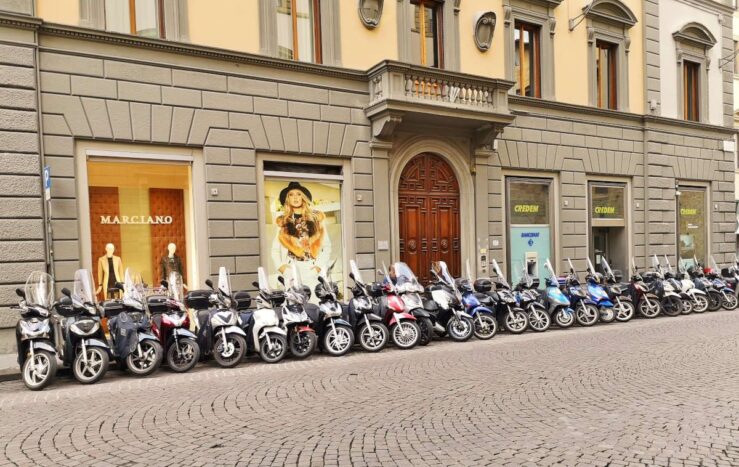
Rows of scooters line a street in Florence’s historic centre.
Florence 3-Day Itinerary Overview
Day 1: Historic Centre & Duomo Route
Day 2: Uffizi & Medici Florence
Day 3: Oltrarno, Boboli Gardens & Viewpoints
Why This Florence Itinerary Works
Florence is compact, but many visitors underestimate how much time the major museums require. This itinerary groups attractions by neighbourhood to minimise walking and avoid unnecessary backtracking.
Day 1 focuses on Florence’s essential landmarks and historic centre.
Day 2 is dedicated to Renaissance art, museums, and Medici history.
Day 3 explores the Oltrarno district, gardens, and viewpoints beyond the busiest tourist areas.
If this is your first visit to Florence, these three days provide the best balance between architecture, art, history, and local atmosphere.
Before You Go
Book ahead: Reserve Uffizi Gallery tickets well in advance, particularly between April and October. If you want to visit the Accademia Gallery to see Michelangelo’s David, book that ticket early too.
Expect to walk: Florence’s historic centre is compact and this itinerary is designed to be completed mostly on foot. Comfortable footwear is essential, as you will cover several kilometres each day.
Start early: Arriving at major attractions shortly after opening helps you avoid the busiest crowds and leaves more time to enjoy Florence at a relaxed pace.
Follow the route: The itinerary groups attractions by neighbourhood to minimise unnecessary walking and backtracking. If you are short on time, prioritise Day 1 and Day 2, which cover Florence’s best-known Renaissance landmarks.
Is 3 Days Enough in Florence?
Three days is enough for a first visit to Florence. It allows you to see the city’s key Renaissance landmarks, major museums, and historic districts at a comfortable pace.
You will not see everything Florence has to offer, but you will experience a well-rounded introduction to the city’s Renaissance heritage, including the Duomo, Uffizi Gallery, Ponte Vecchio, and Oltrarno. If you have extra time, Florence also makes an excellent base for exploring Tuscany. Consider adding a day trip to Siena, visiting the spectacular towers of San Gimignano, or spending a day among the vineyards and hilltop villages before visiting Volterra. Extending your stay allows you to experience a broader side of Tuscany beyond Florence’s Renaissance treasures.
Day 1: Historic Centre & Duomo Route
Walking distance: Approximately 5 to 6 km
Pace: Moderate sightseeing day
Main highlights: Duomo, Piazza della Signoria, and Palazzo Vecchio
Pre-book: Brunelleschi’s Dome climb (recommended)
Your first day begins in the heart of Florence at the magnificent Duomo complex, the city’s most important architectural and cultural landmark. From here, you will follow an easy walking route through Florence’s historic centre, discovering its greatest Renaissance squares, medieval streets and political landmarks.
1. Cathedral of Santa Maria del Fiore
The Cathedral of Santa Maria del Fiore is the centrepiece of Florence’s historic skyline and one of the most significant Gothic structures in Europe. Built in red, white and green marble, it dominates the city with Brunelleschi’s revolutionary dome rising above it.
The entire Duomo complex extends beyond the cathedral itself and includes Giotto’s Campanile, the Baptistery of San Giovanni, and the Opera del Duomo Museum. Together, they form one of the most important religious and artistic ensembles in Italy.
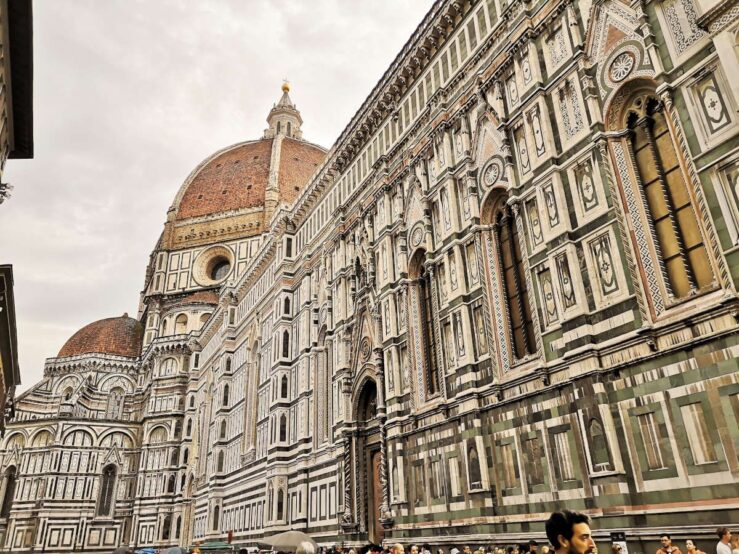
Brunelleschi’s dome dominates Florence’s skyline and remains one of the greatest engineering achievements of the Renaissance.
From here, it is worth circling the square slowly to appreciate the scale of the architecture before continuing onward.
Aim to arrive before 09:00 if you plan to climb Brunelleschi’s Dome, as timed entry slots fill quickly during spring and summer. If you are not climbing the dome, simply admire the exterior before continuing to Giotto’s Campanile.
2. Giotto’s Campanile
From the cathedral entrance, walk a few metres north to Giotto’s Campanile. Visiting the bell tower immediately afterwards keeps you within the Duomo complex before moving towards Piazza della Signoria.
Those who climb the tower are rewarded with panoramic views over the Duomo and the terracotta rooftops of Florence, while others can simply admire its detailed exterior from ground level.
If you intend to climb both Brunelleschi’s Dome and Giotto’s Campanile on the same day, allow more time – at least two hours. Entry is timed and queues can still form during spring and summer.

To ascend Giotto’s Campanile you must be ready to climb 400 steps.
3. Baptistery of San Giovanni (St. John)
Directly opposite the cathedral is the Baptistery of San Giovanni, one of the oldest buildings in Florence. Its octagonal shape and green-and-white marble exterior mirror the cathedral’s design, but its origins date back even earlier.
Inside, golden mosaics and the famous Gates of Paradise doors highlight the importance of this space in Florentine religious life.
Leaving the Duomo complex behind, you gradually move into Florence’s civic and political heart.
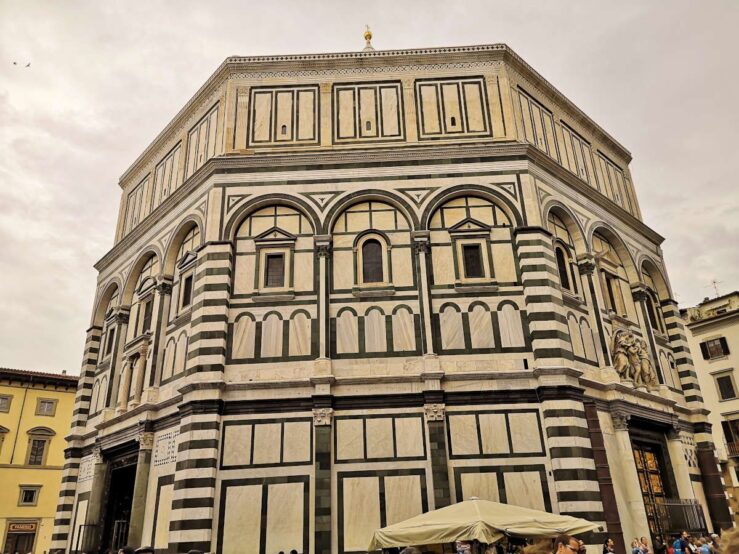
The Baptistery of San Giovanni from 1059 is the oldest building in Florence.
4. Piazza della Signoria
Piazza della Signoria has been Florence’s political centre since the fourteenth century and makes a natural stop after exploring the Duomo. The square is effectively an open-air sculpture gallery, allowing you to appreciate Renaissance art without entering a museum. Surrounded by sculptures and historic buildings, it is easy to imagine the political dramas and public ceremonies that unfolded here during the Renaissance.
This is also one of the best places in the city to pause briefly, take in the atmosphere, and observe daily life unfolding around you.

Piazza della Signoria has served as Florence’s political heart since medieval times.
5. Loggia dei Lanzi
At the edge of the square, Loggia dei Lanzi functions as an open-air sculpture gallery. Renaissance and Roman works stand side by side here, making it one of the most accessible art spaces in Florence.
The setting allows you to experience major works of art in a completely open public environment, rather than inside a museum.
6. Palazzo Vecchio
Palazzo Vecchio was the centre of Florentine political power for centuries and remains one of the best places to understand how the city evolved from a medieval republic into a Renaissance powerhouse. Its fortress-like structure reflects the city’s medieval political power, while the interior contains richly decorated halls and frescoes.
Even from the outside, the building remains one of Florence’s most recognisable landmarks.
From Piazza della Signoria, the route naturally continues through the historic centre’s narrow streets toward the next major square.
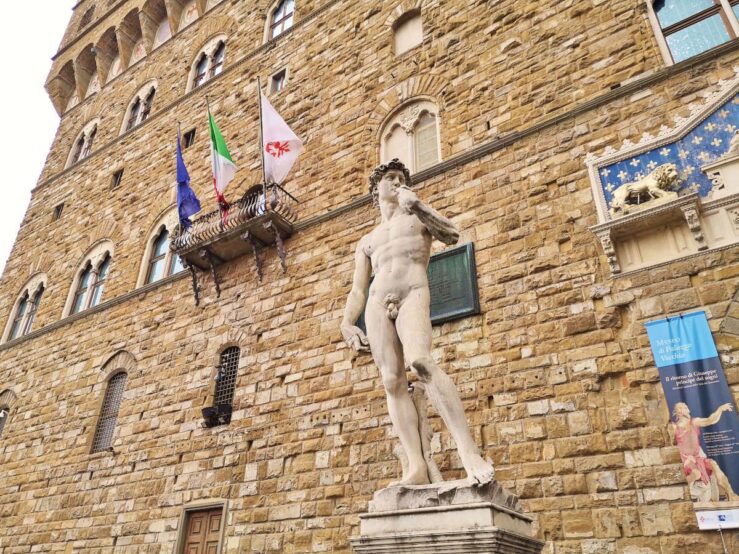
In front of the Palazzo Vecchio, a replica of the original ‘David’ statue by Michelangelo stands.
7. Piazza della Repubblica
Piazza della Repubblica feels noticeably different from the medieval streets surrounding it. Open, elegant, and lined with cafés, it reflects Florence’s 19th-century transformation while still occupying the site of the ancient Roman forum.
It represents a clear shift in atmosphere, from medieval Florence to a more modern city structure.
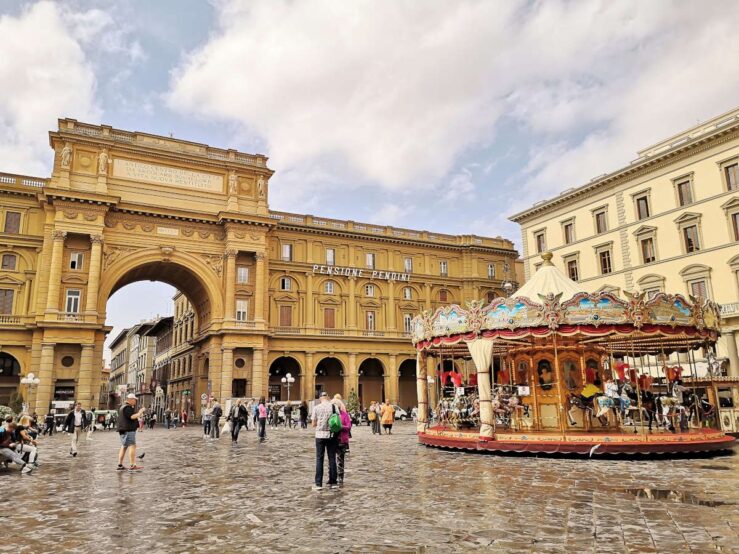
Piazza della Repubblica is the site of the city’s old Roman Forum – today it is still Florence’s vibrant heart | Photo: Travel In Culture
8. Casa di Dante Museum
A short walk away, you reach the Casa di Dante Museum, dedicated to Florence’s most famous poet, Dante Alighieri. The museum explores his life and literary legacy, while the surrounding streets preserve the feel of medieval Florence.
End the evening around Piazza della Signoria or Ponte Vecchio, where restaurants and wine bars stay lively well after sunset. This is also an excellent opportunity to experience Florence’s atmosphere after the daytime crowds have thinned.
Day 2: Uffizi & Medici Florence
Walking distance: Approximately 5 to 6 km
Pace: Full sightseeing day with several museum visits
Main highlights: Uffizi Gallery, Palazzo Medici Riccardi, Basilica di San Lorenzo and Mercato Centrale
Pre-book: Uffizi Gallery (essential) and Accademia Gallery if visiting
Begin your second day at the Uffizi Gallery, one of the world’s greatest museums and an essential stop on any first visit to Florence. Afterwards, continue on foot through the historic centre, following the city’s Renaissance heritage from Medici palaces to historic churches and lively market streets.
1. Uffizi Gallery
Begin your second day at the Uffizi Gallery, one of the world’s greatest collections of Renaissance art. Allow at least three hours for your visit and book a timed-entry ticket well in advance, particularly between April and October. If you try to rush through the galleries, you will miss many of the masterpieces that make the museum one of Florence’s essential attractions.
The gallery was commissioned by Cosimo I de’ Medici in 1560 and designed by Giorgio Vasari to house the offices of the Florentine magistrates, which explains its name, as uffizi means “offices” in Italian. It later became one of Europe’s first public art museums.
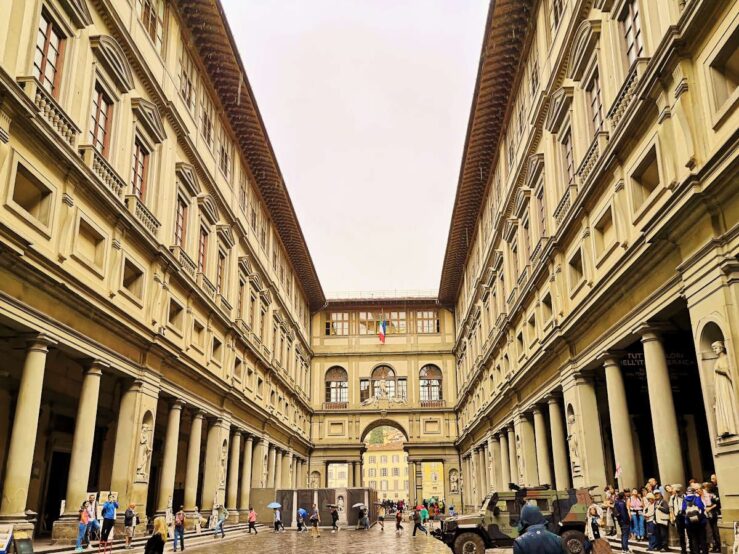
The Uffizi Gallery houses masterpieces by Botticelli, Leonardo da Vinci, and Michelangelo.
Inside, you will discover an outstanding collection of paintings and sculptures spanning the 14th to the 16th centuries. Highlights include Botticelli’s Birth of Venus, Michelangelo’s Tondo Doni, Leonardo da Vinci’s The Baptism of Christ, together with works by Giotto, Raphael, Correggio, and many other Renaissance masters. The museum also displays important paintings by European artists such as El Greco, Rembrandt, Rubens, Velázquez, and Goya.
Another highlight is the Vasari Corridor, the elevated enclosed passage linking the Uffizi with Palazzo Pitti via Ponte Vecchio. Built for the Medici family, it allowed the rulers of Florence to travel discreetly between their residence and the seat of government without entering the busy streets below.
After exploring the Uffizi Gallery, continue north through the historic centre towards Palazzo Medici Riccardi. Since the Uffizi is the highlight of today’s itinerary, we recommend admiring the next two landmarks mainly from the outside to leave enough time for the rest of the day’s sights.
2. Palazzo Medici Riccardi
From the Uffizi Gallery, walk north through Florence’s historic centre to Palazzo Medici Riccardi, the first great Renaissance palace built for the powerful Medici family. The walk itself takes you through some of the city’s most elegant streets and provides a welcome break after several hours inside the museum.
Although the palace can be visited, we recommend admiring it mainly from the outside to make the most of your three days in Florence. Built in 1444 for Cosimo de’ Medici and designed by Michelozzo, it became the family’s principal residence and helped establish the architectural style that influenced Renaissance palaces across Italy. Notice the harmonious façade, elegant arched windows and the large iron rings once used to tether horses.
If you have extra time in Florence, the interior is worth visiting, particularly the magnificent Chapel of the Magi, decorated with Benozzo Gozzoli’s celebrated Renaissance frescoes. For this itinerary, however, continue a few minutes on foot to the Basilica di San Lorenzo, one of Florence’s most important Medici landmarks.
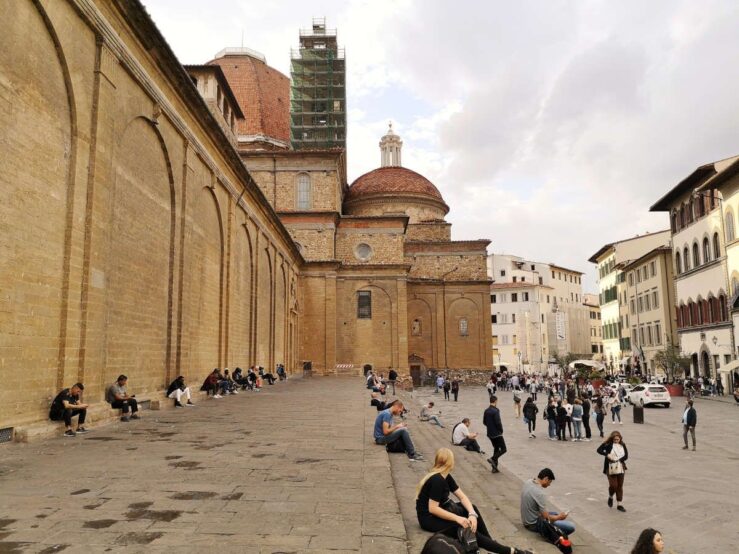
Basilica di San Lorenzo is one of Florence’s most important churches and closely associated with the Medici family.
3. Basilica di San Lorenzo
Just a few minutes from Palazzo Medici Riccardi stands the Basilica di San Lorenzo, one of Florence’s most important churches and the spiritual centre of the Medici family. For this three-day itinerary, we recommend admiring the basilica from the outside before continuing to Mercato Centrale, unless you have a particular interest in Renaissance architecture or religious art.
The basilica is renowned for its harmonious Renaissance design, created by Filippo Brunelleschi, and for works by Donatello, whose bronze pulpits remain among the church’s artistic highlights. The adjoining Medici Chapels, built as the family’s mausoleum, are among Florence’s most important Renaissance monuments and are well worth visiting if you have additional time in the city.
You can also appreciate the church’s distinctive unfinished façade and photograph the surrounding square before continuing a short distance to Mercato Centrale for lunch.
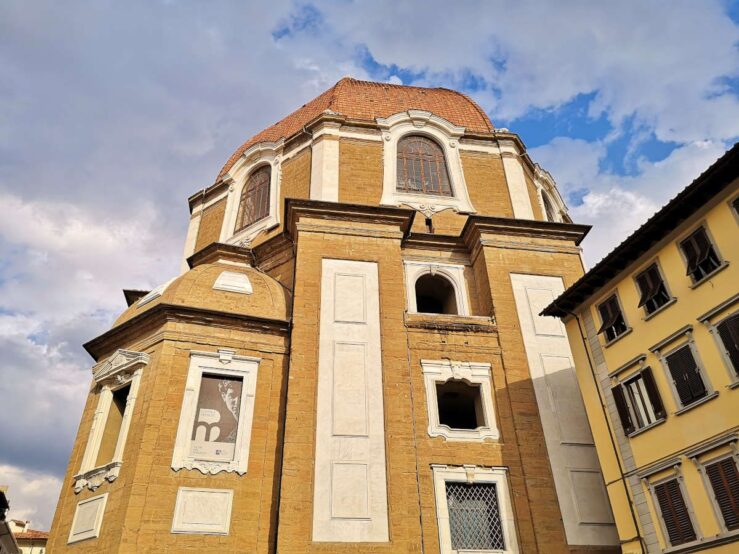
The Medici Chapels were built as the mausoleum of Florence’s powerful Medici family and form part of the San Lorenzo complex.
From San Lorenzo, continue to nearby Mercato Centrale, where you can enjoy lunch before the afternoon’s museums and landmarks.
4. Mercato Centrale (San Lorenzo Market)
After a busy morning of churches, museums and Medici history, Mercato Centrale is an ideal place to pause for lunch.
The architect behind the stunning building with wrought-iron ceilings and covered arcades is Giuseppe Mengoni, the architect also behind the Galleria Vittorio Emanuele II in Milan.
Still today, there is a whirl of activity around the place. The San Lorenzo Market comprises both the market building and the surrounding streets with plentiful shops and stalls. The first floor opened in 2014 with a complete food hall on the occasion of the 140th anniversary of the Mercato Centrale.
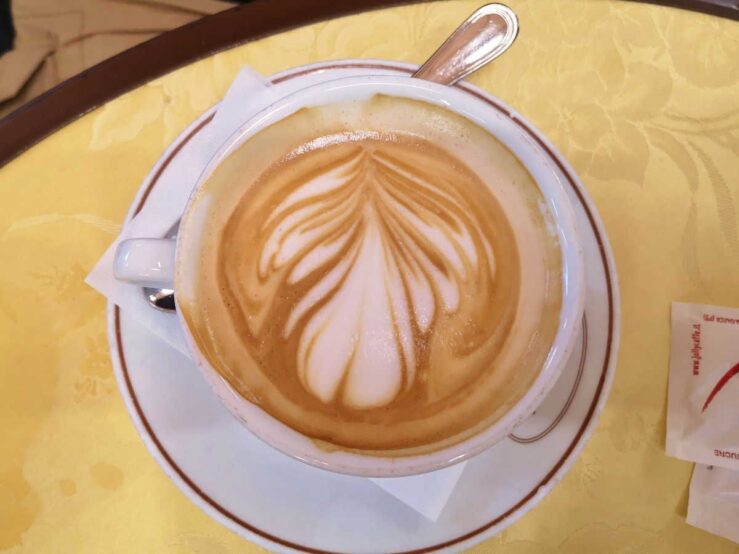
A freshly prepared cappuccino at Mercato Centrale in Florence.
After lunch, choose one or two additional attractions depending on your interests and remaining energy. Depending on whether you prefer Renaissance sculpture, scientific history, architecture or religious art, choose one or two of the following four attractions.
For your (first) optional stop, choose between Florence’s most famous sculpture museum and one of the city’s most fascinating science museums. Do you prefer Renaissance masterpieces? Choose the Galleria dell’Accademia.
5A. Galleria dell’Accademia
Galleria dell’Accademia features an outstanding collection and houses among great Renaissance sculptures the original David by Michelangelo, sculpted between 1501 and 1504. Also, works by Botticelli and other grand Italian artists are on display in the Galleria. Many of these masterpieces were previously in the Medici family’s possession.
Are you interested in science and astronomy? Visit the Galileo Museum instead.
5B. Galileo Museum
The Galileo Museum boasts both the Medicean collection of scientific instruments, as well as other mathematics and physics collections. Specifically, the museum features two telescopes and the objective lens of the telescope with which Galileo spotted the Galilean moons of Jupiter. Also, the Grand Duke Peter Leopold’s chemistry cabinet is on display.
The museum is a real gem if you are interested in science and scientific discoveries.
For your optional final visit of the day, choose between another Renaissance landmark and one of Florence’s most impressive churches.

Rusticated stonework on the Renaissance Palazzo Strozzi in Florence | Photo: Travel In Culture
6A. Palazzo Strozzi
Palazzo Strozzi from 1489 is one of the finest examples of Italian Renaissance architecture.
It was Filippo Strozzi the Elder’s impressive construction to manifest his political and his family’s status in Florence.
When he died in 1491, Duke Cosimo I de’ Medici confiscated the palace and continued the works – shaping it in the same rustic style as the Palazzo Medici Riccardi. It wasn’t returned to the Strozzi family until 30 years later – and remained in their possession until 1937.
6B. Basilica di Santa Maria Novella
The Basilica di Santa Maria Novella is adjacent to and has given name to Florence’s central railway station. It was built by the Dominican order of the Catholic Church between 1246 and 1360.
The church and the Green Cloister house significant art treasures, such as Gothic and Renaissance frescoes. Moreover, the church includes several funerary chapels and monuments for Florentine families.
The church is famed for its impressive green and white marble façade featuring a unique Renaissance architecture. The Romanesque façade was designed by the architect Leo Battista Alberti and completed in 1470.
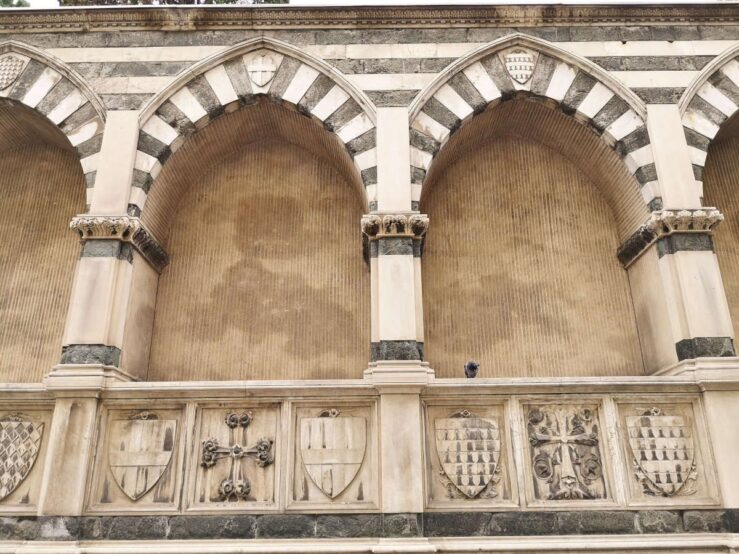
The Renaissance marble façade of the Basilica di Santa Maria Novella, dating from the 15th century, is one of the finest examples of Renaissance architecture in Florence.
Whichever combination you choose, Day 2 provides a deeper understanding of Florence’s artistic, scientific and architectural achievements. After a full day of museums, churches and Renaissance history, the evening is an ideal opportunity to slow down and enjoy Florence’s restaurant scene.
Day 3: Oltrarno, Boboli Gardens & Viewpoints
Walking distance: Approximately 7 to 8 km (including uphill sections)
Pace: Moderate, with some uphill walking
Main highlights: Palazzo Pitti, Boboli Gardens, Ponte Vecchio, and Piazzale Michelangelo
Pre-book: Palazzo Pitti and Boboli Gardens (recommended)
Today takes you across the River Arno into the characterful Oltrarno district, where Renaissance palaces, historic gardens, and artisan neighbourhoods reveal a quieter side of Florence. Finish the day at Piazzale Michelangelo for one of the city’s most memorable panoramic views.
Start early at 08:30 to make the most of the day. Begin the day on the south side of the Arno at Palazzo Pitti, the vast former residence of the Medici family.

A marble sculpture in the Boboli Gardens, part of the historic Medici landscape behind Palazzo Pitti in Florence.
From there, continue through the Boboli Gardens before making your way to Piazzale Michelangelo, one of the city’s most famous viewpoints.
Visit Piazzale Michelangelo early in the morning for quieter viewpoints, or return at sunset for Florence’s most famous skyline.
Expect several uphill sections between Boboli Gardens and Piazzale Michelangelo, so wear comfortable walking shoes.
The Oltrarno district is one of Florence’s best areas for a relaxed lunch or dinner away from the busiest tourist streets.
If you plan to visit Palazzo Pitti or Boboli Gardens, booking tickets in advance can save time during busy periods.
1. Palazzo Pitti
Palazzo Pitti was the principal residence of the Medici rulers during Florence’s grand ducal period. Today it houses several museums and galleries, while its monumental façade remains one of the largest Renaissance palace fronts in Italy.
2. Boboli Gardens (Giardino di Boboli)
Behind Palazzo Pitti lie the Boboli Gardens, one of the most famous historic gardens in Italy. Developed by the Medici family from the 16th century onwards, the gardens combine landscaped avenues, fountains, sculptures and terraces overlooking Florence. The grounds became a model for many later European royal gardens and remain one of the city’s most attractive green spaces.
Walking through the gardens offers a welcome contrast to Florence’s museums and churches while providing excellent views of the surrounding city and Tuscan hills.
3. Piazzale Michelangelo
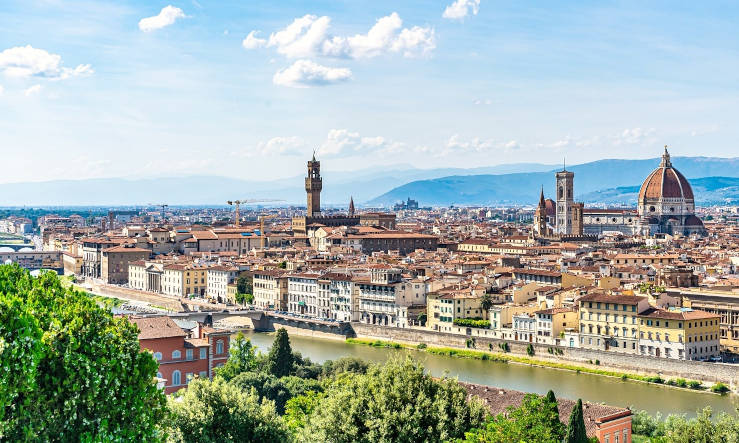
Florence seen from Piazzale Michelangelo, with Brunelleschi’s dome rising above the city’s terracotta rooftops.
Continue uphill to Piazzale Michelangelo, Florence’s most celebrated viewpoint. Built in the 19th century, the large terrace offers sweeping panoramic views across the city, including the Duomo, Palazzo Vecchio, Santa Croce, and the River Arno.
The climb requires some effort, but standing above the city with Brunelleschi’s dome rising from a sea of terracotta rooftops is one of those views that visitors remember long after leaving Florence.
The viewpoint is particularly popular around sunset, when the warm light illuminates Florence’s terracotta rooftops and Renaissance skyline. Even visitors with limited time in Florence often consider Piazzale Michelangelo one of the city’s essential experiences.
4. Ponte Vecchio
From the viewpoint, make your way back towards the historic centre and cross the iconic Ponte Vecchio. Spanning the River Arno since the 14th century, it is Florence’s oldest bridge and one of the city’s most recognisable landmarks.

Ponte Vecchio is the only Florentine bridge to survive the Second World War.
Unlike most historic bridges, Ponte Vecchio is lined with shops built directly above the river. The bridge became famous for its goldsmiths and jewellers, many of which still operate here today. Crossing Ponte Vecchio also provides excellent views along the Arno and a chance to appreciate one of Florence’s most enduring symbols.
5. Mercato del Porcellino
A short walk from Ponte Vecchio brings you to Mercato del Porcellino, a historic market area known for leather goods, souvenirs, and local products. The market takes its name from the bronze wild boar fountain known as Il Porcellino.
According to local tradition, visitors who rub the boar’s nose and place a coin in its mouth will one day return to Florence. Whether or not you believe the legend, the market remains a lively stop in the heart of the city.
6. Basilica di Santa Croce
Leaving the commercial streets around Mercato del Porcellino behind, continue east toward one of Florence’s most important religious landmarks. Constructed by the Franciscan order, the basilica is renowned not only for its Gothic architecture but also for the famous individuals buried here.
Often referred to as the “Temple of the Italian Glories”, Santa Croce contains the tombs and memorials of figures including Michelangelo, Galileo, Machiavelli, and Rossini. The church’s artistic and historical significance makes it one of Florence’s most rewarding cultural landmarks.
7. Bargello National Museum (Optional)
If you still have time and energy for one final museum, the Bargello National Museum offers one of Florence’s finest collections of Renaissance sculpture. Housed within a medieval palace, the museum contains masterpieces by Donatello, Verrocchio, Michelangelo, and other influential artists.
Compared with the Uffizi Gallery and Accademia, the Bargello often receives fewer visitors, making it an excellent choice for those wishing to explore Florence’s artistic heritage in a quieter setting. It provides a fitting final stop to three days spent discovering the city that helped shape the Renaissance.
One-Day Florence Itinerary: Ponte Vecchio, Oltrarno & Florence Viewpoints
Three days in Florence is enough to experience the landmarks that defined the Renaissance, from Brunelleschi’s dome and Michelangelo’s sculptures to the Medici palaces and the artisan streets of Oltrarno. While you could spend weeks exploring Florence’s museums and churches, this itinerary covers the city’s essential experiences in a logical and manageable way, making it an ideal introduction for first-time visitors.
If you are continuing your journey through Tuscany, Florence makes an excellent base for visiting Siena, San Gimignano, Pisa and the Chianti wine region. See our Tuscany travel guides for suggested day trips and longer itineraries.
Frequently Asked Questions
Is 3 days enough in Florence?
Three days is enough to experience Florence’s main Renaissance highlights without rushing. You can visit the Duomo complex, Uffizi Gallery, Ponte Vecchio, and the Oltrarno district, while still having time to enjoy the city’s atmosphere, viewpoints and historic streets at a relaxed pace.
How should I spend 3 days in Florence?
The most effective way to spend 3 days in Florence is to group sights by neighbourhood. Day 1 focuses on the Duomo and the historic centre, Day 2 on the Uffizi Gallery and Medici landmarks, and Day 3 on Oltrarno, Boboli Gardens, Ponte Vecchio, and Piazzale Michelangelo.
Should I buy Uffizi Gallery tickets in advance?
Yes, booking Uffizi Gallery tickets in advance is strongly recommended. The museum is one of Florence’s most visited attractions and often sells out, especially between April and October. Advance booking helps you avoid long queues and secure a preferred time slot.
Is Florence walkable?
Yes, Florence is highly walkable. Most major attractions are located within the compact historic centre, and this itinerary is designed so that you can explore almost everything on foot without needing public transport.
Where should I stay for a 3-day trip to Florence?
For a 3-day trip, the Historic Centre and Santa Maria Novella area are the most convenient places to stay. Both locations allow easy walking access to Florence’s main attractions, including the Duomo, Uffizi Gallery, and Ponte Vecchio.
When is the best time to visit Florence?
The best time to visit Florence is during spring (April to June) and autumn (September to October), when the weather is pleasant and crowds are more manageable. Summer is popular but often hot and busy, especially around major attractions.
Can you visit Florence without a car?
Yes, you can easily visit Florence without a car. The historic centre is pedestrian-friendly, and most attractions are within walking distance. Public transport is only needed for arriving at or leaving the city.
Florence 3-Day Itinerary at a Glance
| Day | Focus | Key highlights |
|---|---|---|
| Day 1 | Historic Centre & Duomo Route | Duomo, Giotto’s Campanile, Baptistery, Piazza della Signoria, Palazzo Vecchio, Piazza della Repubblica |
| Day 2 | Uffizi & Medici Florence | Uffizi Gallery, Palazzo Medici Riccardi, Basilica di San Lorenzo, Mercato Centrale, optional museums (Accademia or Galileo Museum) |
| Day 3 | Oltrarno, Gardens & Viewpoints | Palazzo Pitti, Boboli Gardens, Ponte Vecchio, Piazzale Michelangelo, Santa Croce (optional Bargello Museum) |
Continue Exploring Florence and Tuscany
For more information about cultural things to do and itineraries in Florence, see our Florence Travel Guide and Florence Itineraries, including our Florence One-Day Itinerary on Foot for those who are short on time.
If you are curious about other destinations in Tuscany, see our Tuscany Travel Hub.
Read more about day trips in Tuscany and Tuscany itineraries.
Continue your Italy itinerary with Rome? Take a look at Spectacular Sights Around Piazza Navona and Where to Stay in Rome
Images courtesy of Travel In Culture. Selected images from Pixabay.