




San Gimignano, Italy: Medieval Towers, Things to Do & Where to Stay
By ANL | UPDATED:
All photographs in this article were taken by Travel In Culture.
San Gimignano combines a remarkably preserved medieval centre with the vineyards, olive groves, and cypress-lined hills of the Val d’Elsa. Its towers, historic squares, churches, and narrow streets make the town fascinating to explore, while its elevated position offers beautiful views across the Tuscan countryside.
But San Gimignano’s towers tell more than a story of medieval architecture. They are the legacy of a period when wealthy families competed for influence and status, turning economic power and family ambition into an extraordinary skyline. Exploring the town today is therefore also a way of seeing how rivalry, wealth, and political change shaped a medieval community.
🏰 Medieval skyline → 14 surviving medieval towers create one of Tuscany’s most distinctive townscapes
🏛️ Historic centre → Explore medieval streets, piazzas, churches, and palaces within the UNESCO-listed town
🍷 Wine → Taste Vernaccia di San Gimignano in the vineyards and wine shops around the town
🌿 Landscape → Discover vineyards, olive groves, and cypress-lined hills across the Val d’Elsa
🚶 Exploring → The compact historic centre is best discovered on foot
🕰️ Time needed → A full day covers the main sights – staying overnight offers a quieter experience
Selected for Historic Centre Location → Leon Bianco
Selected for Value → Hotel Bel Soggiorno
Selected for Countryside Stay → Hotel Casolare Le Terre Rosse
This guide follows our cultural travel method, exploring San Gimignano not only through its famous sights, but also through the history, architecture, traditions, and landscape that have shaped this town in Tuscany. In particular, the medieval towers offer a fascinating window into the wealth, rivalry, and ambition that once shaped life within the town’s walls.
1. San Gimignano’s Medieval Skyline: Rivalry, Wealth and Power
San Gimignano’s extraordinary skyline is one of the most recognisable in Tuscany, but the towers are more than picturesque remnants of the Middle Ages. They are the architectural expression of a period when wealth, family rivalry, trade, and political ambition shaped the town.
Rising above the Val d’Elsa, the surviving towers recall the period when San Gimignano was a prosperous stopping point on the Via Francigena and wealthy families competed to demonstrate their social and economic power.
The landscape surrounding San Gimignano is equally distinctive. Rolling Tuscan hills, vineyards, olive groves, cypress trees, and winding country roads create a timeless rural setting, with the medieval towers rising above the hilltop town. Seen from the surrounding countryside, San Gimignano appears almost like a medieval town suspended above the green and ochre landscape of the Val d’Elsa.

Piazza della Cisterna, the atmospheric heart of San Gimignano’s medieval centre.
From Pilgrimage Route to Medieval Power
San Gimignano’s location was central to its medieval fortunes. The first known documentary reference to a place called prope Sancto Geminiano adiacente, meaning approximately “near San Gimignano”, dates from 929. The settlement stood on a fertile hillside in the Val d’Elsa and was associated with the bishop of Volterra.
Its position along the Via Francigena, the medieval pilgrimage route towards Rome, was particularly important. Pilgrims and other travellers passing through the region brought opportunities for trade and commerce, helping San Gimignano develop from a small settlement into a prosperous medieval commune.
Beyond the Via Francigena, San Gimignano was connected to a wider network of routes across Tuscany, bringing travellers and commercial activity through the region. Its position along these historic routes helped establish San Gimignano as an important stopping point and contributed to the wealth that would later shape its extraordinary skyline.
San Gimignano’s surrounding countryside also played an important role in its prosperity. Agriculture, vineyards, olive groves, saffron, and wool production contributed to the local economy, while merchants and moneylenders became increasingly influential within the town. As wealth accumulated, powerful families began to compete for influence, and their prosperity became increasingly visible in the architecture of the town.
Why Did San Gimignano Build So Many Towers?
Between the 12th and 13th centuries, wealthy families built tower-houses within San Gimignano, creating an increasingly dramatic skyline. At the height of the town’s prosperity, there were around 72 tower-houses, built by families wealthy enough to undertake such ambitious construction projects.
The towers served practical purposes, but they were also powerful symbols of social and economic status. In medieval San Gimignano, a tall tower made a family’s wealth and influence visible across the town. Merchants, bankers, and other prosperous families could effectively turn their economic success into architecture, creating a skyline shaped by competition between private households.
The tower-houses were not simply symbols of wealth. Families lived in these tower-houses, while the ground floor could also serve as a workshop or commercial space, bringing domestic and economic life together under the same roof. Over time, architectural styles changed, with larger rooms, wider openings, brick construction, and lower buildings appearing alongside the earlier tower-houses.
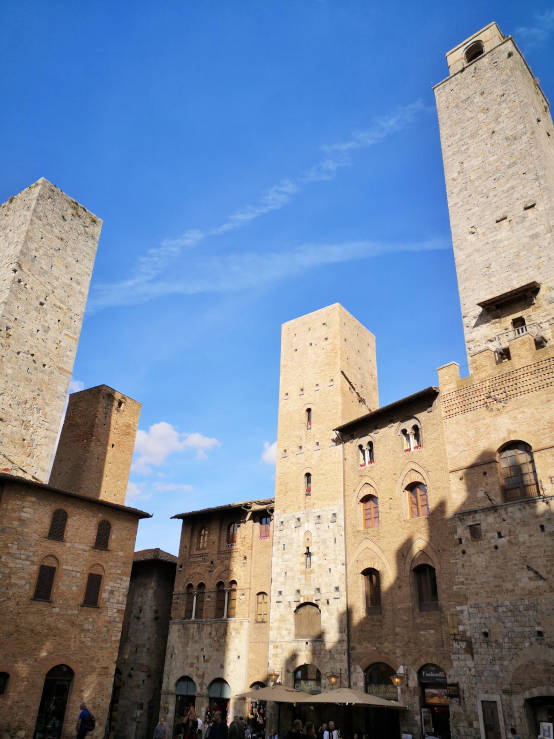
San Gimignano’s medieval towers rise above the historic town | Photo: Travel In Culture
San Gimignano’s prosperity eventually declined. From the mid-14th century, famine and plague caused a sharp demographic and economic downturn, and the town subsequently came under Florentine control. Its role in the region became less significant.
Paradoxically, this decline helped preserve the medieval character that makes the town so distinctive today. San Gimignano did not undergo the extensive later redevelopment that transformed many other Italian towns. Its medieval streets, squares, churches, palaces, and towers remained remarkably intact.
Today, only 14 of the medieval towers survive. Among them are the Torre Grossa, the Chigi Tower, and the Salvucci towers, while traces of others can still be found within the historic centre. Together, they form one of Italy’s most distinctive historic skylines.
The historic centre was inscribed on the UNESCO World Heritage List in 1990, recognising not only its individual monuments but also the exceptional preservation of its medieval urban landscape. The towers are therefore best understood as part of a much larger cultural story: they reveal how pilgrimage, trade, wealth, rivalry, and changing political fortunes shaped San Gimignano over the centuries.
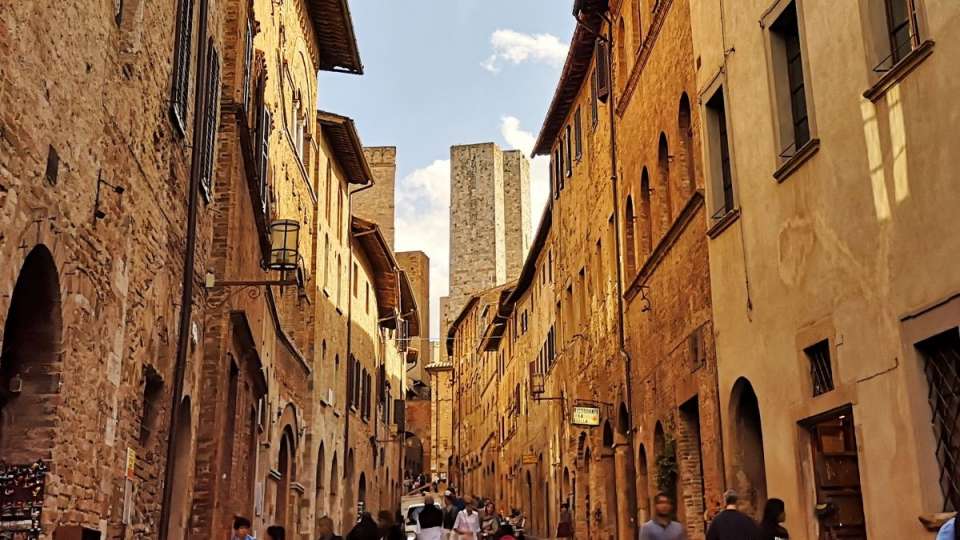
The story becomes even more tangible when exploring the historic centre on foot, where the towers rise above the narrow streets and medieval squares and where many of the town’s most important landmarks are concentrated.
2. San Gimignano’s Top Landmarks and Things to Do
Once you are inside San Gimignano’s walls, the best way to experience the town is on foot. The historic centre is compact, and many of the main sights are clustered around two medieval squares. Rather than rushing between attractions, look at how the towers, churches, palaces, and narrow streets fit together. The pleasure of San Gimignano lies as much in the spaces between the landmarks as in the landmarks themselves.
For the medieval atmosphere → Piazza della Cisterna
For art and frescoes → Cathedral of San Gimignano
For the best panoramic view → Torre Grossa
For the countryside and Vernaccia → Rocca di Montestaffoli
For a quieter experience → Sant’Agostino and the surrounding streets
Walk Through the Medieval Centre
Begin at Piazza della Cisterna, one of San Gimignano’s most atmospheric squares. The triangular piazza takes its name from the travertine well at its centre, built in 1287. Medieval houses, palaces, and towers surround the square, creating an unusually complete impression of the town as it might have appeared centuries ago.

Piazza della Cisterna with Torre Grossa, Torre Chigi and other medieval towers rising above the historic centre | Photo: Travel In Culture
From here, walk towards Piazza del Duomo, the religious and civic heart of San Gimignano. The Cathedral, or Collegiata di Santa Maria Assunta, contains an impressive collection of medieval frescoes, including scenes from the Old and New Testaments. Inside the Chapel of Santa Fina, Renaissance frescoes by Domenico Ghirlandaio add a later layer to the town’s artistic history.
Next door, the Palazzo Comunale houses the Civic Museum and Picture Gallery. The building includes the Sala di Dante, associated with the poet’s visit to San Gimignano in 1299, as well as works of medieval and Renaissance art.
If you have time for only one panoramic climb, make it the Torre Grossa. At about 54 metres, it is the tallest surviving tower in San Gimignano. From the top, the perspective changes completely: the dense medieval town unfolds beneath you, while beyond the rooftops the Val d’Elsa stretches into the Tuscan countryside. The view makes it much easier to understand why San Gimignano’s skyline has survived as such a defining part of the town.

Medieval towers rising above San Gimignano’s historic centre.
Look Beyond the Main Squares
Once you have seen the best-known sights, leave the busiest part of the centre and explore some of the quieter streets. San Gimignano rewards curiosity, with medieval doorways, small courtyards, stone façades, and towers appearing unexpectedly between the main landmarks.
The Church of Sant’Agostino is worth seeking out for its frescoes and quieter atmosphere. Torre e Casa Campatelli offers another perspective on the town, taking you inside a historic tower-house and showing how one of these characteristic buildings was incorporated into the life of a later Tuscan family.
These less prominent places are useful reminders that San Gimignano is not simply a collection of medieval monuments. Its historic character comes from the relationship between private homes, religious buildings, public spaces, and the streets connecting them.
See San Gimignano from Above
For another perspective, walk up to Rocca di Montestaffoli, the remains of the medieval fortress just beyond the Cathedral. From here, the towers appear together against the surrounding hills, making the relationship between the historic centre and the Tuscan landscape particularly clear.
The fortress is also home to the Vernaccia di San Gimignano Wine Experience, making it a natural place to begin discovering the local wine that has been part of the area’s identity for centuries.
And leave a little time simply to wander. One of the most memorable experiences in San Gimignano can be as simple as turning away from the main piazzas and following a narrow street until a tower suddenly appears above the rooftops or the countryside opens up beyond the town walls. In a place so famous for its skyline, some of the best views are the ones you do not set out to find.
If you would like to explore San Gimignano and its surroundings beyond the main sights, these guided experiences offer another way to discover the area.
3. Culture, Food and the Tuscan Landscape
San Gimignano is often remembered for its towers, but the landscape beyond the medieval walls tells another important part of its story. Vineyards, olive groves, saffron fields, and rolling hills surround the town, creating the agricultural setting that has supported local life for centuries. To experience San Gimignano fully, it is worth looking beyond the skyline and discovering some of the flavours and traditions rooted in this countryside.
Vernaccia
San Gimignano’s historic white wine is one of the defining products of the surrounding landscape. Look for opportunities to taste it in local wine bars, restaurants, or at the Rocca di Montestaffoli.
Saffron
Saffron was an important medieval product of the area and remains part of San Gimignano’s culinary heritage. Its history connects the town’s medieval prosperity with the agricultural landscape beyond its walls.
The Tuscan landscape
Vineyards, olive groves, cypress trees, and rolling hills surround the medieval town. This landscape is not merely a backdrop to San Gimignano: it has helped shape the food, wine, economy, and identity of the area.
Vernaccia: The Wine of San Gimignano
Vernaccia di San Gimignano is perhaps the most famous product associated with the town. This crisp white wine has been produced in the surrounding hills for centuries and has a particularly strong connection with San Gimignano’s history. References to Vernaccia appear in medieval sources, and the wine was already well known beyond Tuscany by the late Middle Ages.
The wine also offers an interesting contrast with the image most visitors have of San Gimignano. The towers tell the story of wealthy medieval families and urban competition, while Vernaccia leads you out beyond the walls to the vineyards that helped make the surrounding countryside economically valuable.
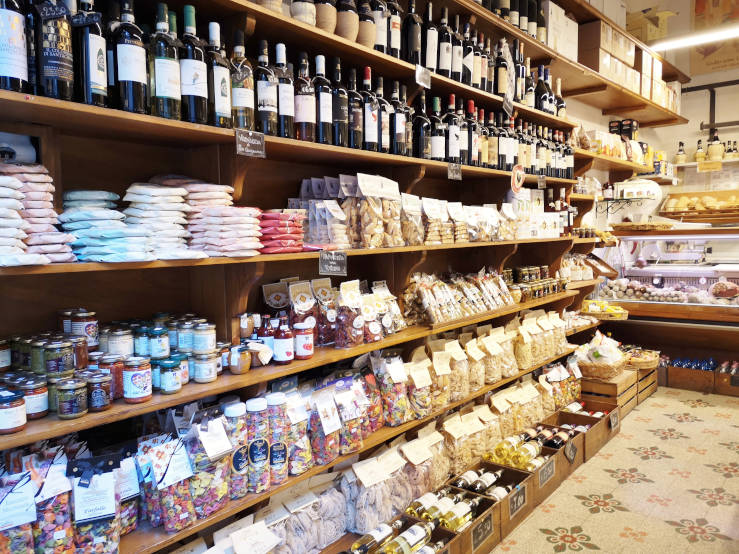
Vernaccia di San Gimignano and other local products in a shop in the historic centre.
One of the best places to explore this connection is the Rocca di Montestaffoli, where the Vernaccia di San Gimignano Wine Experience provides an introduction to the wine and its territory. You can also look for Vernaccia on restaurant wine lists throughout the historic centre and in the surrounding countryside.
If you enjoy wine, consider allowing enough time for a tasting rather than treating Vernaccia as simply another item to sample with lunch. The wine is part of the identity of the landscape, and tasting it in San Gimignano gives you another way of understanding the countryside surrounding the town.
Saffron and the Flavours of the Countryside
Vernaccia is not the only local product with a long history. Saffron was another valuable agricultural product associated with medieval San Gimignano and contributed to the town’s prosperity. The spice was highly prized and could be used in cooking as well as trade, making it an important part of the agricultural economy.
Today, saffron is a much less dominant part of everyday life than it was in the Middle Ages, but it remains part of the area’s culinary heritage. You may encounter it in local dishes, speciality products, or shops selling Tuscan food.
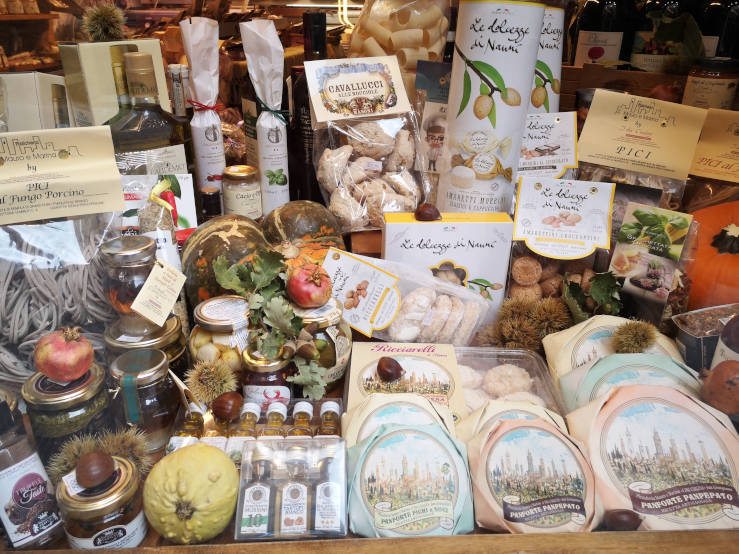
Tuscan delicacies displayed in a shop window in San Gimignano.
Other flavours of the region are more immediately familiar: extra virgin olive oil, Tuscan bread, pecorino cheese, cured meats, seasonal vegetables, and pasta dishes made with local ingredients. Rather than looking for one defining dish, it is often more rewarding to think of San Gimignano’s food culture as an expression of the wider Tuscan countryside.
The Landscape Beyond the Medieval Walls
One of the pleasures of visiting San Gimignano is seeing how quickly the urban landscape gives way to open countryside. Leave the historic centre and the dense arrangement of towers and stone buildings soon becomes a landscape of vineyards, olive groves, cypress-lined roads, and rolling hills.
This is where San Gimignano becomes particularly different from a conventional historic-city destination. The countryside is not simply a scenic backdrop for photographs of the towers. It helps explain why the town developed where it did and why agriculture, trade, and food have remained closely connected to its identity.
If you have more than a few hours in the area, consider taking a short drive or walk through the surrounding countryside. The changing perspectives back towards San Gimignano can be just as rewarding as the views from within the historic centre. From a distance, the towers appear as a compact silhouette rising above the agricultural landscape, bringing the story of the medieval town and its territory together.
A medieval tower of San Gimignano rising above the surrounding Tuscan landscape and olive groves | Photo: Travel In Culture
This is one of the most rewarding ways to experience San Gimignano. Inside the walls, the towers tell the story of medieval wealth and rivalry, while outside them, vineyards, olive groves, and rolling hills reveal the landscape that has sustained the community through the centuries. If you stay into the evening, the contrast becomes even more apparent: as the day visitors leave and the streets grow quieter, San Gimignano gradually feels less like a famous Tuscan attraction and more like a small historic community surrounded by its countryside.
4. Planning Your Trip to San Gimignano
San Gimignano is easy to visit, but the experience can vary considerably depending on how you plan your time. Most visitors come for a few hours as part of a Tuscany day trip, while staying overnight allows you to discover a quieter side of the town after the busiest part of the day.
If San Gimignano is part of a wider Tuscany itinerary, our Tuscany Travel Guide brings together the region’s historic cities, medieval hill towns, countryside, and travel ideas to help you plan the rest of your journey.
How long? A few hours cover the main sights. A full day allows time for museums, food, wine, and slower exploration.
Getting around: The historic centre is compact and best explored on foot.
By car: The historic centre is pedestrianised, so you need to leave your car in one of the designated parking areas outside the walls.
For a quieter experience: Stay overnight or arrive early, when the medieval streets feel considerably more peaceful.
How Much Time Do You Need?
If San Gimignano is part of a wider Tuscany itinerary, allow at least three to four hours to walk through the historic centre, visit the main squares, see the Cathedral, and climb the Torre Grossa. A full day gives you more time to explore the smaller museums and churches, enjoy a leisurely lunch, taste Vernaccia, and walk beyond the busiest streets.
| If you have… | Prioritise… |
|---|---|
| 2–3 hours | Piazza della Cisterna, Piazza del Duomo, the Cathedral, and a walk through the medieval streets |
| 3–4 hours | The main historic centre, Cathedral, Torre Grossa, and Rocca di Montestaffoli |
| One full day | The main sights plus Sant’Agostino, Torre e Casa Campatelli, lunch, and a Vernaccia tasting |
| One night | A slower visit, with the historic centre in the evening and early morning, plus time for food, wine, and the surrounding countryside |
| Two days | San Gimignano at a relaxed pace combined with wine, countryside, and nearby Tuscan destinations |
For the most atmospheric experience, however, consider staying one night. Once the day-trippers have departed, the town takes on a different character. The stone streets become quieter, the towers are beautifully lit towards evening, and there is more time to experience San Gimignano without feeling that you are moving from one attraction to the next.
When Is the Best Time to Visit?
Late spring and early autumn are particularly appealing for combining the historic centre with the surrounding countryside. Summer brings warm, bright days and a lively atmosphere, but it is also the busiest period.
Whatever the season, arriving early in the day or staying into the evening can make a noticeable difference. San Gimignano is at its most rewarding when you have enough time to slow down and experience the town between the main sightseeing hours.
Getting to San Gimignano
San Gimignano is located between Florence and Siena and is most easily reached by car or organised excursion. There is no railway station in the historic town, so travellers arriving by public transport generally need to combine a train with a bus connection.
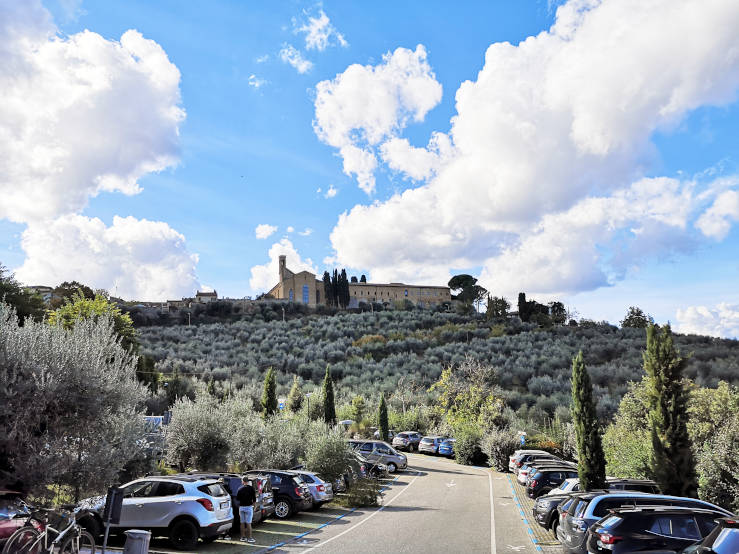
If you are driving, remember that the historic centre is pedestrianised. Parking is available outside the medieval walls, from where you can continue on foot into the centre.
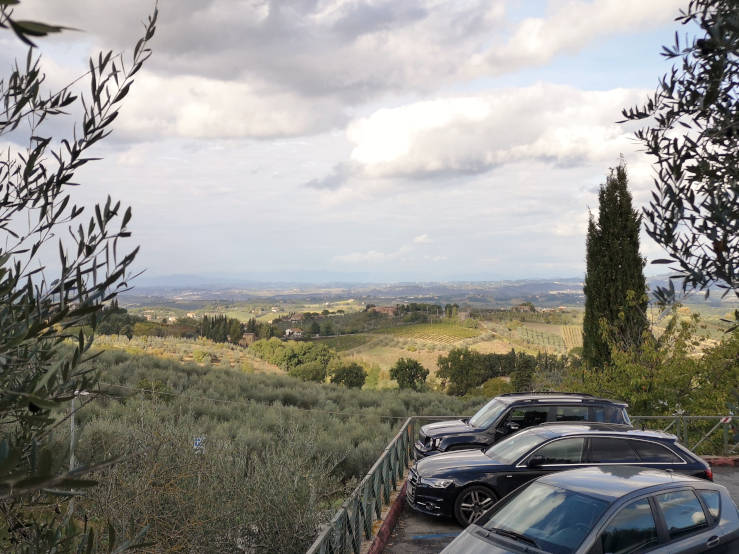
Parking outside San Gimignano, with the Tuscan countryside stretching beyond the medieval hill town.
If you are visiting as part of a wider Tuscany road trip, the surrounding countryside makes the journey itself part of the experience. Allow some flexibility rather than treating San Gimignano as simply a stop between Florence and Siena: the views approaching the town are among the best introductions to its extraordinary setting.
5. San Gimignano Itineraries and Travel Ideas
San Gimignano is compact enough to explore without a complicated itinerary. Here are two ways to plan a visit, depending on how much time you have.
Piazza della Cisterna
→
Piazza del Duomo
→
Cathedral & Palazzo Comunale
→
Torre Grossa
→
Medieval streets
→
Rocca di Montestaffoli
Choose this route if San Gimignano is one stop on a larger Tuscany itinerary. Allow around three to four hours, depending on how long you spend inside the Cathedral, museums, and Torre Grossa.
Morning
Piazza della Cisterna
↓
Piazza del Duomo
↓
Cathedral
↓
Palazzo Comunale & Torre Grossa
Lunch
Tuscan food
+
Vernaccia
Afternoon
Sant’Agostino
↓
Torre e Casa Campatelli
↓
Quieter medieval streets
Late afternoon
Rocca di Montestaffoli
→
Countryside views
→
Vernaccia tasting
Evening
Aperitivo or dinner
→
San Gimignano after the day-trippers have left
If you stay overnight, consider this slower version. The extra hours give you time to experience the town rather than simply see it.
More Travel Ideas
| If you are interested in… | Consider… |
|---|---|
| Medieval history | The towers, Palazzo Comunale, Cathedral, and medieval streets |
| Art and frescoes | The Cathedral, Chapel of Santa Fina, and Sant’Agostino |
| Panoramic views | Torre Grossa and Rocca di Montestaffoli |
| Wine | Vernaccia tasting and the vineyards around San Gimignano |
| Tuscan countryside | A drive or walk through the surrounding landscape |
| A quieter experience | Stay overnight and explore early or in the evening |
| A Tuscany road trip | Combine San Gimignano with Siena, Monteriggioni, or other nearby hill towns |
For a first visit, combine the historic centre with at least one experience beyond the main squares. That small change makes San Gimignano feel less like a collection of famous landmarks and more like a place with its own landscape, food culture, and rhythm.
6. Where to Stay in San Gimignano
Combining San Gimignano with Siena? If you prefer to base yourself in a larger Tuscan city, Siena is a convenient option for exploring both the city and the surrounding countryside. See also our guide to Where to Stay in Tuscany for broader travel planning across the region.
7. San Gimignano Travel FAQs
Is San Gimignano worth visiting?
Yes. San Gimignano is particularly worth visiting for its exceptionally well-preserved medieval centre, distinctive towers, historic churches, and beautiful position above the Val d’Elsa. Its compact size also makes it easy to explore on foot. For a more atmospheric experience, consider staying overnight rather than visiting only as a day trip.
How long do you need in San Gimignano?
Allow at least three to four hours to see the main sights, including Piazza della Cisterna, Piazza del Duomo, the Cathedral, and Torre Grossa. A full day gives you more time for museums, quieter streets, lunch, and a Vernaccia tasting. Staying overnight allows you to experience the town after the main day-tripper crowds have left.
What is San Gimignano famous for?
San Gimignano is famous for its medieval towers, historic centre, and distinctive hilltop skyline. Around 72 tower-houses once stood in the town, built by wealthy families as symbols of their wealth and influence; 14 survive today. The town is also known for its medieval and Renaissance art, Vernaccia di San Gimignano wine, and surrounding Tuscan countryside.
What are the best things to do in San Gimignano?
The highlights include walking through Piazza della Cisterna and Piazza del Duomo, visiting the Cathedral and Palazzo Comunale, climbing Torre Grossa for panoramic views, exploring Sant’Agostino and quieter medieval streets, and visiting Rocca di Montestaffoli. If you have more time, add a Vernaccia tasting or explore the countryside around the town.
Can you visit San Gimignano without a car?
Yes. San Gimignano can be visited without a car, although public transport generally involves combining a train with a bus because the town does not have a railway station. Once you arrive, the historic centre is compact and best explored on foot. An organised excursion from Florence or Siena is another convenient option for travellers without a car.
Where is the best area to stay in San Gimignano?
Staying inside the historic centre is ideal if you want to experience San Gimignano early in the morning and after the main sightseeing hours. It puts the principal squares, churches, restaurants, and medieval streets within easy walking distance. A countryside hotel outside the walls is a better choice if you prefer peace, gardens, and views and are travelling by car.
Continue Exploring Tuscany
San Gimignano is ideally placed for exploring Tuscany’s medieval hill towns, historic cities, and vineyard landscapes. Continue your journey with our guides to Tuscany’s main destinations and travel ideas.
- 🏛️ Florence – Renaissance capital of Tuscany, with world-class art, architecture, museums, and historic streets.
- ⚔️ Siena – Medieval city famous for Piazza del Campo, Gothic architecture, and the historic Palio horse race.
- 🏞️ Lucca – Elegant walled city with Renaissance architecture, historic streets, and tree-lined city walls.
- 🪨 Volterra – Ancient hill town with Etruscan heritage, Roman remains, alabaster workshops, and dramatic views.
- 🍷 Tuscany Travel Guide – Explore Tuscany’s Renaissance cities, medieval towns, vineyards, countryside, and cultural heritage.
- 🚗 5 Top-Tier Day Trips from Florence – Ideas for exploring Tuscany beyond the Renaissance capital.
- 🗺️ Tuscany Itineraries – A practical route for combining historic towns into a Tuscany itinerary.
