


Lucca Travel Guide: Best Things to Do, See, and Experience
By ANL | UPDATED:
This guide covers the best things to do in Lucca, from walking the Renaissance walls and exploring historic churches to discovering hidden streets, local traditions, and the city’s unique cultural heritage. It also includes a practical one-day itinerary and travel tips to help you plan your visit.
All photographs in this article were taken by Travel In Culture.
Best known for: Renaissance city walls, Roman heritage, medieval streets, historic churches, and composer Giacomo Puccini.
Time needed: One full day covers the highlights. Stay overnight to enjoy the city’s relaxed evening atmosphere.
Best for: History, architecture, cycling, photography, Tuscan cuisine, and slow cultural travel.
Best way to explore: On foot and by bicycle. The historic centre is compact and largely flat.
Easy day trip from: Florence (around 1 hour 20 minutes by train) and Pisa (around 30 minutes by train).
Do not miss: Walking or cycling the Renaissance walls, Piazza dell’Anfiteatro, Guinigi Tower, Lucca Cathedral, and San Michele in Foro.
Why Visit Lucca?
- 🧱 Magnificent Renaissance walls — Walk or cycle along one of Europe’s best-preserved fortified city walls.
- 🏛️ Layers of history — Discover Roman remains, medieval towers, Renaissance churches, and elegant piazzas within a remarkably intact historic centre.
- ⛪ Outstanding architecture — Admire landmarks such as Lucca Cathedral, San Michele in Foro, and the tree-topped Guinigi Tower.
- 🎼 The city of Puccini — Explore the birthplace of composer Giacomo Puccini and experience Lucca’s rich musical heritage.
- 🍷 Authentic Tuscan atmosphere — Enjoy excellent food, relaxed cafés, and a slower pace than many of Tuscany’s more famous cities.
Few Italian cities are as rewarding to explore without a fixed itinerary. Much of Lucca’s charm lies in wandering its narrow streets, leafy piazzas, and remarkably preserved walls, where history reveals itself around almost every corner.
🏛️ Selected for Historic Centre Location → Palazzo Dipinto
⭐ Selected for Overall Appeal → Hotel Ilaria
For a broader comparison of Lucca’s areas and hotels, see our dedicated Where to Stay in Lucca guide.
This guide follows our cultural travel method, exploring Lucca through the layers that have shaped its identity: Roman foundations, medieval prosperity, Renaissance architecture, and the everyday life that continues within its historic walls.
Whether you have one day or a weekend, these are the essential things to do in Lucca to experience one of Tuscany’s most rewarding historic cities.
Before exploring Lucca’s main sights, it helps to understand the historical layers that shaped the city you see today.
| Period | Historical Chapter |
|---|---|
| 180 BC Roman origins | Founded as a Roman colony, leaving its mark on Lucca’s street layout and Piazza dell’Anfiteatro. |
| Medieval period 6th–15th centuries | A powerful independent republic, enriched by silk production, trade, and merchant families. |
| Renaissance period 16th–17th centuries | The impressive Renaissance walls were built, creating the unique urban landscape visitors experience today. |
| Napoleonic era 1805–1814 | Lucca was ruled by Elisa Bonaparte, Napoleon’s sister, during a period of major political change. |
| Modern cultural heritage 1858 onwards | Birthplace of composer Giacomo Puccini and a continuing centre of music and culture. |
Best Things to Do in Lucca: Walking Route & One-Day Itinerary
This walking route follows a logical circular route through Lucca’s historic centre, beginning at the cathedral before exploring the city’s churches, medieval streets, towers, and famous Renaissance walls.
Approximate distance: 3 km (excluding optional climbs and the city walls)
Lucca Cathedral (Duomo di San Martino)
↓ 3 min
Piazza Napoleone
↓ 4 min
San Michele in Foro
↓ 2 min
Via Fillungo
↓ 5 min
Guinigi Tower
↓ 4 min
Piazza dell’Anfiteatro
↓ 8 min
Walk Lucca’s Renaissance Walls
Botanical Garden
•
Puccini Museum
Perfect One-Day Lucca Itinerary
- 🌅 09:00 — Begin at Lucca Cathedral before the busiest hours and admire its beautiful Romanesque façade and remarkable interior.
- 🏛️ 10:00 — Walk to San Michele in Foro, one of Tuscany’s finest Romanesque churches, before exploring Piazza Napoleone and the surrounding streets.
- 🚶 11:00 — Stroll along Via Fillungo, Lucca’s historic shopping street, browsing artisan boutiques, cafés, and elegant medieval buildings.
- 🌳 12:00 — Climb Guinigi Tower for panoramic views across Lucca’s rooftops and its famous rooftop oak trees.
- 🍝 13:30 — Enjoy lunch in or around Piazza dell’Anfiteatro, one of Italy’s most distinctive piazzas, built on the site of a Roman amphitheatre.
- 🚲 15:00 — Walk or hire a bicycle to explore Lucca’s magnificent Renaissance walls, offering leafy promenades and views across the city.
- 🍷 17:30 — Finish the day with an aperitivo on a quiet piazza before wandering Lucca’s peaceful streets as the evening light settles over the historic centre.
Lucca is one of Italy’s most walkable historic cities. Unlike many Tuscan destinations, its largely flat streets make it easy to explore at a relaxed pace, while the compact historic centre allows visitors to experience its main landmarks comfortably in a single day.
A Brief History of Lucca
Founded as a Roman settlement, Lucca developed into one of medieval Tuscany’s most prosperous cities. During the Middle Ages, powerful families built towers throughout the city, while Lucca’s merchants became wealthy through trade and silk production. Unlike many Tuscan cities, Lucca maintained its independence as a republic for almost five centuries, preserving a distinctive political and cultural identity through periods of major change. This long continuity helped protect the city’s remarkable medieval streets, churches, towers, and urban layout, which remain preserved within the Renaissance walls today. The city’s Renaissance fortifications, completed in the 17th century, reflect this tradition of independence and remain one of Italy’s finest examples of early modern military architecture.
From Roman origins and medieval towers to Renaissance fortifications, Lucca reveals more than two thousand years of history within its remarkably well-preserved city walls. Every corner offers another layer of the city’s rich architectural and cultural heritage.

Passing through Lucca’s historic gates reveals a city designed for walking, where medieval streets, cafés, and restaurants continue to shape everyday life.
Although Lucca can be visited as a day trip from Florence or Pisa, staying overnight allows you to experience its greatest asset: a peaceful atmosphere after the day visitors have left. Early morning and evening are especially rewarding for walking the walls and wandering the quiet streets of the historic centre.
Walk Lucca’s Renaissance Walls
Lucca’s Renaissance walls are the city’s most distinctive landmark and one of the best-preserved examples of early modern fortifications in Europe. Stretching for around 4.2 kilometres around the historic centre, the walls have been transformed from a defensive structure into one of Italy’s most beautiful urban promenades.
Unlike many European cities, Lucca preserved its fortifications rather than replacing them as the city expanded. Today, visitors can walk, run, or cycle along the tree-lined ramparts while enjoying views across the historic centre, medieval towers, and the surrounding Tuscan countryside.
The complete circuit takes around 45–60 minutes at a relaxed pace, although many visitors choose to spend longer stopping at the viewpoints, shaded avenues, and historic bastions along the route. The broad, flat pathway is ideal for both pedestrians and cyclists, while locals also use the walls daily for walking, exercise, and enjoying the green space surrounding the old town.
From Medieval Defences to Urban Park
Lucca’s defensive history stretches back to Roman times, but the walls visible today mainly date from the 16th and 17th centuries. As military technology evolved, the earlier medieval fortifications were replaced with a much larger Renaissance system of bastions and earthen ramparts designed to protect the independent Republic of Lucca.
The massive brick walls, strengthened by eleven bastions, reflected the wealth and independence of a city that had successfully maintained its autonomy for centuries. However, Lucca’s changing political circumstances meant that the walls were never required to defend the city in a major conflict after their completion.
Instead, these impressive fortifications were preserved and transformed into one of Italy’s most remarkable examples of a historic defence system becoming public space. Today, the ramparts form a green belt around the historic centre, offering some of the best views of Lucca’s medieval towers, church domes, and terracotta rooftops.
Walking the walls is therefore not only a sightseeing activity, but also a way to experience how Lucca’s history continues to shape everyday life.
Walking or Cycling the Walls
The complete circuit around Lucca’s walls is approximately 4.2 kilometres and takes around 45 minutes to walk at a relaxed pace. However, the greatest pleasure comes from slowing down, stopping at the viewpoints, and appreciating how the city unfolds below.
Lucca’s Renaissance walls have been transformed into a peaceful tree-lined promenade, offering one of the city’s most memorable walks with views across the historic centre.
Cycling is one of the most popular ways to experience the walls, with bicycles available for rent throughout the historic centre. The wide promenade makes Lucca especially enjoyable for visitors who prefer an easy-going alternative to the steep streets found in many Tuscan hill towns.
- 🚶 Distance: Approximately 4.2 km around the historic centre.
- ⏰ Time needed: Around 45 minutes walking, longer with stops and photography.
- 🚲 Best experience: Hire a bicycle and complete the circuit at a relaxed pace.
- 📸 Best time: Early morning or late afternoon for softer light and fewer visitors.
Piazza dell’Anfiteatro: Lucca’s Roman Heart
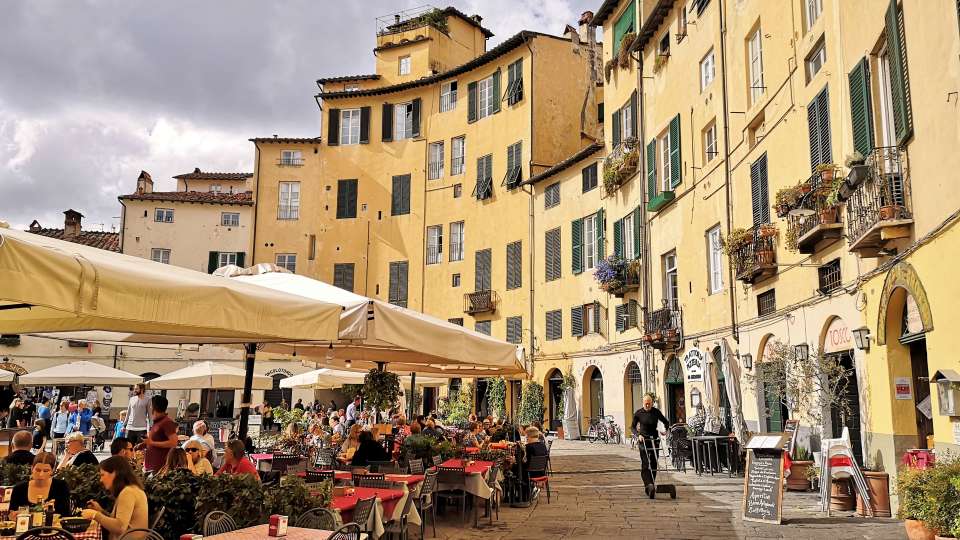
Piazza dell’Anfiteatro follows the shape of the ancient Roman amphitheatre that once stood here, with its curved buildings now creating one of Lucca’s most recognisable public spaces | Photo: Travel In Culture
Piazza dell’Anfiteatro is one of Lucca’s most recognisable landmarks, a distinctive oval-shaped square built on the remains of a Roman amphitheatre dating back to the 2nd century AD. Today, its warm yellow façades, curved buildings, and lively cafés create one of Tuscany’s most atmospheric urban spaces.
Although the Roman arena itself has disappeared, the shape of the original amphitheatre remains remarkably visible. The houses surrounding the square were built directly onto the ancient structure, preserving the outline of the arena and creating the unique elliptical design that visitors see today.
Today Piazza dell’Anfiteatro is one of Lucca’s favourite meeting places, where cafés and restaurants fill the historic square with everyday local life.
From Roman Arena to Medieval Marketplace
During Roman times, the amphitheatre hosted public spectacles and could accommodate several thousand spectators. After the decline of the Roman Empire, the abandoned structure was gradually incorporated into the medieval city, with buildings constructed within and around the former arena.
For centuries, the space served practical purposes, including housing, workshops, and a marketplace. The square was restored and reopened as a public space in the 19th century, when architect Lorenzo Nottolini helped recover its original elliptical form.
A Piazza to Experience Slowly
Today, Piazza dell’Anfiteatro is best appreciated without rushing. Enter through one of its arched entrances, walk around the curved perimeter, and pause at one of the cafés overlooking the square.
Unlike many of Tuscany’s most famous piazzas, which are dominated by a single monumental building, Lucca’s amphitheatre square is an architectural experience in itself. Its charm comes from the way centuries of history are layered together, from Roman foundations to medieval homes and modern daily life.
- 🏛️ The preserved oval shape of the ancient Roman amphitheatre.
- 📸 The best views from the arched entrances leading into the square.
- ☕ A coffee or aperitivo while observing everyday Lucca life.
- 🚶 The surrounding streets connecting the piazza with Via Fillungo and Guinigi Tower.
Lucca Cathedral (Duomo di San Martino)
Lucca Cathedral (Duomo di San Martino) is one of Tuscany’s most important Romanesque churches, combining medieval architecture, Renaissance artworks, and centuries of religious tradition. Located just inside the historic centre near the southern entrance to the city, the cathedral has been the spiritual heart of Lucca for more than a thousand years.
Founded in the 6th century and rebuilt from the 11th century onwards, the cathedral reflects Lucca’s importance as a medieval religious centre and its role along the Via Francigena, the historic pilgrimage route connecting Canterbury with Rome. Its architecture also reveals the influence of the Pisan Romanesque style that spread across western Tuscany during the Middle Ages.

Lucca Cathedral (Duomo di San Martino), viewed across the green lawn in Piazza San Martino.
The Cathedral Exterior
The striped marble façade of Lucca Cathedral is one of the city’s most recognisable architectural features. Built in the Romanesque style, it displays the characteristic columns, arches, and intricate details that define medieval Tuscan architecture.
A particularly fascinating feature of the façade is the variety of column designs. Unlike many medieval churches where columns follow a uniform pattern, the columns of Lucca Cathedral display different shapes and decorative styles, reflecting the craftsmanship and artistic ambition of the builders.
The façade is slightly asymmetrical because the bell tower predates parts of the current building. This unusual arrangement gives the cathedral a distinctive appearance and reflects the many stages of construction and rebuilding that shaped Lucca over the centuries.
- ⛪ Style: Romanesque architecture with Pisan influences.
- 🧱 Exterior: Striped marble façade with uniquely varied column designs.
- 📜 History: Rebuilt from the 11th century onwards and connected to the Via Francigena pilgrimage route.
- ✝️ Treasure: Home to the Volto Santo, Lucca’s most important religious symbol.
Inside the Duomo
The interior contains an impressive collection of artworks spanning several centuries. Among the highlights are works by leading Italian artists, including Jacopo della Quercia’s magnificent marble tomb of Ilaria del Carretto, one of the masterpieces of early Renaissance sculpture.
The cathedral’s wooden ceiling, marble decorations, chapels, and religious artworks reveal Lucca’s wealth during the medieval and Renaissance periods, when the city prospered through trade and banking.
The Volto Santo of Lucca
One of the cathedral’s greatest treasures is the Volto Santo di Lucca (Holy Face of Lucca), a revered wooden crucifix that has been one of the city’s most important religious symbols for centuries. According to tradition, the relic arrived in Lucca during the Middle Ages and helped establish the city as an important pilgrimage destination along the Via Francigena.
For centuries, pilgrims travelled to Lucca to venerate this sacred image, strengthening the city’s role as a religious centre in Tuscany. This connection continues today through the annual Festa della Santa Croce, held each September, when a candlelit procession passes through the historic centre in a tradition that links Lucca’s medieval heritage with modern civic identity.
Visitor Information
Allow around 45 minutes to one hour to appreciate the cathedral and its main highlights. The cathedral museum and nearby bell tower provide additional insight into Lucca’s religious history and artistic heritage.
- ⭐ The Volto Santo, Lucca’s most important religious symbol.
- 🎨 The marble tomb of Ilaria del Carretto by Jacopo della Quercia.
- 🏛️ The Romanesque marble façade and historic bell tower.
- 🚶 The cathedral’s connection to the Via Francigena pilgrimage route.
Guinigi Tower: Lucca’s Medieval Symbol
The Guinigi Tower is one of Lucca’s most recognisable landmarks, famous for the holm oak trees growing on its rooftop garden. Rising above the city’s terracotta rooftops, the tower offers one of the finest views over Lucca’s historic centre and the surrounding Tuscan countryside.
Built in the late 14th century by the powerful Guinigi family, the tower reflects the wealth and ambition of Lucca’s medieval merchant elite. At a time when wealthy families across Tuscany competed to build increasingly impressive towers, the Guinigi Tower became a symbol of civic pride and prosperity. Unlike many surviving medieval towers, the Guinigi Tower was designed less as a defensive structure than as a symbol of wealth, influence, and civic prestige.
A Tower from Lucca’s Golden Age
During the Middle Ages, Lucca was an important centre of international trade, particularly famous for its silk production. Wealthy merchant families built fortified houses and towers throughout the city as both residences and symbols of their influence.
The Guinigi family was among the most powerful of these families. Paolo Guinigi, who ruled Lucca in the early 15th century, transformed the tower into a statement of prestige, adding the rooftop garden that remains its most unusual feature today.
The Rooftop Garden and City Views
The climb to the top of the Guinigi Tower involves 233 steps, but the reward is one of Lucca’s most memorable viewpoints. The rooftop garden, planted with mature holm oak trees, creates a striking contrast between nature and medieval architecture.
From above, visitors can see the compact layout of Lucca’s historic centre, with the cathedral, church towers, Renaissance walls, and surrounding hills forming a remarkable urban panorama. The view also reveals how successfully Lucca has preserved its medieval character.
| 🌳 Rooftop Oak Trees A medieval tower transformed into a living garden | 🏰 Medieval Power Built by the influential Guinigi family in the 14th century | 📸 City Views One of the best perspectives over Lucca’s historic centre |
Lucca’s Medieval Towers
Lucca was once known as a city of towers, with more than 100 medieval towers rising above its streets. These structures demonstrated the wealth and influence of competing families, while also serving practical defensive purposes.
Most of Lucca’s towers disappeared over time as the city changed, but the Guinigi Tower survived and remains a reminder of the city’s powerful merchant past. Together with the nearby Torre delle Ore, it continues to define Lucca’s historic skyline.
- ⏰ Time needed: Allow around 30 to 45 minutes, including the climb and viewpoint.
- 👟 Good to know: The tower is reached by stairs only.
- 📸 Best time: Late afternoon offers beautiful light over Lucca’s rooftops.
- 🌳 Highlight: The rooftop garden with its historic holm oak trees.
Explore Lucca Beyond the Main Sights
Lucca’s greatest pleasure lies not only in its famous landmarks, but also in the atmosphere of its historic centre. Behind the Renaissance walls, the city unfolds through narrow medieval streets, elegant squares, hidden courtyards, and quiet corners where centuries of history remain part of everyday life.
Unlike larger Tuscan cities such as Florence, Lucca invites slow exploration. The compact historic centre is best experienced on foot, allowing time to discover small churches, artisan shops, traditional cafés, and the details that reveal the city’s layered past.
Wander Lucca’s Historic Streets
Via Fillungo is Lucca’s main historic street and has been the commercial heart of the city for centuries. Following the route of the ancient Roman street system, it runs through the centre of Lucca and connects many of the city’s most important landmarks.
Today, the street combines historic architecture with boutiques, cafés, and local shops. Look upwards to admire medieval towers, Renaissance façades, and the details of buildings that reflect Lucca’s long history as a wealthy trading city.
Beyond its famous landmarks, Lucca’s charm lies in its quiet streets, warm-coloured façades, and atmospheric corners where centuries of history remain part of everyday life.
As you wander through Lucca’s historic centre, you will notice medieval towers rising above the rooftops. Between the 12th and 14th centuries, wealthy families built these towers as symbols of influence and status, during a period when Lucca was one of Tuscany’s most prosperous cities. Although fewer towers survive today than in some Tuscan towns, those that remain reveal the city’s medieval character.
Lucca’s Roman Heritage
Although Lucca is often associated with medieval and Renaissance architecture, the city still preserves important traces of its Roman past. The Roman street layout continues to influence the historic centre, while Piazza dell’Anfiteatro and Piazza San Michele both reveal how ancient civic spaces were absorbed into the medieval city.
Discover San Michele in Foro
The Church of San Michele in Foro stands at the centre of Piazza San Michele, one of Lucca’s most beautiful squares, built on the site of the ancient Roman forum. Its name reflects this location, as the church was constructed directly on the former heart of Roman civic life. During the Middle Ages, the square continued to serve as an important gathering place and market area, remaining one of Lucca’s main centres of public activity.
Its richly decorated Romanesque façade is one of the city’s most impressive architectural sights.
The upper façade of San Michele in Foro showcases the extraordinary decorative detail of Lucca’s Romanesque architecture, with multiple levels of columns, arches, and geometric patterns creating one of the city’s most distinctive church façades | Photo: Travel In Culture
The church reflects Lucca’s medieval prosperity, with rows of columns, sculptures, and decorative details created during a period when the city competed with other Tuscan centres in artistic achievement. A particularly striking feature is the variety of column designs across the upper façade, where different shapes, patterns, and decorative styles create an intricate architectural display that rewards close inspection.
The open space around the church also makes Piazza San Michele a wonderful place to pause and observe daily life in Lucca.
Follow Puccini’s Lucca
Lucca is also the birthplace of Giacomo Puccini, one of Italy’s most celebrated composers. His connection with the city remains visible throughout the historic centre, where visitors can explore places linked to his life and musical legacy.
The Puccini Museum, located in the house where the composer was born, provides insight into his childhood, career, and lasting influence on opera. For music lovers, attending a performance or simply walking through the city that shaped his early years adds another dimension to a visit.
Find Hidden Piazzas and Quiet Corners
Some of Lucca’s most rewarding moments come away from the main attractions. Wander through side streets near the cathedral, discover small squares surrounded by medieval buildings, and explore quieter neighbourhoods where local life continues at a relaxed pace.
The absence of heavy traffic inside the historic centre makes Lucca particularly enjoyable for slow travel. Even during busy periods, a few minutes of walking away from the main streets often reveals a more peaceful side of the city.
| Experience | Best For | What You Experience |
|---|---|---|
| Morning in Lucca | Photography and quiet exploration | Empty streets, soft light on historic façades, and peaceful visits to the main landmarks. |
| Afternoon in Lucca | Culture and sightseeing | Museums, churches, shopping streets, and leisurely walks through the historic centre. |
| Evening in Lucca | Atmosphere and local life | Aperitivo, illuminated streets, restaurants, and the relaxed rhythm of a Tuscan evening. |
Looking for more things to do in and around Lucca? Browse popular activities below.
Planning Your Visit to Lucca
Best time: April to June and September to October offer pleasant temperatures, fewer crowds, and ideal conditions for walking the city walls.
Time required: One full day is enough to experience Lucca’s main sights. Staying overnight allows you to enjoy the city after day visitors leave and explore at a slower pace.
Getting around: Lucca’s historic centre is compact, flat, and best explored on foot. Cycling the Renaissance walls is one of the city’s most memorable experiences.
Good to know: Comfortable shoes are recommended, as many streets have uneven stone paving and the best experiences often come from walking without a fixed route.
Official tourism: Lucca official tourism information
- 🎟️ Tickets — Lucca’s main attractions, including Guinigi Tower and museums, require separate admission. Consider which sights are most important before purchasing tickets.
- 🚲 Cycling the walls — Renting a bicycle is one of the best ways to experience Lucca and allows you to complete the Renaissance walls at a relaxed pace.
- 🚗 Driving — The historic centre is a restricted traffic zone (ZTL). If arriving by car, use one of the car parks outside the walls.
- 👟 Walking — Lucca is one of Tuscany’s easiest cities to explore on foot, but comfortable footwear is still recommended for the historic streets.
- 📅 Events — The Lucca Comics & Games festival attracts large crowds every autumn, so accommodation should be booked well in advance during this period.
Lucca’s massive Renaissance walls contain several historic gateways that connect the modern city with the pedestrian-friendly old town.
Why Stay Overnight in Lucca?
Many visitors explore Lucca as a day trip from Florence, Pisa, or other Tuscan destinations. However, staying overnight reveals a quieter and more authentic side of the city.
Once the day visitors leave, Lucca’s medieval streets become peaceful, restaurants fill with local residents, and the illuminated walls create a completely different atmosphere from the busy daytime city.
- 🌅 Peaceful evenings — Walk the city walls and historic streets after the daytime crowds have disappeared.
- 🍝 Tuscan dining — Enjoy local restaurants and traditional dishes without rushing back to another destination.
- 📸 Better photography — Early morning and evening provide the best light for Lucca’s architecture.
- 🚲 A slower pace — Experience the city walls, piazzas, and neighbourhoods without trying to fit everything into a few hours.
- 🗺️ Explore further — Lucca makes an excellent base for destinations in northern Tuscany such as Pisa, the Garfagnana mountains, and Tuscan villas.
If your itinerary allows, spending at least one night in Lucca is highly recommended. For guidance on hotels and areas to stay, see our dedicated Where to Stay in Lucca guide. See also our guide to Where to Stay in Tuscany for a broader view of the region.
Where to Stay in Lucca
For a detailed comparison of Lucca’s neighbourhoods and hotels, see our dedicated Where to Stay in Lucca guide.
Frequently Asked Questions About Lucca
Is Lucca worth visiting?
Yes. Lucca is one of Tuscany’s most rewarding historic cities, combining remarkably well-preserved Renaissance walls, medieval streets, elegant piazzas, Roman heritage, and beautiful churches within a compact and walkable historic centre. It offers a more relaxed atmosphere than Florence while still providing outstanding architecture, history, and authentic Tuscan experiences.
How much time do you need in Lucca?
One full day is enough to experience Lucca’s main highlights, including the Renaissance walls, Piazza dell’Anfiteatro, Lucca Cathedral, San Michele in Foro, and Guinigi Tower. Staying overnight allows you to enjoy the city’s quieter evening atmosphere, explore at a slower pace, and experience Lucca after many day visitors have left.
Why is Lucca famous?
Lucca is famous for its exceptionally preserved Renaissance city walls, which completely surround the historic centre and have been transformed into a tree-lined walking and cycling promenade. The city is also known for its Roman amphitheatre square, medieval towers, Romanesque churches, silk-trading heritage, and as the birthplace of composer Giacomo Puccini.
What is Lucca best known for?
Lucca is best known for its Renaissance walls, which remain among the finest examples of early modern fortifications in Europe. Other highlights include Piazza dell’Anfiteatro, Guinigi Tower with its rooftop oak trees, Lucca Cathedral, San Michele in Foro, and the city’s beautifully preserved medieval street layout.
Can you walk on Lucca’s city walls?
Yes. Lucca’s Renaissance walls are fully accessible to pedestrians and cyclists. The complete circuit is approximately 4.2 kilometres long and offers one of the city’s most enjoyable walks, with views over historic rooftops, church towers, gardens, and the surrounding Tuscan countryside.
Is Lucca a good day trip from Florence?
Yes. Lucca is one of the best day trips from Florence thanks to its direct train connections, compact historic centre, and easy walking route between the main sights. However, staying overnight is highly recommended if you want to experience the city’s peaceful evenings and slower rhythm.
When is the best time to visit Lucca?
Spring (April to June) and autumn (September to October) are generally the best times to visit Lucca, with pleasant temperatures and fewer crowds. Summer offers long days and a lively atmosphere, while winter provides a quieter experience for exploring the historic streets and churches.
Continue Exploring Tuscany
Lucca is an excellent base for exploring northern Tuscany, with Renaissance cities, historic hill towns, and scenic landscapes all within easy reach.
- 🏛️ Florence – Renaissance capital of Tuscany with world-class art, architecture, and museums.
- ⚔️ Siena – Medieval city famous for Piazza del Campo, Gothic architecture, and the historic Palio horse race.
- 🌿 Montecatini Terme – Elegant spa town with historic thermal baths and extraordinary hilltop views.
- 🏰 San Gimignano – UNESCO-listed hill town famous for its medieval towers and skyline.
- 🪨 Volterra – Ancient Etruscan town with Roman ruins, alabaster workshops, and dramatic hilltop views.
